
Once the Coues buck stepped into clear view, I quickly assessed the shot. He was broadside to very slightly quartering-to and well within my effective range. I drew without hesitation, eased the sight pin low on his vitals, and subconsciously triggered the shot by tightening my back muscles. The bow recoiled with a dull thud and the arrow flashed ahead, striking the buck perfectly. He raced up and over the hill, but I knew he wouldn’t go far. After waiting the recommended 30 minutes, I followed a profuse blood trail that led straight to the downed buck. He was sprawled out in a large opening less than 40 yards away. It was an ultra-quick, clean kill.
Immediately, I felt a great deal of gratitude for taking this incredible animal — and for the lethal precision imparted by my bow setup. But, perhaps more than anything, I knew the ultra-sharp broadhead at the tip of the arrow is what really did the killing, and I came away pleased with the overall result.
You can argue with other bowhunters till you’re blue in the face about what’s the best broadhead, but at the end of the day, it’s your confidence that matters most. Let it guide you into the most lethal model for your particular bow setup and bowhunting pursuit.
In this article, I’ll outline the pros and cons of different types of broadheads and the importance of accuracy, penetration, strength and blood loss and tissue damage. In the end, this should help guide you to the most effective broadhead that gives you the greatest amount of confidence in the widest range of shooting scenarios.

Fixed-Blade Heads
The main attraction to using a fixed head is what you see is what you’ll get — there’s nothing mysterious about impact and how blades will slice. The broadhead will arrive on target the same way it leaves the bow, so cutting action is simple and effective.
Penetration is usually improved as well, due to a fixed-blade head’s more compact size and less abrupt blade angle compared to a larger-cutting mechanical. This generally makes this style of head ideal for archers pursuing large game such as elk or moose, or for those using reduced energy setups (i.e., bows with short draw lengths and/or reduced draw weights). Deep penetration is important for achieving an entrance and exit hole for profuse tissue damage and blood loss.
The challenge in using some fixed-blade heads, of course, is shooting precision. If arrow speed is too fast, say beyond 280 fps, shooting consistency can get iffy, depending on how well the bow is tuned, the type of fletching used, shaft weight or quality, the arrow’s FOC, or how well the archer shoots (i.e., poor form leads to inconsistent shooting). Without consistency, a bowhunter will lose confidence in placing the arrow right into the animal’s kill zone. This is the chief concern when using fixed-heads with today’s fast, high-performing compounds.
However, fixed-blade heads with smaller cutting diameters and compact configurations boast superior aerodynamics. Such heads will often solve the accuracy problem, but at the sacrifice of shorter blades and a narrower cutting swath — a compromise many bowhunters are happy to take in lieu of simplicity and deep-penetrating performance. Top-notch heads that fall into this category are the Slick Trick Standard, Tooth of the Arrow 4-Blade 1-Inch, NAP Nitron or Deep Cuts Series, and Wasp Bullet, to name a few.

Mechanical Heads
The two big pluses to using a mechanical head are shot-to-shot consistency and a deadlier wound channel. The best mechanical heads use blade mechanisms that tuck in tight to the ferrule to reduce or eliminate blade-surface area. This keeps the projectile aerodynamic and nearly field-point accurate, despite less-than-perfect arrow tuning and/or shooting form. For this reason, mechanicals are quite popular, with more and more designs hitting the market each year.
Most of today’s mechanical heads come with super-large cutting swaths (i.e., 2-inches wide or larger), which increases blood loss, tissue damage, and aids in fast recovery, especially when an animal is shot “far back” in the paunch region.
These are all desirable traits but only if the broadhead works as designed. Unfortunately, not all mechanical broadheads are grounded in solid engineering principles. Some heads have blade systems that fail to open reliably or require a great deal of force to deploy on impact. Others come with flimsy or low-quality blades that tend to bend, twist or shatter on impact. Others use blade mechanisms that severely chop at flesh, rather than slice smoothly — impeding penetration and overall killing performance. Once a bowhunter experiences failure or poor performance from a mechanical head, they will rarely give one another chance — going the fixed-blade route for good.
This is unfortunate as there are several trustworthy mechanicals on the market. The key is selecting a model that best matches your bow’s energy output. For example, if you shoot less than say 55-60 pounds and use a fairly light arrow (under 350-400 grains), you should probably choose a mechanical with a low-resistance blade-deployment system and one with a smaller cutting diameter — generally 1.75 inches or less — to ensure deep penetration. Good examples are the Rage Black Series Trypan or Hypodermic +P, G5 Deadmeat, and SEVR 1.5, to name a few.
Hybrid Styles
Some bowhunters like the idea of combining the best of both worlds — a broadhead that boasts both fixed blades and expanding (mechanical) blades. These “hybrid” heads are gaining in popularity due to their great arrow flight and failsafe cutting action. Most hybrid heads come with a cut-to-the tip design, too, which enhances penetration to offset some of the potential energy loss caused by the super-large, expanding blades. The SEVR Hybrid, Slick Trick Assailant, Grim Reaper Hybrid, Muzzy Trocar HB, Bloodsport Gravedigger, and Swhacker Hybrid, are some popular models to consider.

Weighing the Pros and Cons
Here are four aspects I consider critical when sizing up broadheads: accuracy, penetration, strength, and sharpness, which determines tissue damage. They are all equally important to me, and I don’t like compromising on any of them!
Accuracy and Forgiveness: Every bowhunter wants a broadhead that flies like a field point, but there are very few that can actually do this, despite extreme tuning and precise arrow setup. The reason why is because all broadheads have at least some exposed blade surface area that differs from a smooth, streamlined field tip. Even so, both fixed and mechanical heads shoot extremely well when matched with the correct arrow spine, fletching, and arrow speed.
I was reminded of this just a couple days ago while practice shooting. In preparation for a wintertime Arizona deer hunt, I shot two Easton A/C arrows tipped with G5 Striker fixed-blade broadheads into a block target from 60 yards away. When I went to pull the arrows, I was amazed — both were stuck together! With a well-tuned setup, even fixed heads can shoot with amazing precision.
Even so, mechanical heads, with their aerodynamic shape and “tucked in” blades are typically more accurate and forgiving than fixed models. How much more forgiving and accurate is debatable. After all, my double-stacked fixed-blade group proves that for sure.
To improve accuracy with all broadhead types, you must dial in your bow for ultra-clean arrow flight. I prefer to paper-tune my setups. It’s also important to evaluate arrow speed and match it to an appropriate broadhead. With a well-tuned bow and arrow speed under say 275 fps, you can shoot a wider variety of fixed-heads with outstanding accuracy.
For example, I use a light to moderate compound setup — 27.5-inch draw length, 60-pound pull weight, and a 400-grain arrow. With this speed, and when using either Bohning Blazer or AAE Hybrid 26 vanes, I can achieve great precision with different types of fixed-blade models. Bowhunters with ultra-fast setups, or with less-than-perfect arrow tuning, may be limited to using a super-compact fixed head, or mechanical, to achieve a similar level of consistency. Try different heads and evaluate your overall shooting performance.
For my style of bowhunting, particularly deer hunting out West, I demand all-around shooting precision. For this reason, I will reduce fixed-blade size and/or use a high-quality mechanical broadhead until my long-range groups are inside a deer’s vital zone region — not on one shooting day, but over the course of several weeks. I shoot every one of my broadhead-tipped hunting arrows from 50 or 60 yards to ensure it groups consistently well, then I number it “#1.” If not, the arrow won’t go hunting with me. After test shooting, I either install new broadhead blades or touch up edges using a high-quality sharpener.
You will have to find your own accuracy sweet spot based on your preferred bowhunting pursuits. Maybe 6-inch-size broadhead groups at 40 yards are suitable for you. Whatever it is, my advice is to wring as much accuracy as possible from your setup to promote consistency. Do not settle for second-rate performance due to poor broadhead selection.
Penetration: Arrow energy plays a significant role in how well a broadhead penetrates, but so does the broadhead’s overall structure. For example, the tip of the broadhead, the ferrule’s shape, blade length and angle, cutting width, and number of cutting blades, all impact a broadhead’s penetrating ability. Generally speaking, broadheads with fewer cutting blades and smaller cutting diameters penetrate deeper.
In bowhunting, the goal is simple: drive the broadhead through both lungs and acquire an entrance and exit hole for maximum blood loss, rapid death, and easy tracking and recovery. To ensure this happens, you want deep penetration, and it’s always best to consider worst-case shooting scenarios when considering a particular broadhead design and arrow energy.
A great example is a deer positioned slightly quartering-away that suddenly changes to a severe quartering-away angle because it took one step in the wrong direction just as you were releasing the arrow. It can happen, and in my mind, your broadhead-arrow combination should be up to the task.
Years ago, I conducted an experiment by using a sheet of particle board covered with thick cloth to replicate hair and animal hide. I shot a number of different broadheads at the board from 20 yards away, and the results were astounding. Two broadheads glanced completely off the board, whereas most others skidded several inches before penetrating. And those heads with slender, ultra-sharp cutting noses effectively penetrated without skidding. My conclusion is that broadhead size and shape do matter, so don’t take it lightly.

Bottomline: If you use a low-energy setup, go with a somewhat slender, easy-cutting fixed-blade head or mechanical to optimize penetration. If your setup produces above-average energy, say 65 ft./lbs. of kinetic energy or more, then by all means consider a wider-cutting head that causes more tissue damage.
For my particular hunting setup, which produces 55 to 58 ft./lbs. of kinetic energy, I tend to favor fixed-blade heads with moderate cutting diameters. I also prefer broadheads with more gradual blade angles — nothing too abrupt. When using a mechanical, I usually go with a front-opening expanding-blade mechanism and a 1.5-inch cutting swath to alleviate penetration concerns.
Strength: A good broadhead is durable and strong, so it can continue to do its job despite impact with thick hide and heavy bone. Once a broadhead blade or body becomes compromised — by breaking or bending way out of shape — it becomes worthless, losing its cutting ability.
For this reason, strength is important. But how strong does a broadhead actually have to be? This, of course, is highly subjective and not as simple as choosing one material over another. For example, I’ve seen all-steel broadheads fracture and come apart when impacting heavy bone, while some aluminum body heads maintained their shape under similar shooting conditions, so go figure.
By and large, however, all-steel broadheads are stronger than aluminum. But I still consider a high-quality aluminum alloy strong enough for nearly all bowhunting applications. The key is selecting a well-made head from a reputable manufacturer. For example, Muzzy, NAP, Wasp, Shwacker, and others are well known for ultra-strong aluminum broadhead designs.
Sharpness and Tissue Damage: Without a lethal, razor-like edge, a broadhead’s blades could “glide over” arteries and blood vessels, causing little tissue damage and blood loss. A dull edge also prohibits penetration by chopping rather than slicing easily through hide, fat and tissue.
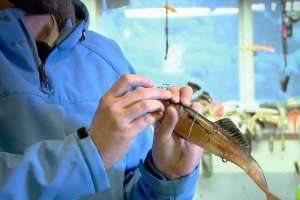
“Sharpness is what makes a broadhead lethal,” said my good friend Ron Way, a retired aerospace engineer and broadhead designer. “Sharp cuts cause a continuous-bleeding cycle in flesh, leading to massive hemorrhaging and easy tracking. This is why I work diligently to sharpen or resharpen every blade on every broadhead.”
Broadhead cutting width and blade length are two other important aspects. A large cutting swath produces more of a gaping hole to allow blood to flow out for easy tracking and recovery. The length of the cutting blades could also impact tissue damage and blood loss. For example, imagine a short edge vs. a long edge moving through flesh. If the entire edge is sharp, then there may be little difference in the amount of tissue being cut, as long as the depth is the same. But if the edge is somewhat dull on the blades, then the longer edge will have more time to slice and do damage, potentially clipping more blood vessels.
This is one reason why I’m cautious about shooting broadheads with ultra-short blades and smaller cutting diameters — both can potentially cause less tissue damage. For this reason, I favor fixed-blade heads with slightly larger cutting diameters and medium-sized blades. With a mechanical head, cutting diameter is usually not a problem — a definite plus.
“In my opinion, the advantages of shooting a mechanical outweigh the disadvantages,” said Way. “The primary advantages are accuracy and, if there’s a poor hit, the recovery rate will be much higher due to a larger entrance hole and possibly an exit hole as well.
“I’ve traveled to Africa three times now to hunt various types of game. On all three trips, I used a Rage on every animal except my Cape buffalo, where I used a heavy arrow and Cutthroat broadhead. My standard setup is a 70-pound bow, 29-inch draw length, and about a 475-grain arrow. The guides and professional hunters told me they are big fans of Rage broadheads, since they cause tremendous bleeding for faster kills and easy trailing. This says a lot to me, since African animals are among the toughest out there.”
For low-energy setups, Way recommends mechanicals with a cut-on-contact tip and a smaller cutting swath, such as Rage models with +P blades.
Final Thoughts
Don’t risk ruining your hunt by pursuing game with the wrong broadhead. Select a model that is accurate, sharp, and durable — whether this be fixed or mechanical. But, most importantly, choose a model that gives you the greatest amount of confidence in all ethical bowhunting situations.

Sidebar: What’s Sharp Enough?
To kill game effectively, broadhead blades must be sharp, but what’s sharp enough? I like to take a piece of leather and rub it against the blade. The blade should cut the leather instantly. If not, it’s probably not sharp enough, and it could spell problems in the bowhunting woods.
My good friend Ron Way, a retired aerospace engineer and broadhead designer, insists on using ultra-sharp broadhead blades. To achieve this, he goes over every blade using a two-step process.
“I like to remove every blade, then go over them with ceramic sticks and a leather strop that’s covered in a polishing compound,” said Way. “What a difference it makes, which is a real confidence booster for me.”
Like Way, I prefer to touch up broadhead blades using a DMT diamond broadhead sharpener, or by using various medium- and fine-grit stones, depending on the broadhead I’m using. This helps keep broadhead blades wicked sharp and ready for hunting.
Sidebar: Shooting In the Wind
There’s no question, a mechanical broadhead — with its low-profile shape and reduced blade surface area — will outshoot a fixed head when the wind is up and howling. However, how much more forgiving and accurate depends on many factors, such as wind speed, overall shape of the mechanical head, your arrow’s FOC, and shooting distance. So this is not always a black-and-white comparison.
Another thing to consider is arrow position once the broadhead strikes. In a firm crosswind, the arrow will tend to fishtail or “wag” as it flies downrange. This could mean a slightly angled impact. For this reason, a deep-driving broadhead, regardless of style, is still super important. So be sure to choose an effective broadhead design that can overcome this type of shooting challenge.