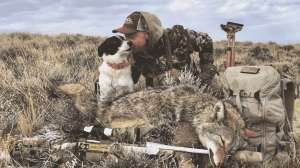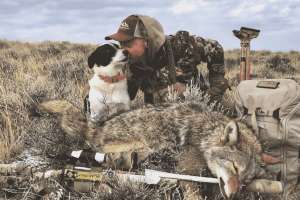

It wasn’t brutally cold, but the wind throttled up after dawn. The rabbit squeal was lost quickly to its hum over Hell’s Canyon. An hour and three moves later, the sun was still a chalk smudge in a low dark ceiling. I tucked call and binocular in my jacket, grabbed the Model 70 and rose. Had I sat another minute or so, the coyote would have come over the ridge into my lap. We now stared stupidly at each other, 100 yards apart.
I sank slowly to a sit, out of sight. Unsure, the coyote eventually peeked. My .243 bullet killed it.
In this post-industrial age, many decades after hoof-powered agriculture, many of us make part or all of our living seated. Sitting, we accomplish useful tasks that require little physical effort. Kneeling or standing, we work harder to keep our balance and soon tire. Afield, sitting pulls our silhouettes out of the sky and hides them from game. We relax, binoculars steady to pick detail from thick places or resolve it at distance. We breathe easily and deliver our best performances with predator calls. Sitting, we can hold a rifle almost as still as from prone or across sandbags on a bench.
I’ve shot a few animals offhand; but it’s hardly my choice when there’s time to drop into a lower position without spooking the game. Standing, you’ve just two points of contact with Mother Earth, and your center of gravity is far above it. Unless you brace against a tree or on long shooting sticks, there’s no front-end support to steady the rifle. A strap or sling around your arm can deaden some of the bounce; but as your left elbow is hanging in space, any pressure on that arm moves it.
Prone, you can support your left elbow on the ground; sitting or kneeling, you get help from that knee. A sling in these positions is a huge assist, transferring some of the muzzle mass to the big muscles of your left shoulder and adding tension that takes jitters from your sight picture.
Prone, you’re steadiest. Your center of gravity is almost kissing the earth. And nearly every part of your body contacts it. Given a sling or bipod, you need not work to keep anything aloft; the rifle is ably supported with your muscles relaxed. For these reasons, finding a place to lie down to shoot gets a lot of my attention on a hunt. I’d rather fire prone from 225 yards than offhand from 75.
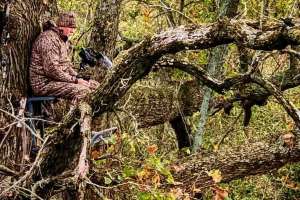
But sitting is much more versatile than prone and can keep your shots almost as near the middle. From a sit your rifle and sight-line clear grass and brush that hide an animal or might deflect bullets fired from prone. Sitting adapts readily to uneven ground and requires a smaller patch of earth than does prone. And a sit is easy to assume — if indeed you must move at all! If you hunt from an elevated stand, you may have only to lift your rifle onto a tree limb or a window sill on the box. If, like me, you’d rather still-hunt, you’ll spot some animals when you pause, others as you ease through cover or along its edge. Dropping to a sitting position takes but a second.

Basic Sitting Positions
Three basic sitting positions are open, crossed-ankle and crossed-leg. With the open option, your knees are up in front of you, heels spread comfortably and pressed firmly into the earth. It’s the obvious choice when you’re shooting from a slope across a draw. You can easily move your feet to broaden your base for more stability, or spin on your fanny to shift your point of aim. Because finding the rifle’s natural point of aim matters, an open sit can be more effective than a lower, steadier sitting position. When time is short you can pivot fast while resisting the urge to force the rifle on target with your arms. So you’ll get a poke at a coyote that just figured out you weren’t a rabbit. Prone and in a cross-legged sit, you’ll quickly “run out of swing.” But with an open sitting position, you can follow the coyote across the flat. Pull your knees in a tad to add elevation for game climbing away.
You’re smart to aim your body before you drop to the ground, so the rifle naturally points where you want the bullet to go. After all, you can pivot most easily standing. When my fanny hits the ground in an open sit, the rifle points naturally across my left little toe. I lean well forward to place my elbows in front of my knees. Lumbar muscles tugging the backs of my elbows against the faces of my knees “lock in” the position. Failing to hook elbows over knees, you must tense your abs to keep from falling backward and use your arms to steady elbows on knee-caps — a wobbly stack indeed!
On level ground a crossed-ankle sit is as fast as an open sitting position. It’s the standard start to the 200-yard rapid-fire stage of the National Match course, where riflemen must shoot sitting from a standing start. The clock starts when targets appear. Crossing ankles while waiting upright for those targets is a time-saver. So is a forward lean. When behinds hit the mat, savvy shooters are already bent forward to lock elbows over knees.
On sloped or broken ground, the crossed-ankle sit isn’t as useful as the open position, because your feet are close together out front, not spread. Your base is more linear than broad and triangular. Still, shooters young and slim enough to jack-knife into a crossed-ankle sit can shoot tight groups with it, as it’s lower than an open sit. The pronounced forward lean also absorbs recoil well, speeding follow-up shots.
When I fired four-position matches in high school and college, just about every competitor used a crossed-leg, or “Indian” sit, legs folded underneath, calves resting on opposite insteps. In this position, the backs of your elbows again press the faces of knees, though here the knees are almost horizontal. Skinny girls fell easily into sitting; not so beefy guys. At university, disciplined shooters kept their thighs limber by studying and watching television from a crossed-leg sit, 11-pound match rifles in firing position, slings taut. In heavy hunting clothes, your legs cold from waiting on stand or tired from a steady plod, making like a pretzel is a slow, unpleasant process.

Practice Makes Sense
Whatever sitting position you plan to use afield, practice makes sense. Before each shot, live-fire or with the rifle empty, check where it wants to point. Finger off the trigger, shut your eyes and relax into it for three deep breaths. Open your eyes. Is the sight still on target? If not, change your position. Don’t force the rifle; it will move off-target when the trigger breaks, nudging the bullet toward its natural point of aim. Also, call your shots. If a bullet doesn’t strike where you remember the sight, you’ve done something wrong. A bullet that strays where you expected it to is still a bad shot — but correctible. If you miss the call, you don’t know why the bullet wandered or how to land the next one in the middle.
Practicing your sit can be as easy as dry-firing in your living room at a thumbtack on the wall. Dry-firing won’t hurt most centerfire repeaters. A .22 rimfire rifle similar in weight and feel to the rifle you carry for coyotes or big game is a low-cost live-fire option.
Time Honored Technique
Historically, shooting from the sitting position has claimed some impressive predators. Corbett’s 1938 hunt for the Thak maneater was one of the most difficult of his many tiger hunts. After a month of tiring days tracking and cold nights over baits, he hiked 20 miles home to rest. As if on signal, the beast struck again. Corbett returned. One evening weeks later she gave voice — a mating call. Corbett hurried toward it. Behind a rise in the jungle, he placed his .450/400 on a rock and mouthed a reply. The tigress came on immediately and fast, “... working herself up into a perfect fury.”
Suddenly she was so near he heard her breathe. He paused; then “... as she again filled her lungs, I did the same with mine, and we called simultaneously. The next moment the blast of her deep-throated call struck me in the face.” As her enormous head loomed at mere feet, Corbett’s first softnose struck under her right eye. Knocked from his perch by the recoil, he fired the second barrel into her throat as he landed in a heap. The tigress was dead.
In 1898, new rails were snaking their way west through Africa’s bush from Kenya’s coast toward Uganda. Work stopped late that year at the Tsavo River, as two man-eating lions prowled camps at night, brazenly taking coolies from their fires and tents. Engineer J.H. Patterson, in charge of building the Tsavo bridge, lay in wait for the cats. They proved devilishly clever. On December 9, a breathless lad reported a fresh kill; but at Patterson’s approach a snapped twig sent the lions off. A subsequent beat pushed a huge maneless brute into his sights at 15 yards. But when he pulled the trigger, he heard only “the dull snap of a misfire.” Unnerved, he forgot his second barrel. The cat looked him over briefly, then bounded away.
In a fresh machan nearby, Patterson sat into the night. He awoke to rustlings below. A lion crept around the flimsy 12-foot structure, “gradually edging … nearer and nearer.” Pulse racing, he held fast for two hours. Then a feline form ghosted from the night almost at his feet. He fired, sending more shots into the thrashing beast as fast as he could run the bolt. A burden for eight men, the cat taped nearly 10 feet.
On the 27th, the second lion visited a camp, circling a tree festooned with terrified coolies. From a machan in that tree the next night, Patterson fired four shots from 20 steps. The next morning a low growl alerted trackers. A bullet brought the animal on. When two more took no effect, Patterson dashed to join his gun-bearer in the nearest tree. Perched on a limb, he finished the cat, almost identical to the first. The lions had killed and eaten at least 28 Indian coolies, plus African natives of whom no record was kept.
A good shot sitting can make any day brighter.