
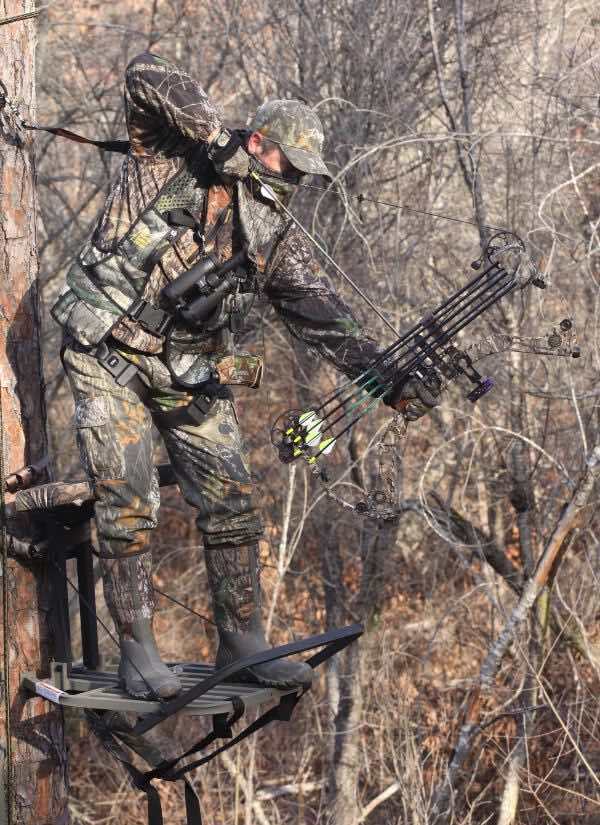
The rustling of dry leaves on the slope behind me caused me to freeze like a Washington D.C. statue. The rustling picked up in pace, and I distinctly heard soft grunts behind the noise of the nearing commotion. Even without visual confirmation, I trusted that a rutting buck was pursuing a hot doe down the hill into the creekside opening where I waited. Feeling confident that their actions held their full attention, I stood while grasping my bow off the hanger in a slow, but smooth move.
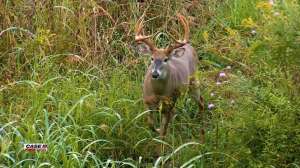
A moment later, a doe appeared directly under my stand. Her tongue hung out and her rib cage heaved as she gulped in air to replenish for the next run from an annoying suitor. With a glance over her shoulder, she was off again like a Hellfire missile. Mr. Personality promptly took her place under my stand as he paused to scent check the area. Because of his stout stature and 5x5 frame, I immediately sized him up as a shooter. When he dropped his head a second time, I drew instantly while nudging the pin into an aiming position, and without hesitation, dropped the string before he could renew the chase. The arrow caught him quartering away and exited out near the opposite front leg. I watched him explode in a feeble escape that ended with a summersault at the base of a broad oak trunk.
As I calmed my nerves, my only thought was this: Had I paused to settle that pin a second longer, I could have easily missed the opportunity or worse yet, wounded the buck with a shot too far back when he ran again. That’s why I practice for the 5-second — or less — shot during the offseason.
Practice for It
Offseason practice sessions shine as a time to produce tight groups and brag about shots from extended distances. Keep up that good work. In most instances, tight groups and hitting the bull’s-eye at 90 yards arrive from thoughtful form, a smooth draw and settling on the target for several seconds to ensure the perfect launch. Whenever I visit a shooting range, I see the competitive nature of archers as they methodically attempt to pull off their best shots in the presence of peers.
In addition to jamming arrows into the 10 ring for your next social media post, start or end your shooting session with shooting exercises to mimic the 5-second shot. You know that shot like the one I described above? In a noisy or silent arrival by a rutting buck, you suddenly stare into your shooting lane at a deer that has all the bodily signals it is going to be there only for a brief moment.
To get a shot off in these surprising situations, your practice should include having your bow either held in a lackadaisical manner or on a stand. You need to bring that bow up, hook your release to the string quickly, draw and get the pin on its mark all in seconds. You also need to maintain true shooting form and hit your anchor point while releasing in an almost instantaneous motion.
This exercise doesn’t need to be practiced at longer distances as I’m a firm believer shots over 30 yards require a more thoughtful and slow shooting process. Shots at 20 yards or less, the majority of whitetail treestand shots according to Pope and Young records, are where this exercise has merit.
I continue my practice even into deer season. How? My quiver ALWAYS holds a Judo small game point. After every morning sit and before every afternoon hunt, I practice the seconds-only shot from my treestand. I slam the arrow into an area of dirt or duff away from expected shooting lanes to boost my confidence.
Gear Up for It
Put your smartphone down for a second; you can order Judo points off Amazon in a minute, and you might want to add to that order. Organization makes every job more efficient. Get your stand organized to be ready for the snapshot. After checking all safety measures off the to-do list, organize your gear. Begin with your bow.
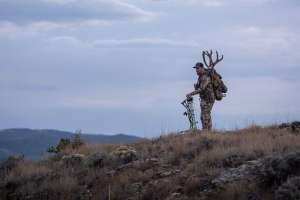
A handful of companies manufacture screw-in or buckle style bow hangers. Invest in one. You cannot sit comfortably for hours in a tree holding a bow. These hangers place your bow out in front of you in a vertical, hanging format. This provides you with minimal movement to grab your bow when seconds count. Your arrow is nocked, release attached (if that’s the type you use) and the bow is pointed in the direction of a likely shooting lane.
Over the years, I have also relied on a bow cradle that attaches to my belt and rests on my high hip; it works great when I’m holding my bow. Slip the lower cam into it and you no longer support the entire weight of the bow; it rests in the cam cradle. I can do the same with one of my hunting pants by slipping the cam into a cargo pocket. These products help you be ready without fatigue if a deer lingers near your location while you’re standing.
Next, organize your gear. Sometimes I simply use tree limbs to hang my stuff, but when limbs lack, a product such as the Muddy Outdoors Multi-Hook Accessory Holder gives you organization to always be ready in a stand. You can hang your grunt call, rattling antlers, daypack and more from the hanger that easily attaches around the trunk of any tree.
And don’t forget about lunch, drinks or your oversized smartphone. Attach a basket to the side of your treestand set for quick retrieval or stashing gear if you hear the pitter patter of hooves behind you.
Plan/Strategize for It
Lastly, plan for that quick shot. You can do some of these chores in the preseason or right before you climb into a stand. Begin with clearing all limbs from shooting lanes so when the unexpected happens, your arrow doesn’t glance off an obstructive branch. You can also pre-range all shooting lanes before your hunt. If you lack memorization skills (how well did you do in school?) utilize utility flags and write the distances on them with a Sharpie, big and bold.
You should also consider looking for ways to pause a rutting buck near your treestand. Adding several mock scrapes to your shooting lanes, dispensing scent via drippers or soaked wicks, and adding a decoy peeking from nearby brush also could stall a buck intent on burning rubber. Despite relying on my Rocky Mountain Hunting Calls Deer Dialect 2.0 grunt call, I also practice mouth grunting. A subtle, well-timed grunt at the right moment could give you another few seconds for optimum shot placement.
Throughout the pre-rut and rut, deer abandon patterns and speed up their momentum. Be ready to take advantage of that blurred shot when the stars align.
Photos by Mark Kayser