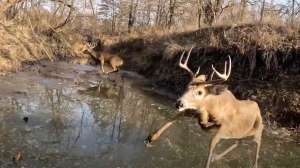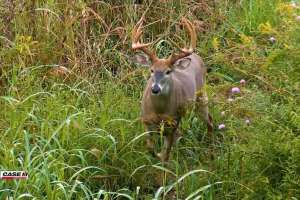

It was a trifecta of fakery as the buck hit the emergency brake and skidded to a halt. I first spied the buck across a small wetland cruising for nonexistent does in a pre-rut perplexity driven by testosterone drunkenness. The calm evening allowed my grunts to reach the buck, and he did a 180 to see “what’s up” on my side of the pond. His hard brake occurred later after he trotted my direction and saw my buck decoy, its ears positioned back, juiced up with dominant buck lure. The calls, decoy and scent worked like an NFL Super Bowl team operating in unison to win the Lombardi Trophy.
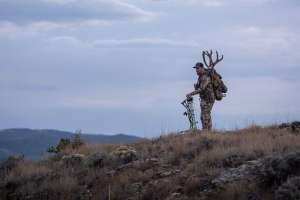
After an initial gaze, the buck also pasted his ears back to his skull and started a stiff-legged, parallel march toward my decoy. His route brought him right into my shooting lane as I peered down from the hang-on treestand 20 feet up in an aged cottonwood. As the buck reached a slam-dunk distance, I waited for him to put his full attention toward the decoy. When he did, I drew swiftly. The three-blade broadhead hit hard, causing the buck to explode in a karate-kicking fashion, but it was just show. He stopped 75 yards from my stand and teetered into his final bed as I watched.
Calls, scents and decoys team together for a collaborative effort you can put into play each fall. The good news is this trio works from the early to late season. Nevertheless, the lust fog of the whitetail rut is when the best results materialize. Consider one if not all for a chance to put deer into your can’t-miss zone.
Scents
Whitetail scents offer a pre-set attraction that lures in a buck and distracts him for a shooting opportunity. Set the scent out in a variety of manners and it provides a natural element that invokes curiosity. When combined with decoys and calls, scent can cement the reality of the ruse. A deer hears vocalizations, eventually sees your decoy, then smells the expected odor of other deer. I cannot think of a deer hunt where I did not use whitetail scent, regardless of the season.
When hunting a stand, I typically dispense scent via a dripper over a mock scrape or on a scent wick. While hunting with friends at a stand I may have never visited before, I take precautions not to leave my own odor in the area, but I use misting bottles to spray appropriate scent at a deer’s nose level in shooting lanes. When a deer passes through a shooting lane or down a trail, it hits the scent stream, pauses and focuses all its attention on the scent while I calm my buck fever and do my best to settle the pin for a close-range shot.
I’ll be honest: I’ve never had good results using scent in the drag fashion as I make my way to a stand. Several of my friends have, but my memories don’t include that experience. On the other hand, having bucks lose themselves in the olfactory preeminence of various deer lures is almost a daily occurrence while bowhunting the rut for me.
As a rule of thumb, I use straight doe urine or a dominant buck urine in the early season. During the pre-rut, I stick with a dominant buck lure and begin mixing estrus into the mix. Around buck decoys, I keep these two going as they tell a tale of breeding activity. While using a lone doe decoy, I utilize estrus scents such as the wildly popular Golden Estrus from Wildlife Research Center. Wicks on or near the decoy hold scent effectively.
Of course, the chronic wasting disease dilemma has brought additional regulations to the scent world. Fortunately, synthetic scents save the day to provide a legal and effective means to stay in the scent game. Proven to work as well or even better than the real deal, synthetic scents have stronger attraction qualities and don’t break down like actual, collected urine.
As a disclaimer, remember that too much of a good thing isn’t good for your trifecta ruse. An olfactory overload could cause deer to hit the panic button instead of hitting the accelerator. Use scent sparingly in moderate doses as a deer would dump in natural behavior. Too much scent can have negative consequences. I learned that the hard way once when I dumped a whole bottle on a wick and the ground around. A bruiser buck rolled in later and quickly dashed off as it smelled the toxic spill.
Also, use a proven scent and store it appropriately. Keep our scent in a cool, dark location. Refrigeration doesn’t hurt scent, and throw away any from the past season as it could send an alarm message.

Calls and Rattling Antlers
Since electronic calls are illegal in many regions, you will need lessons on learning to play the kazoo for vocalizations and beating the antler drums to create the sound of whitetail fight club.
The first time I grunted in a whitetail, I used my mouth after hearing the real deal several times. My rendition (that I use to this day when a grunt is required in milliseconds) sounds purposefully like a grunting pig. The reason is whitetail grunts sound like the soft grunts of a pig in a cool mud bath. If you practice only one deer vocalization, make it the grunt.
You should also learn the bleat because it can attract bucks and does. During the rut, an estrus doe will announce her breeding presence with bleats, and communicates to the rest of the herd with this distinctive sound. Soft bleats work to coax any deer, and loud bleats have the power to bring a buck trotting during the rut. Grunts and bleats can lure deer from 100 yards or further, but think of them as coaxers when deer are passing just out of bow range.
During the rut, you may also hear the snorting cadence of the snort-wheeze call. When a buck sends a snort-wheeze through the woods, he means business. This rhythmic blowing of air out tells other bucks to stay away or trouble is brewing. Although grunts and bleats work excellent to contribute to the realism of a decoy, when another buck hears a snort-wheeze, say from 100 yards out and then approaches to see a buck decoy with ears laid back, he can provide quite a show — and shot opportunity.
I use the snort-wheeze call as a long-range lure, and also use rattling antlers as a way to get deer (seen and unseen) headed in my direction from a long ways out. Antler rattling 101 is easy to pass. Remember that fights typically only last a few seconds or up to a minute. Bucks may repeat fights several times over the course of 10 minutes, so rattle, wait and rattle again several times. Always be prepared in between rattling sessions because bucks may race to the ringside event. Rattling works best when deer are beyond 100 yards and veiled by vegetation. I prefer using real antlers, but you can also use a product like the Mini Rattle Cage from Rocky Mountain Hunting Calls.
A good rule of thumb for any call is to avoid using it during calm conditions when deer are close. Restrain from calling when deer are already within archery range and let your other ruses such as scent and a decoy do their part.
One of my best memories was on a whitetail hunt in Kansas. A 5.5-year-old buck came racing so hard to my rattling that he didn’t even see the decoy or smell my deer scents as he skidded to a halt in the oak leaves a last time below my treestand.

Deer Decoys
Waterfowl and turkey hunters understand the importance of showing their quarry what is making all the fuss. If you have not tried a whitetail decoy, then it may be time to add that to your arsenal. Most decoying involves a whitetail buck decoy used in the pre-rut throughout the rut. A doe decoy works anytime, but has lots of potential in the post-rut when bucks are looking for their last fling before the testosterone tank hits empty. Don’t overlook a decoy; it may not be right for all occasions, but it will produce results in the right situations.
For a decoy to work its best magic, follow a few guidelines. First, don’t put your decoy too far out from your stand. Keep it close. I never have a decoy farther than 20 yards away for this reason. Take a setup in an opening. A buck that spies your decoy from the opposite side of the decoy could stay on the opposite side. It may not come in for a confrontation and a 20-yard shot could easily become a 50-yard shot.
Next, be aware of evolutionary behavior between deer. Mother Nature taught bucks to greet bucks and does in different manners, especially during the rut. Rutting bucks meeting in the wild walk up to each other in a parallel style. As they near each other, their hackles raise and they pin their ears to the side of their head. This macho-man approach emphasizes body size and meanness. While using a buck decoy, position it to a broadside or quartering-toward position to your stand. This ensures you of a broadside or quartering-away shot. Turn the ears down for an aggressive appearance. For a doe decoy, position it quartering away and a buck will approach from her rear to scent check in a similar, quartering-away position.

Buck and doe decoys should be upwind if possible and allow for a space between you and the decoy. This area is for deer to situate downwind, but upwind of your stand. Scents placed near the decoy give any approaching deer a blast of authentication. Calls also work great to alert fringe deer to your decoy. Tip: Placing a decoy in tight cover often does more harm than good because it surprises a deer. I recommend avoiding decoys on small food plots or around bait sites; here, I’d rather let the food alone work its magic.
As for plastic or screen-printed decoys, that’s your choice. I often keep a photo-realistic 2-D Montana Decoy Company buck decoy folded in my backpack for quick deployment, even while walking to a stand. These 2-D decoys can fool a buck and are easier to implement in seconds.
3-D decoys also work wonders. Their downfalls include bulkiness and noise if you decide to move them. Nevertheless, if you have one stashed by your stand, it’s also ready to set up when you arrive.
I once used a 2-D prototype deer decoy a friend of mine created along the picked side of a standing cornfield. At daybreak, a buck came down the edge, and I slid back into the stalks. I had placed scent on the cornfield picked edge, and a few grunts had him eyeballing my decoy as I hunkered behind it in the standing corn. He started into the small opening and turned broadside at 15 yards to maneuver past a few stalks, giving me an opportunity to draw. When he stepped clear, I released. The crackling explosion of his cornfield escape lasted only seconds as he crashed dead in a row 100 yards away. It was one of many trifecta successes I’ve had over the years, and the reason I continue to put this team on the field for a win.
Sidebar: Whitetail Scent — Good. Your Scent — Bad.
Your trifecta of fakery works only as well as your scent control. Let your scent wander and the trap slams shut without your intended target. Start your scent control with a trip to the laundromat. Every clothing item I wear is washed in scent-eliminating detergent, then sprayed and stored in scent-free totes. In my opinion, the easiest laundry detergent to use is the all-new Wildlife Research Center Scent Killer Gold Laundry Detergent Ultra-Concentrated Detergent Strips. Take them anywhere easily, even while flying.
I spray my dry, clean clothes with Scent Killer Gold and do the same with anything that can hold scent such as my bow wrist sling and any fabric on my release. I wash my backpack and keep it sprayed down as well. Not only does a fresh spray zap scent now, but Scent Killer Gold continues to work for 20 days beyond application. My clothes then go into an air-tight tote along with a Scent Killer No Zone Tote Tamer to maintain scent control in air spaces.
In the field, I try not to touch anything in nature, especially with my bare hands, to avoid leaving scent. My boots get sprayed before leaving the truck with Scent Killer Gold, and I have even been known to detour into a cowpie now and then to add natural scent to my boot bottom. I trim all trails to my ambush sites extra wide to avoid brushing up against vegetation. I do the same with short pathways to mock scrapes or branches where I plan to hang a scent wick. In addition to keeping scent off vegetation, the wide pathway accommodates the carrying of 3-D decoys to avoid the noise of slapping branches on plastic.
With attention to your own scent control, the ruse you set up has more potential to work the wonders you intended.