
I love turkey hunting. My friends and I call it elk bowhunting for the everyman. You get the same excitement of hearing boss males sound off, strut their stuff, and trying to call them in close enough for a shot despite their world-class defenses. The best thing is, there is much more opportunity to hunt turkeys than elk, and at much more reasonable cost.
When I set up a pair of 12 gauge shotguns for turkey hunting years ago, I spent a lot of time on the range pattern testing various load and choke combinations to find those that would give me consistently acceptable patterns at up to 50 yards using lead shot. I shot 10 different loads through six different choke tubes off the bench in each gun – my shoulder took a beating – but in the end, I found what I was looking for.
Then two things happened. I started hunting states that require non-lead shotshells for hunting, and in late 2024, my right shoulder started giving me fits. Fast forward to October 2025, and I underwent a right shoulder replacement surgery. I had to give up shooting my compound bows forever, and decided it would be prudent to start shooting a 20 gauge for turkey hunting to avoid the punishing recoil of my favorite pump-action 12 gauge.

The switch was also made possible because of the lethality of the new TSS turkey loads now available in all gauges. Lots of research, more pattern testing, and conversations with ammo makers and serious hunters with lots of experience made me realize that it is possible to meet, and sometimes even exceed, the performance of my 12 gauge guns using lead loads with my 20 gauge using TSS shotshells. The result is I am now carrying a lighter shotgun, have significantly reduced recoil, and can still hammer birds at the 50-yard mark if necessary – though I want them much closer, of course!

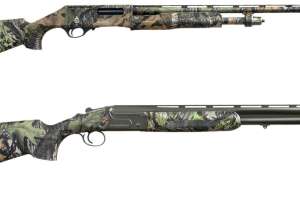
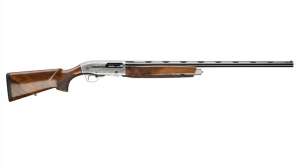
After a bunch of testing, I ended up adding a .560 Trulock Turkey Federal TSS #7 choketube to my Remington Model 1100 Youth 20 gauge shotgun. I also added an aftermarket recoil pad to both add a little length of the gun and reduce recoil, and topped it with an Aimpoint Micro H-1 2 MOA red dot optic.
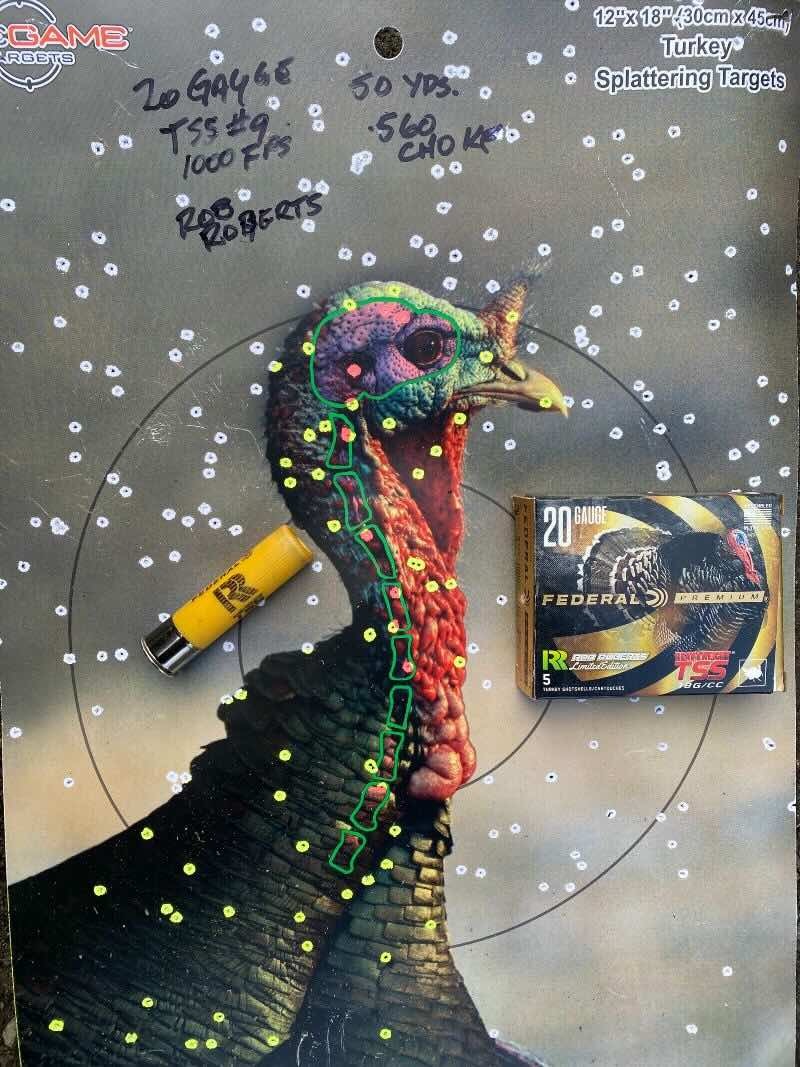
I pattern-tested it with several loads – both conventional lead and TSS – before settling on Federal’s HEAVYWEIGHT TSS Rob Roberts Special Edition, 3-inch 20 Gauge, loaded with 1 5/8 ounces of No. 9 TSS Shot, with a muzzle velocity of 1,000 fps. My second favorite load is the same configuration using No. 7 TSS shot. Both these loads feature 18 g/cc tungsten-alloy shot that’s 56 percent denser than lead for the highest pellet counts and the most kinetic energy at longer ranges. The rear-braking FLITECONTROL FLEX wad and advanced buffering material helps keep it all together through both ported and standard turkey chokes. Importantly, the full-length wads prevent direct contact of the extra-hard pellets and the bore, protecting the barrel, while the roll crimp and clear card wad keeps buffering material in place.
The key here, of course, is that with dense TSS shot, you can shoot smaller pellet sizes than required with lead shot to achieve the same kinetic energy at extended ranges. If the shotshell has a muzzle velocity of 1,200 fps, for example, at 40 yards a No. 9 TSS pellet generates about 374 ft./lbs. per square inch of penetration energy, while a No. 5 lead pellet generates about 241 ft./lbs. per square inch, and a No. 6 lead pellet generates about 205 ft./lbs. per square inch. A No. 7 TSS pellet produces about 535 ft./lbs. per square inch. That means you get denser patterns, which in turn permits the use of the 20 gauge (and in some cases, even 28 gauge and .410 bore shotguns) instead of the 12 gauge.
The baseline for patterning any shotgun/choke/load combination is twofold – put a minimum of 100 pellets inside a 10-inch circle at a given distance, and that the pattern must be uniform, meaning the pellets strike the target in an even distribution, with no obvious gaps. In my own setup testing, I found pretty much any TSS load would give me this performance at 40 yards. It was when I stretched it out to 50 yards that, in this case, the Rob Roberts loads won the day.
If there is a downside, it is the cost of the TSS loads. They’re much more expensive than lead loads due to the high cost of the tungsten raw materials. Across manufacturers offering TSS turkey shotshells, the cost ranges from about $10-$20/shell, more or less, while 20 gauge lead loads generally cost less than $3/shell. To mitigate this, I’ve also patterned this same 20 gauge load, choke combination with several lead loads, and found one – Federal’s Grand Slam load featuring 1 5/16 oz. of No. 5 shot at 1165 fps – that produces excellent 40-yard patterns. So, in situations where lead shot is legal and I’m hunting tight cover or over decoys where shots will probably be under 35 yards, I could use the more inexpensive lead loads (cost: about $2.50/shell) with confidence.
I field tested my new setup during opening week of California’s 2026 spring season. Hunting public ground in NorCal with my friends Jim Velasquez and Sam Johnson, we hammered three big gobblers in three days using my 20 gauge and the Rob Roberts No. 9 shot loads, at ranges from 25 to 55 yards. Every bird was stoned.

Next up for me is a late-April trip to western South Dakota, where I have tags to hunt both public state ground and the Crow Creek Indian Reservation. I’ll be leaving the 12 gauges at home and packing my little 20 loaded with the Federal Premium TSS ammo. Why would I shoot anything else?