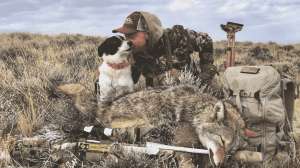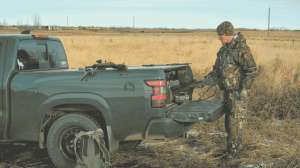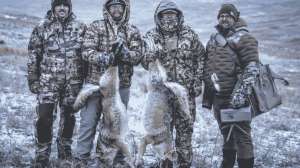

Coyotes aren’t much different from humans in that they like life to be easy and safe. The less work and risk involved in obtaining the necessities of life, the better we both like it. It’s why most hunters don’t venture far from their vehicles and why coyotes like nothing better than an already dead carcass. By recognizing this tendency in both ourselves and the four-legged predators we pursue, it’s possible to increase hunting success.
Let’s never forget that we are predators, too, just like our quarry. If we dig a little deep, we can quickly find significant similarities in what we value and how we both pursue those values. One of those similarities is the desire to remain unseen.
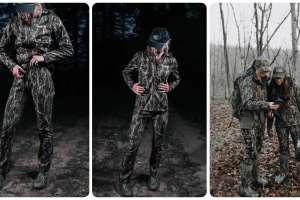
It’s well understood that many prey species rely heavily on concealment for survival. However, predators rely on remaining hidden as well, all the better to catch that prey, but also to remain hidden from bigger predators and not become prey themselves. A glance into the closet of any well-equipped hunter will confirm we humans understand the importance of camouflage and concealment equally well — with the companies marketing that clothing perhaps the best at exploiting our desire to be hidden.
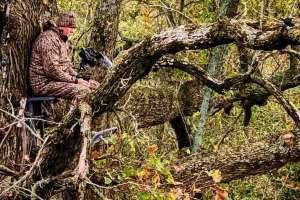
While I tend to be a skeptic about the relative effectiveness of various camo patterns, I’m completely sold on the idea that we need to keep concealment top of mind when hunting predators. Let’s not forget that visual concealment includes not being seen while walking to our hunting spots, as well as minding the background and even the sun’s position when we finally sit down. Sitting motionless in the shadow of a bush, tree or rock is an effective concealment option. And let’s not forget scent control is an important part of concealment. This includes minimizing the smells we exude as well as considering the direction the wind takes them.
Understanding that predators value concealment, too, is particularly important to finding them, especially during daylight hours. Most of their hunting activity occurs at night, partly because in the rural farming/ranching country where we typically hunt them, daylight is a dangerous time to be about. So, when the sun rises, they retreat to places where they can hide. In my part of the world, these tend to be pockets of brush or trees absent from any regular human activity. But in other areas of the country these safe spots will be different, and they can even vary depending on climate and season.
Calling on the fringes of these spots will quickly bring them out to the edges but getting them to move farther out into the open is a sometimes proposition, simply because they value concealment. When they do respond, it’s not uncommon to see them take advantage of the terrain to remain hidden as they move. I’ve regularly seen coyotes use irrigation ditches as a means of approaching a caller, remaining unseen until the last moment. Not asking them to cross wide-open spaces by setting up so they can approach along the edges of a tree lot or ravine is an effective strategy. Being just one leap away from concealment gives them a sense of security, making them more likely to respond.
Taking the Easy Route
Another trait we share with coyotes is the desire for easy travel. Movement always takes energy, and for us lazy humans expending a minimal amount of energy is a natural tendency. Predators feel the same way, although their motivation is likely more primal, in that if energy is not conserved, hunger and death could follow. I know that would motivate me!
Conserving energy is especially important during the winter months when food is scarce, deep snow makes travel difficult and more fuel is required for the body to keep warm. A calling setup that requires a coyote to approach through deep snow is a poor bet for success. However, if there’s a snowmobile track that runs across the field, the packed snow left behind makes for easy movement and the hunter’s odds just got better.
Snow is a reality in my part of the world, and I’ve gone so far as to deliberately create pathways with a snowmobile for coyotes to follow. I’ll also ask landowners who are out feeding cattle to drive their tractor along a specific route, just to create a trail for coyotes to follow. And since I don’t like trekking through deep snow either, I’ve made trails for me to walk along as well; all the better to walk more easily into a hot calling spot.
If there is no snow, there are still features that provide a pathway of least resistance that a predator can be enticed to follow. These include game trails, two-track roadways, railroad beds, frozen waterways and the trails cattle inevitably make as they move about in pastures. And if a trail offering easy travel also offers some of that concealment we’ve already discussed it’s a winning combination for any predator responding to a call.
Of course, it’s also the perfect route for a hunter looking to move easily and undetected into a predator’s backyard. But that confluence of values shouldn’t surprise us, since we are both predators. However, there is one major area in which predator hunters and their prey differ — physical fitness.

Fast and Light
Unlike humans, predators travel light. I’ve never seen a healthy coyote that isn’t a shining example of physical fitness, or seen one loaded down by a backpack bulging with gear. I certainly can’t say that about myself. Want to kill more coyotes? Be like the hunters we hunt, improve fitness and travel light. Both will allow a hunter to walk farther, travel faster and stay out longer.
While it is possible to buy light weight in our gear, that isn’t an option for our bodies. When it comes to fitness, discipline and hard work are the only routes to success, regardless of what the gadget and supplement sellers try to tell us. Fortunately, there is no shortage of options in ways to build fitness. It can be done through participation in active sports or through a personal workout program. Walking, running, pickleball, soccer and weight training are just a few examples. Our typical excuse for not working more on fitness is a lack of time. However, our quarry doesn’t have that excuse, because most of their meals are earned by a vigorous workout.
Reducing the weight of the gear we carry can help us travel farther and stay out longer regardless of fitness level, making it worth looking at that option, too. As I’ve aged, I’ve certainly cut down on the weight I carry. My rifles are now equipped with carbon fiber or slim barrels, as well as lightweight stocks such as MDT’s HNT-26 chassis system, which weighs just 26 ounces. Likewise, my favored shooting support system is now Spartan’s lightweight Springbok carbon fiber bipod weighing in at 11 ounces. My backpack is Tenzing’s PP15 Predator Pack (discontinued unfortunately), which has a built-in seat and just enough storage without being too bulky or heavy.
And while large e-callers produce awesome volume and sound, I’ll typically be seen carrying Foxpro’s Hellcat Pro, a compact lightweight unit that does everything I need, including having an integral decoy. And I’m not adverse to leaving the e-caller behind and using old-fashioned mouth calls, just to save weight.
We’ll never be as fast or fit as the predator’s we pursue, but getting lighter and stronger is a sure bet for improved hunting success.

Cheap Food
Another similarity we share with predators is a desire for cheap food. My wife does the grocery shopping at our house, and she exemplifies this in that she’s great at finding sales and making the grocery budget stretch as far as possible. When a big sale strikes, she braves the crowds and shows up to get the deals. While she uses money to pay for our groceries, predators “pay” for theirs with effort.
Food doesn’t come easy in the wild because it’s usually necessary to hunt it down and kill it. Occasionally, a predator will encounter a “sale” on cheap food, and when they do it’s a certainty that a crowd will show up to take advantage of it. These “sales” include roadkill along a highway or railroad track, as well as the untimely death of domestic animals. Of course, a flock or herd of largely helpless domestic animals that require killing first also qualifies as cheap food in a predator’s value system.
If an off-world alien wanted to hunt humans, a grocery store on discount day would be a good place to start. When we hunt predators, finding their version of discount day is a jackpot waiting to happen. In a coyote’s world, that jackpot often takes the form of dead livestock. Natural deaths are inevitable in any cattle herd and so most cattle producers have a spot where they dump deceased livestock. Finding those places inevitably yields an almost endless supply of coyotes, because when the locals are removed, others will show up to replace them. They just can’t resist this equivalent of cheap food.
What qualifies as cheap food for a predator will vary based on climate, agricultural activity, seasons and animal life cycles. I’ve seen a farmer’s pile of dumped potatoes attract coyotes and found evidence of coyotes stripping corn cobs off stalks to gnaw on the kernels. Like the safe zones they retreat to in the daytime, easy food sources can vary widely, but finding them should be on every hunter’s priority list.
Conclusion
There is no doubt humans are the apex predator, and because we are predators, we share a lot of characteristics with those further down the predator chain. We value concealment when on the hunt, traveling the easy route is always an attractive option, we hunt better when we’re fit and fast and cheap food is an irresistible attraction. Understanding ourselves goes a long way toward understanding other predators, and keeping these four values in mind will make us better hunters.