
My history with pop-up ground blinds goes back to the mid 1990s. In fact, writing this review reminds me of a visit I made to visit Keith Beam and Brooks Johnson in their “factory” for making Double Bull Archery ground blinds. I use quotation marks because it was little more than a small space in an industrial park in a northern suburb of Minneapolis, Minnesota, with a few tables and a couple of older women working on sewing machines. That afternoon I watched Brooks explain and demonstrate a hub-style ground blind. I’d never seen anything like it before — and neither had the entire hunting industry. Double Bull brought its innovative design to the market in 1994, and I still own and use a couple of the originals (T2 and T5 models).
Since the invention of hub-style pop-up ground blinds by Keith and Brooks, there have been many improvements and further innovations. Today, many companies offer hub-style pop-up blinds with hunt-friendly features, and due to competition, the price has stayed in check — great news for hunters!
For example, the Ol’Man Bounty Hunter 270 blind, the focus of this field test, has an MSRP of only $216.99, and the street price is less than $200. Forever ago, you had to pay at least twice that amount for a Double Bull.

Ol’Man On the Prairie
During spring 2026, I field tested the new Ol’Man Bounty Hunter 270 blind on the South Dakota prairie. Each year I pursue turkeys with my bow on a mix of private land and Walk-In areas. My permission property isn’t large, and generally that’s true of the Walk-In areas I hunt, too. This means that “running and gunning” with my bow isn’t the best way to tag a bird. Rather than tromping/sneaking around and bumping turkeys onto properties where I can’t follow them, I’ve learned through decades of experience that I’m far better off placing a blind and waiting for birds to come to me.
The trick with using pop-up blinds on the South Dakota prairie is wind, which always seems to blow the strongest on planned hunting weekends. I typically share my SoDak turkey bowhunts with a few buddies, and we often hunt in pairs because it helps pass the time in the blind while waiting on birds. In addition, a buddy is often critical because setting up a blind is a two-person job on days with winds of 17-ish mph or higher. One person holds the blind in place while the other anchors the blind’s four corners with stakes and then secures each wall with ropes and stakes.
This was the case on April 13, 2026, in eastern South Dakota. I was joined in the field by Bill, a friend since we were kids. He had tagged a tom on opening day of the season (April 11) while hunting solo from his blind; that day we were blessed with calm conditions so we could spread out and scout/cover more ground by hunting alone.
Well before daylight, Bill and I hiked slightly more than a half-mile along a river-bottom permission property, with plans of setting up my Ol’Man Bounty Hunter 270 blind on the highest point of the property. Our ambush was next to a barbed-wire fence; the nearest tree was 200 yards away. Unlike whitetails, which take a week or more to become comfortable seeing a pop-up blind suddenly appear in their home range, wild turkeys seem to view them as hay bales that have always been there.
My decision to place the blind next to a barbed-wire fence was largely due to the fact we could tie one of the wall support ropes to a fence T-post. The wind was predicted to be strong that late-morning from the northeast — about 20 mph. We’d be south of the fence, with our open shooting window facing southwest, so the cold wind wouldn’t hammer our faces.
The wind was blowing 10 mph when Bill and I set up the blind in the dark, and because we weren’t anywhere close to roost trees, we had the luxury of using our headlamps. A half-hour later, a few gobbles greeted us from the nearby river-bottom as the eastern sky brightened. I was optimistic!
As always when hunting from a pop-up blind, we were dressed in black to help hide in the shadows. That said, the day before in the yard back at camp we tested what a bird could see when looking at the blind. Under a bright noon sun, Bill sat in the blind while wearing a light-gray hoodie; I was curious if I’d be able to see him when looking at the three panels featuring one-way, see-through viewing technology. According to the Ol’Man product description, this technology is supposed to enable a hunter to see through the panels but remain hidden from wary animal eyes. From our testing, it worked well. Bill could watch me walking around in the yard and I couldn’t see him in the blind, even when he waved his arms.
FYI: The Bounty Hunter 270 is named as such because a hunter in the blind can see through three of the four panels. The back panel is all black and not see-through; it does, however, have a small peek window that you can use if wanted.
Our decoy setup that morning included a lone hen slightly to our left, plus a jake standing over a bedded/breeding hen directly in front of the blind. The jake was 9 yards from the blind. That morning I was also field testing the new G5 Outdoors Dirty Bird turkey broadhead, which is designed for head/neck shots, so I wanted a bird close. (Click here to read my review of the Dirty Bird.)
Ol’ Man Bounty Hunter Top Takeaways
You can read the specific details of my morning turkey success in South Dakota in the link to my Dirty Bird review, so here I’ll focus specifically on the role the Ol’ Man Bounty Hunter 270 played on the prairie.
When Bill and I finally had six jakes appear north of us (on the other side of the fence), we spotted them because of the blind’s right see-through panel. By then, we’d been in the blind for a few hours and the winds had picked up to the predicted 20 mph, but the blind was solid as a rock. The fabric fits tightly to the fiberglass posts.
My shooting window was the entire width of the center panel, and it was opened just enough top-to-bottom to prevent interference issues with the flight of my 3-inch-cutting diameter Dirty Bird broadhead. When the jakes finally walked in and stopped at 11 yards, just behind my jake decoy, I picked out a red head/neck that was statue-still. I drew when they were walking directly toward the blind at 15 yards and they never saw my movement in the blind’s dark interior.
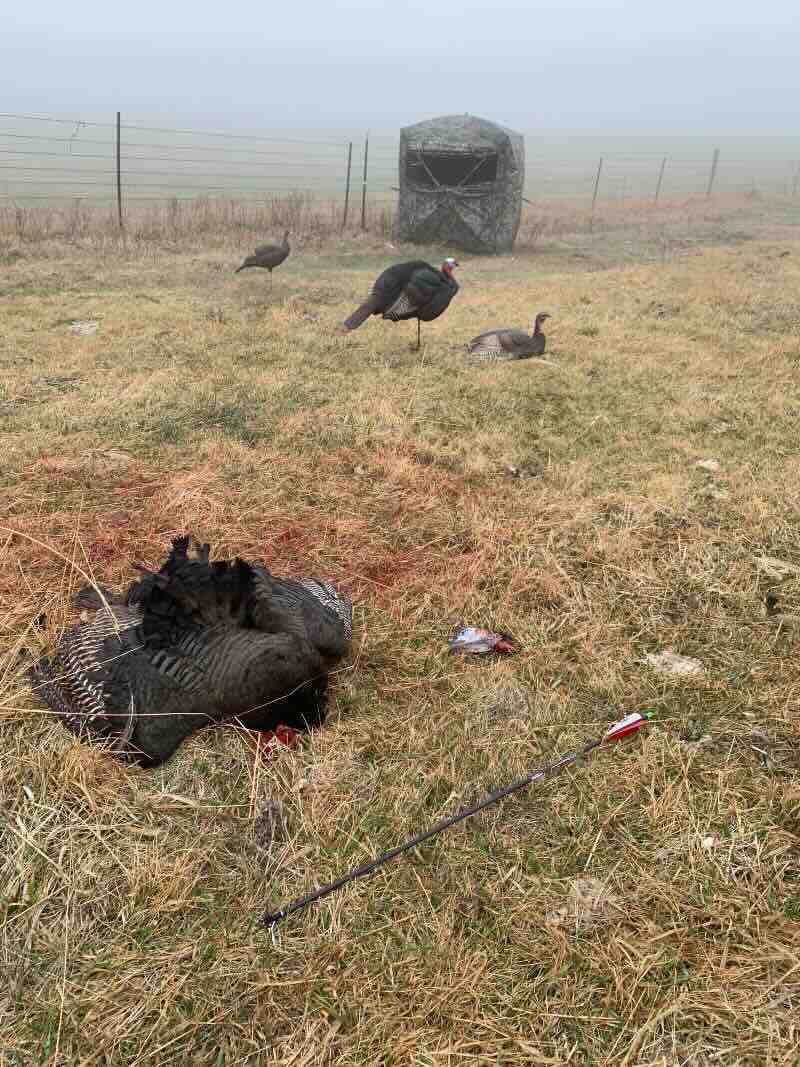
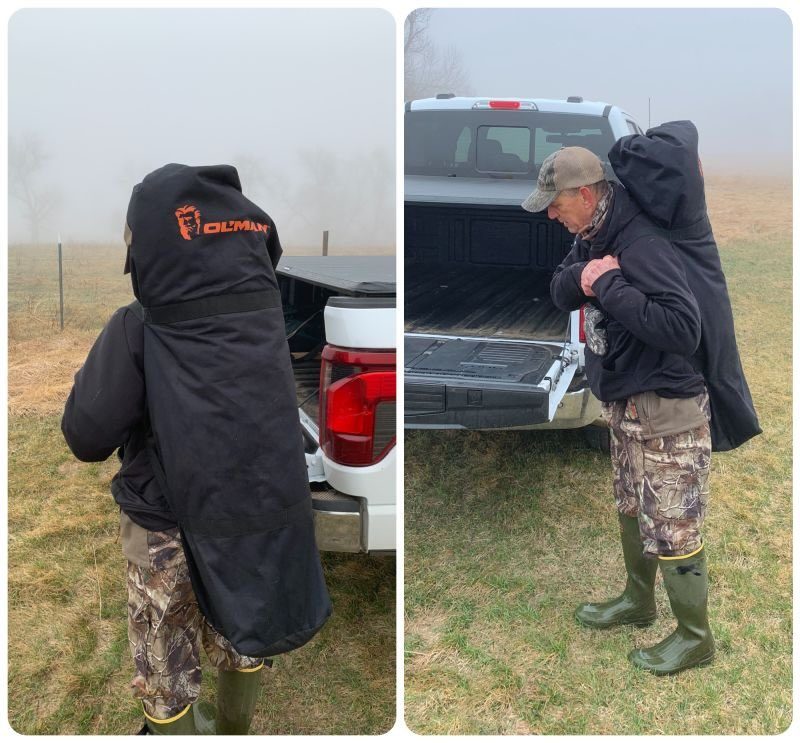
The photos here show what the Ol’ Man Bounty Hunter 270 looked like on the foggy morning in South Dakota. Looking back on that morning, here are my top three takeaways on the new blind:
1: The Bounty Hunter 270 weighs only 18 pounds yet is large enough for more than one hunter. It’s advertised as having a capacity for two or three hunters. In my opinion, I’d say the capacity is two bowhunters or gun hunters, or one hunter (gun or bow) with two non-hunting friends. The footprint is 58x58 inches, with 72-inch hub-to-hub width, and 68-inch interior height.
2: The Bounty Hunter 270’s slide-open windows are quiet and allow you to configure your center shooting window or side windows exactly as you desire. At times Bill and I cracked the side windows to make visibility in the distance a bit easier, but as soon as we had birds within 60 yards of the blind, we slipped the side windows completely closed for maximum concealment. Note: All the windows feature the see-through fabric for maximum visibility.

3: The blind’s 270-degree, one-way, see-through viewing technology helps you hunt more effectively because you can see more of your surroundings, and it positively makes your time in the field more enjoyable. A big part of turkey hunting success is calling at the right time and then gauging a bird’s response to your calls, and being able to see 270 degrees instead of simply out your center shooting window panel (90 degrees) increases your visibility by a factor of three.
Final Thoughts
Currently I own a half dozen hub-style pop-up blinds, and I’ve worn out at least that many in the past 30 years. I’ve even lost a few in South Dakota by leaving them up from one weekend to the next; tremendous high winds ripped them from the stakes and deposited them in pieces in the river-bottom. Not good! I no longer leave them set up for more than one evening, and even then only if the wind forecast is favorable. Of all my hub-style blinds, the Bounty Hunter 270 is the lightest, so it immediately became one of my favorites. And it’s the only one I have that has see-through panels, which I love!
I don’t own a single pop-up blind, regardless of price, that I haven’t modified in some small way to fit my specific needs, and this holds true for the Bounty Hunter 270. My alteration was inexpensive and effective, and it’s tied to the strong South Dakota winds. What I did was added three large safety pins to each of the side panel sliding windows, so six safety pins total. I use the safety pins to keep the two halves of a window tight to each other in heavy winds.
If you’re looking to purchase a lightweight and affordable hub-style pop-up blind with see-through panels, I think you’ll be pleased with the Ol’Man Bounty Hunter 270. I know that I’ll be tagging turkeys from it for many years to come!