Posts
Best of the Best Predator Rifles
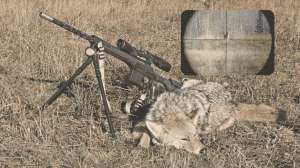
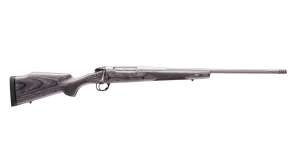
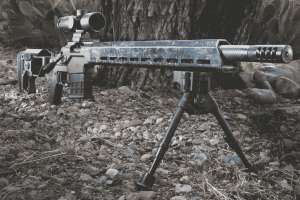
The coyote was obviously “road shy.” It completely ignored the plaintive, moaning squalls from my mouth call, sitting motionless on an irrigation dike across the pasture from the edge of a county road. My favorite predator rifle, a super accurate pre-64 Winchester chambered in .220 Swift and equipped with a custom Fajen laminated walnut stock, was rock steady in the notch I had scooped into the top of the plowed snowbank I was hidden behind. I had done lots of long-range shooting with this outfit at prairie dogs and rock chucks and taken coyotes and foxes at 300 yards, but this canine was going to be a challenge, registering just over 550 yards on my rangefinder.
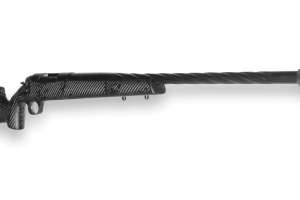
I centered the crosshairs of my Nikon scope, set on 12X, just over the coyote’s head, tugged the trigger and almost instantaneously saw snow kick up on the hillside right behind it. My immediate thought was that I had shot high, but then in seemingly slow motion the coyote simply toppled over without a quiver — my farthest shot ever at 557 yards.A predator rifle doesn’t get much better than that, but my Swift was “ruined” a short time later by a master gunsmith friend. He was on a spring bear hunt with me, and I showed him some stock blanks I had collected. He quickly glommed onto a gorgeously figured piece of Myrtlewood I had acquired some 20 years earlier and fitted my .220, which he re-barreled with a new accurized Shilen barrel, with a custom stock made from that Myrtlewood blank. A stunning tight-grouping beauty of a rifle that I retired except for rare excursions.My first predator rifles, used mainly for hunting foxes while I was in high school, were a Model 94 Winchester .30-30 Win. and a .30-caliber surplus WWII carbine. Their best attribute was the ability to get a fox running in high gear and keep it going while I filled the air with near misses.During my first year in college at Brookings, South Dakota, I hit it off with an old German gunsmith who I helped on occasion in his shop, and ended up trading him my two rifles, some cash and some work time for an FN-actioned, Douglas-barreled, medium-weight, .22-250 Rem., which at the time was still classified as a wildcat cartridge. Under the gunsmith’s tutelage, I glass bedded the stock, honed the action, lapped the barrel and worked up handloads that grouped consistently under an inch. Over the next several years, that rifle paid for itself several times over, downing several hundred winter-white white-tailed jackrabbits that fetched a buck each on the carcass.During my senior year, I was shooting jackrabbits one afternoon and a local rancher watched as my two companions pushed through a shelterbelt he had given us permission to hunt. I flattened 23 of the critters from one location and let him take six more with my rifle. At the end of the hunt, he made me an offer that was three times what I figured the rifle was worth. I finally relented and sold it to him.I spent the next several years swapping between the completely rebuilt and several custom 6mms, which originally hit the market as the .244 Remington caliber. I built my first one while I was in the army because I wanted a varmint gun that could also be used for big game — a medium-weight rifle with an FN action. Over the next few years while in the Army and working for Colorado Game and Fish, I took elk, mule deer, a bighorn ram, pronghorns and a bunch of foxes and coyotes with that gun. The only drawback to the 6mm as a predator rifle was, even with a lightweight 75-grain bullet it wasn’t very fur friendly.In 1965, Remington, Ruger and Kimber started production of rifles chambered in .22-250 as a factory cartridge and I soon had all three to field test. I fell in love with the Kimber Pro Varmint model, and with a bit of stock work and glass bedding, barrel lapping and honing and action smoothing work, turned the rifle into an even more deadly predator producer. My last encounter was with a pair of coyotes on one of my baits, where I flattened the farthest canine at 440 yards and his confused and hesitant companion at 400 yards. Predator rifles don’t get much more effective than that.My latest predator-punching acquisition is a lightweight, fast-action Bushmaster AR-15 chambered in .223 Rem. This was a rifle format I avoided like the plague until a good friend and full-time predator damage control specialist, Byron South, got me a Bushmaster AR to field test. The accuracy and ease of handling were real eye openers, and when fur prices skyrocketed that Bushmaster and my Remington R-15 fur friendly .223s were my constant predator-calling companions.Through the years, the .220 Swift was always my key predator rifle and accounted for over 500 predators and uncountable varmints before my gunsmithing buddy made it a showpiece I retired.If I had to choose a single predator/varminter caliber rifle today, it would be the .22-250 Remington loaded with 52-grain hollowpoint bench rest bullets to a velocity of 3,700 fps. With such an outfit, I’d be ready for any critter from gophers to Alaskan wolves.