
That coyotes are one of the smartest, most adaptable critters in North America is no secret. And unlike some wildlife species whose populations are threatened by continually expanding urban and suburban sprawl, in many instances coyotes are not only surviving but thriving in this ever-changing landscape. From coast to coast, north to south, they’ve established territories in parks, along golf courses and even in densely populated neighborhoods. Here they can find food, shelter and protection from creatures that prey on them — most notably humans.
I remember the first time I encountered suburban coyotes on a regular basis. Living on the beach in Huntington Beach, California, back in the late 1970s, I’d head off to work at first light driving along the beach-hugging Pacific Coast Highway. Many mornings I’d run into coyotes cruising next to PCH as they headed back into a large protected wetlands area bordered by beach houses. These encounters got me thinking, How can I hunt these coyotes?
As the years went by, I moved several times and started traveling the country to hunt. As I did so I started finding some really, really good coyote hunting near suburban communities. Having grown up in close proximity to people, these dogs were not nearly as skookum as those living in rural areas frequented by predator hunters, which made them susceptible to even my amateurish hunting and calling skills.
Studying Urban Coyotes
Perhaps the most comprehensive research study of urban coyotes is the ongoing Cook County Coyote Project (www.urbancoyoteresearch.com/ initiated in 2000. Researchers continuously capture a subset of coyotes, then collar and release them at their capture site. They are then monitored to understand how they live in urban areas and how they interact with other wildlife, domestic animals and humans. During the summer of 2011, the Anthem Highlands neighborhood of the city and county of Broomfield, Colorado, experienced multiple serious incidents between humans and coyotes; in response, they initiated a study that offers more interesting insights.
So, what has this, and other research, told us about urban coyotes?
For one thing, even in an environment where they can feed on food scraps left by humans, in the Cook County study 42 percent of their diet consisted of rodents. Also, according to the study, when whitetail deer drop their fawns in spring, the coyotes hammer them, killing anywhere between 20 to 80 percent of the annual fawn crop depending on the region. They also eat a lot of cottontail rabbits, and those pesky, pooping ducks and geese that populate parks and golf courses get it, too, as do their eggs during the nesting season. They also will eat cats, both pets and those that have gone feral. Being omnivores, urban coyotes in Cook County also raid gardens for fruits and vegetables, with fruit accounting for more than 20 percent of their diet when it’s available.
The study has also shown that urban coyotes maintain similar home territory characteristics of their wild brethren. The radio-collared coyotes have an average home territory size of about 3 square miles when living in a communal (pack) setting, but this expands to up to 25 square miles for solitary animals. In other words, they live a life similar to rural coyotes, adapting their movements and habits depending upon the season, as well as the availability of food, shelter and environmental conditions.
Exploring Suburban Hunting Options
As suburbia expands, it draws a cross section of the population to live there. There will be hunters, non-hunters, anti-hunters and those who never give it a thought moving in. As such, one needs to tread lightly when thinking about setting up a stand site close by.
The first step is to make sure that nearby vacant land is actually open to hunting. A city’s boundaries can extend farther than you might think. A county might have ordinances against hunting, or specific laws regarding the discharge of firearms, including distance from buildings or near or across roads, and if any caliber or centerfire restrictions are in place. You might be surprised to find centerfire rifles are not allowed, but archery equipment (including a scope-sighted crossbow, my current favorite), shotguns, muzzleloaders or airguns might be legal. Many of these governments have dealt with the issue of burgeoning deer herds and have implemented hunting regulations to deal with the urban deer. State laws might even be different for hunting on state or federal land vs. hunting in what is considered an urban or semi-urban environment.
When you find areas that appear promising — and you can do so from home using OnX or HuntStand apps, for example, or by doing basic internet research — try calling the local animal control officer or game warden. These folks will be familiar both with relevant legalities, as well as where concentrations of urban coyotes can be found. A local gun shop, hunting store or gun or archery club might have employees or members with valuable information. If you’re polite and lucky, they might even share it with you.
“Secret” Spots
Once I figure out the legalities and have spoken with locals in the know, I now have some idea on where to begin. I then start looking for two key starting points — public lands open to hunting and farmland in and around expanding developments. Here are two examples.
For many years, my wife Cheryl and I lived in a large retirement community north of Tucson, Arizona. The development was centered around three golf courses, which featured a constant water source, “No Hunting” signs and large populations of rabbits, deer, rodents, quail, songbirds and other tasty morsels the local coyotes and bobcats loved. It was bordered by both state trust and federal lands that were open to hunting.
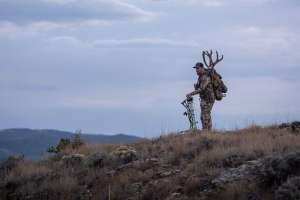
The surrounding public desert sprawled in all directions, and the local predator hunters pounded it. But the areas adjacent to the development that were accessible only by hiking several miles into roadless tracts were untouched. It was here where I killed several coyotes by entering and exiting undetected by the locals. I’d hike into my spots in the dark well before first light, carrying typical hiking clothes to change into before hiking out in my large frame pack that also carried my e-caller and my take-down air rifle or short-barreled Remington Model 870 — and hunt at dawn. This is an ideal situation, because all wildlife is drawn to the golf course’s water, food and protection.
Other excellent possibilities are areas that have been farmland for generations, but are slowly being developed into housing tracts that include both high-density housing as well as ranchettes of 1 to 5 acres. In such areas many farming operations remain, and this mix of habitat can be heaven for coyotes and bobcats that find lots of food, water, cover and little, if any, hunting pressure. Where I live now some of the local farmers who don’t allow hunting for deer, upland birds or waterfowl will permit limited access for hunting the coyotes that harass their domestic cattle, goats and chickens.
Travel routes are key. Since you cannot hunt the hub of the coyote’s urban habitat — the park, golf course, etc. — you’ll need to hunt the fringes. That means finding preferred travel routes between there and huntable lands, whether that is public ground or private land where you’ve gained permission to hunt. Drainage ditches, blocks of timber, freshly cleared land with big dozer piles, and so on are great places for predators to travel between their food and water sources and huntable lands where they can sleep the day away undisturbed.
Call ’Em Up
One thing I learned about this game is that you don’t have to be Big Al Morris or Garvin Young or win a world calling championship to successfully call suburban coyotes. Since they’re generally hunted very little, they’re probably uneducated, too. Rabbit distress and rodent squeaks are my basic go-to calls. In some locales I might add some quail calls, or a meadowlark in distress, or woodpecker sounds. And since all good callers like to “match the hatch,” a kicker in this environment can be the sounds of domestic cats, puppies crying, chickens clucking and even goats braying.
Regardless, I keep my calling low and subtle. They might be city clickers and they might be unhunted, but coyotes are still coyotes, so start off slow and low. The only education I want to give them is the last sound they’ll ever hear — the sound of a shot.
Final Thoughts
The first time I pulled off one of my suburban stealth hunts still makes me smile. I’d seen coyotes regularly near my golf course home, and had a good idea where they spent the day on the adjacent public lands. I loaded up my pack and, with the wind blowing from the 9th fairway up into the mountain, I made a wide circle up the slope, then fish-hooked around into position on a semi-open sagebrush flat so the breeze was wafting up into my face. I changed into my camo, slipped up over a knob and set up. It was dead calm, and when I could barely see I started a soft calling sequence, using rodent squeaks, transitioning to a dying rabbit sequence 15 minutes later.
It wasn’t 30 minutes after first light when the big dog showed himself, coming right for me. At 50 yards I tuned him up with a load of No. buckshot from a Model 870 I’d had since college. The nearest house was a quarter-mile away, and the thousands of local residents had no idea I was on the planet.
I was hooked. And why not? I’d figured out how to have excellent coyote hunting in an area not polluted by other hunters that, if I didn’t overhunt it, would be golden seemingly forever. And no one was the wiser. Does it get any better?