
It’s a safe bet most readers of this magazine don’t go predator hunting by just walking out the back door. I grew up on a farm, so there was a time I could do exactly that. But, of course, I couldn’t go far on foot and if I wanted to take more than a handful of predators a year, I had to get in a vehicle and drive somewhere.
Today, I’m like most hunters in that if I want to hunt at all, I need to go for a drive. Every coyote, fox and wolf I’ve taken during the past five decades required me to travel to where they lived, making that vehicle a key element of a successful hunt.
Home Base
When my wife and I were starting out, we were a one-vehicle family, meaning a single vehicle had to serve many purposes including being my hunting rig. It meant hunting gear, groceries and kids were mutually exclusive, but we made it work.
There are plenty of hunters for whom this is still the case. But regardless of vehicle size or features, when we’re out hunting our vehicle effectively becomes home base. It’s where we retreat for food, water, shelter and supplies. This requires efficient storage of both frequently used and emergency gear, and how we store that gear is a key factor in a successful hunt. Whether we hunt with the family hatchback or a dedicated 4x4 truck, the same storage principles apply, with organization and compartmentalization being key elements.
Gear Storage
Today, my wife has her own car, so I can leave a lot of gear semi-permanently stowed in my truck. However, the principles of gear storage aren’t much different from when we were a one-vehicle family. I still think in terms of three priorities when setting up a vehicle for hunting. First, a cache of emergency equipment, then a system for organizing my hunting gear, and finally a means of safely transporting firearms. These are the three storage priorities I’d suggest are universal and need to be worked into a properly equipped predator hunting vehicle.
We can likely all agree there’s some emergency gear that needs to be in all vehicles all the time. What it is depends on where a person lives. For me, things such as a first aid kit, jumper cables, a shovel, tire changing tools, bug repellent, fire starting gear, a tow cable, basic hand tools and toilet paper are some of the universal necessities. I take the position that these should be stashed permanently in every vehicle.
And then there’s hunting-specific gear. These items don’t need to be in a vehicle all the time, but having an efficient way of moving them in and out of a vehicle helps ensure they are present when needed.
Gear bags, especially compartmentalized ones, are my preferred way to efficiently move equipment in and out of vehicles. I keep an older version of the 5.11 Range Ready 50L bag set up with my predator hunting gear, and when I’m leaving on a hunt, I just toss it in the truck. A lunch kit and my backpack follow, and I’m assured to have everything I might need for the day, with nothing forgotten. It comes along on overnight trips, too, with just a suitcase added. And when the seasons and the hunting targets change, I just modify the contents to suit.
Having a well-equipped gear bag in the vehicle pays off. Like the time a friend fell while walking back to the truck and packed the muzzle of his gun full of snow. With no way to get it out, he was done hunting, and I let him fret all the way back to the vehicle. When we got there, much to his relief, I pulled a collapsible cleaning rod from my gear bag and cleaned out the barrel for him.

Firearm Storage
Safety is, of course, a key element of transporting firearms, as is securing a firearm from potential damage or events that might cause it to lose zero. And in some cases, quick access is important as it’s common to see a target of opportunity while driving between stands. My favorite solution to these competing requirements is the system offered by Grey Man Tactical. It’s built on a rigid MOLLE panel that attaches to a vehicle’s seat back and accommodates a modular attachment system for firearms and accessories.
Their vertical gun rack is a great way to secure a firearm and the rigid MOLLE panel can also hold lots of other gear in various pouches. Mine has a bipod, first aid kit, hand cleaner and ammo attached. While it takes up some room behind the driver’s seat, it can be easily removed by releasing two buckles, making it a great option for a multi-use vehicle.
Unfortunately, it’s not a good option for hunting in frigid weather, when it’s necessary to avoid cycling a firearm between hot and cold environments. Then, keeping a gun uniformly cold is the hunter’s best option. A basic gun case in the back of the truck is my go-to method then.
Paperwork
With guns and gear stashed away, any experienced predator hunter will tell you the job also requires paperwork, so getting this aspect organized and efficient is similarly a part of vehicle preparation. That paperwork can include licenses, permission slips, a copy of the hunting regulations, property maps and a logbook, as well as the usual vehicle registration and insurance documents.
My favorite way of keeping all this in a vehicle is an organizer that attaches to the flip-down sun visor. While there are lots of poor-quality options for this, I can recommend the one made by CP Gear for military use. Called the MOLLE/Loop Fastener Vehicle Visor Panel, it’s modular and can be configured with an array of accessories. I have mine set up with their accessory pen holder, two card pouches, a notebook and a compact red-light source from 5.11. This is in addition to the pouches already built into the unit. With this system, everything stays accessible, but out of the way until needed.
If the semi-permanent installation of a sun visor organizer doesn’t work for a person, CP Gear also makes a variety of binders and notebook covers that provide a means of easily moving paperwork in and out of a vehicle.
Vehicle Identification
While on the topic of paperwork we should also discuss identification. No, this isn’t about identifying yourself, which is certainly important if you’re dragging a firearm around the countryside, it’s about identifying your vehicle. For those of us, like myself, who hunt almost exclusively on private land it’s important that landowners and curious rural neighbors don’t conclude your parked vehicle is “suspicious.” Toward that end it’s useful to have a strategy that lets people know who you are and what you’re doing.
Individual circumstances will dictate how someone approaches this, but I use a two-pronged tactic. My first identifier is a highly visible coyote decal on the rear window of my truck that serves as a visual reminder to forgetful landowners. A second identifier for those who look closer is a printed card displayed in the rear window that says, “Coyote hunting, with permission,” and lists my name and cell number. I’ve even had calls from neighboring landowners who have stopped to check out my “suspicious” truck and then called me to help control coyotes on their property.

Stealth Matters
While identifying a vehicle to people is important, it’s also necessary to hide it from our prey. It seems like at least once a year I have a coyote hang up in the distance, only to realize that from its vantage point it could see my truck and therefore wasn’t coming one step closer.
While I’ve heard of people using camo netting to conceal a vehicle that can’t be hidden otherwise, I’ve never taken that step myself. I do know a fellow predator hunter, however, who never washed his vehicle all winter, thinking this might make it harder for coyotes to spot.
One thing I have done is swear off hunting from noisy vehicles. This includes trucks that have been modified to have a rumbling, manly sounding exhaust, as well as all diesel trucks. I used to hunt with a friend who had a truck like that and whenever we took my much quieter rig, we killed more coyotes.
Even odor is part of being stealthy. Keeping strong scents out of a hunting vehicle is important because they can transfer to the occupants. Small ozone generators such as those made by Ozonics that plug into a vehicle’s 12V outlet work great to deodorize vehicle interiors and can form part of a vehicle preparation strategy. Stealth matters.
Critter Management
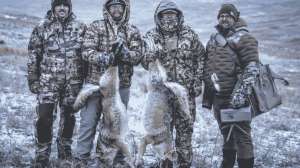
With a vehicle fully set up for success, let’s assume success happens. This makes it necessary to deal with harvested predators, which typically involves giving them a ride in our vehicle. A little preparation here helps deal with some significant issues.
While it’s easy to just toss critters into the back of an open truck box, giving that action a little more thought can be helpful. First, shot predators bleed, often a lot. So, placing the non-perforated side of the animal down means they likely won’t leave a pool of blood in a vehicle. If both sides are ventilated, the entry hole usually bleeds less than the exit, so that’s the side to lay the animal on.
In cold weather you can count on the animal freezing to the truck box, and when it comes time to remove it expect a portion of the fur to remain stuck to the steel. The solution is as simple as prepping the vehicle with some scrap cardboard to lay the animal on. Leave the cardboard stuck to the fur when the critter is removed and as it thaws out in the skinning shed the cardboard will just fall off without harming the fur. And it’ll soak up some of the blood as well.
For those without a truck box, hitch-mounted game carriers will work fine, but remember that the animals can freeze to the steel grates those are usually constructed with. Use the same cardboard solution. Another option, particularly for the SUV hunter, is a large plastic tub with a good lid. A large one will hold several coyotes and even more foxes. When dropping an animal into one of these, especially if located in the heated portion of a vehicle, and before locking down the lid, spray down the interior with an insect killer that’s effective on ticks.
Results
The collection of successfully harvested animals is most likely to happen following careful preparation, including preparation of the hunting vehicle. After all, we’re not walking out the back door to go predator hunting. Of course, everyone’s circumstances are different, so I don’t expect the suggestions I’ve made here to be universally applicable, but if they provide the seeds for ideas that lead to better preparation and organization, we’ve all succeeded.