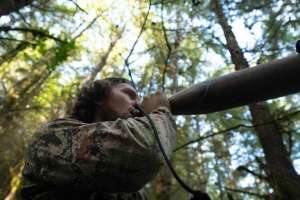

Do you know what the definition of “no fun” is? Having a hip replacement. Do you know what is even worse? Having surgery in December and missing most of the prime predator-calling season. That was my reality a few years back. With no option to hunt, I did the next best thing — I watched predator hunting content. A lot of it.
During that time, I found myself binge-watching episodes of The Last Stand Predator Hunting TV featuring Geoff Nemnich and Rich Paillet. As I watched, I began to notice something beyond the typical kill shots. Nemnich consistently explained not just what he was doing, but why he was doing it. That detail stuck with me.
It also raised a question: Can structured instruction actually make hunters more effective, or is success still earned strictly through trial and error in the field? That question led me to take a closer look at Nemnich’s online training platform.
An Idea Built on Demand
Nemnich’s in-person Coyote Craze College has long been a known commodity, routinely selling out each year. That demand ultimately led to the development of an online version of the course in 2024. “The demand for learning was evident,” Nemnich said. “The online format gives hunters flexibility and allows them to work through the material at their own pace.” The result is a structured digital course featuring more than 20 hours of instruction across 10 modules. Unlike scattered online content, the course is organized to build understanding step by step — a key distinction when compared to typical hunting media.
One of the more practical concepts presented in the course is what Nemnich calls the “Coyote Bubble.” At its core, the idea is simple: hunters must determine whether they are calling within the area a coyote is currently occupying. What makes the concept valuable is how dynamic that area can be.
Seasonal timing, daily movement patterns, terrain and weather all influence the size of the bubble. Summer coyotes tend to stay tight to family groups, resulting in smaller movement zones. During transition periods such as dawn and dusk, that range expands. Terrain and wind conditions further influence how far a coyote is willing to travel.
The takeaway is straightforward. If coyotes are responding but not committing, the issue may not be sound selection — it might be location. In many cases, the better decision is to move closer rather than call longer.

Breaking Down the Setup: The Pie Theory
Setup is one of the most discussed — and often misunderstood — elements of predator hunting. Nemnich addresses this with what he refers to as the “Pie Theory.” The concept frames a setup location as a circle divided into high- and low-probability zones. Portions of the “pie” become low-percentage approach routes due to factors such as hunter entry, visible equipment or unfavorable wind direction.
When hunters set up with a crosswind or headwind, they effectively increase the percentage of the pie that favors a coyote’s approach. This structured way of thinking helps eliminate guesswork and improves shot opportunities before the e-caller is ever turned on.
Stand Spacing and Time Efficiency
Another area where many hunters struggle is determining how far to move between stands and how long to remain on each setup. Nemnich ties both decisions back to the Coyote Bubble. “If the bubble is large, increase the distance between stands. If it’s small, tighten things up,” he explained.
Terrain plays a major role. In thick or broken ground, shorter moves — sometimes as little as a half-mile — are sufficient. In more open country, that distance can stretch to a mile or more.
Time on stand follows a similarly structured approach. While coyotes are capable of high speeds, they typically approach calls at a much slower pace — roughly 10 miles per hour. That equates to about six minutes per mile. Given that many responding coyotes originate within a half-mile, hunters should expect initial visibility within a few minutes.
Nemnich uses this logic to build time frameworks, often dividing stand time into segments to guide sound changes and calling sequences. The result is a more efficient approach that reduces wasted time and increases the number of productive stands per outing.
Solving the Running Shot Problem
Few scenarios challenge hunters more than shooting at a moving coyote. For many, it becomes a guess-and-react situation. Nemnich addresses this directly with a visual chart that outlines lead distances based on range and speed. For example, a coyote running full speed at 100 yards requires roughly a 4-foot lead — approximately one body length. At 200 yards, that lead doubles. While field experience remains critical, the chart provides a structured reference point that helps eliminate much of the uncertainty involved in these shots.

Results Matter
Theory is valuable, but results matter. To evaluate the effectiveness of the course, I looked at feedback from hunters who applied those lessons in the field.
Duane Swaenepoel of Alberta, Canada, tracked his performance across two seasons. Prior to taking the course, he recorded a 38 percent success rate across 90 stands. After completing the training, that number increased to 49 percent over 55 stands. He credits improved caller placement and a better understanding of setup angles as key factors.
Dustin Schrieber, a Texas hunter with more than a decade of experience, reported even more dramatic results. After taking the course, his team increased its contest performance from five or six coyotes per event to as many as 10 to 15, with multiple top finishes. Schrieber pointed to improved decision-making and confidence as the primary benefits.
The course extends beyond recorded instruction. Members gain access to full-length hunting footage that walks through complete stands — including both successes and failures — along with monthly live question-and-answer sessions. These sessions provide an opportunity to address real-world scenarios and expand on course material as hunters apply it in the field.
Conclusion
After working through the material and reviewing field results, one thing becomes clear: This course is not a shortcut, but it is an accelerator. Predator hunting will always require time in the field. However, structured instruction such as this can reduce the learning curve by eliminating common mistakes and providing a framework for decision-making. In the end, success still comes down to execution, but having a clear system to follow can make that execution far more consistent. For more information, visit www.tlshunt.com.

Coyote Craze College
Hunters looking for an in-person experience can attend Nemnich’s three-day Coyote Craze College. The course combines classroom instruction with field application, allowing participants to see concepts applied in real time. Day one focuses on foundational knowledge through lectures and discussion, while days two and three are dedicated to making stands and applying those lessons in the field. For more information, contact Geoff Nemnich at geoff@coyotecraze.com. — Andrew Lewand