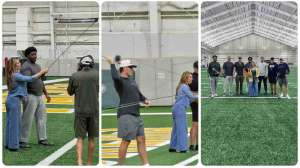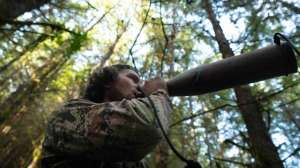

At the 2026 World Archery Field Championships in Yankton, South Dakota, a unique crane-mounted target was used during the team finals on the field course at the NFAA Easton Yankton Archery Center. Instead of the traditional ground placement, a target was elevated into the air hanging from a crane to test the archers’ shooting and thinking ability.
I say “thinking ability” because some archers might mistakenly believe you must adjust your aiming point due to extreme heights (extreme vertical angles). Not so.
When shooting uphill (like at the targets held by the crane in the 2-minute Facebook video below) or downhill (like from a treestand), you must aim (choose the correct bowsight pin) based on the horizontal distance rather than the direct line-of-sight distance. Thankfully, most modern rangefinders calculate for horizontal distance so you don’t have to worry about it.
Let’s take the shooting scenario featured in this video. The shot distance to the two targets if they were on the ground would be 55 meters or 60.1 yards. For simplicity sake, let’s just call it 60 yards. The fact that the targets were raised high in the air by a crane is irrelevant to choosing the correct yardage for aiming. Gravity acts on the arrow (pushing it to the earth) on the horizontal distance only, not the line-of-sight distance. In other words, the competitors would use their 60-yard bowsight pin if the targets were on the ground, and they are using their 60-yard bowsight pin on these targets even though they were raised high in the air.
I’m a math major, so let me run some numbers for you.
I’ve already stated that the distance to the base of the crane is 60 yards. Using geometry for calculating missing components of a right triangle, let’s say the angle at which the archers are aiming is 20 degrees. That would mean the targets are being raised off the ground by approximately 20 yards. That would mean the line-of-sight distance to the targets is about 64 yards.
But as I said, none of this matters for gravity — i.e. which pin to use. You aim for 60 yards even though the line-of-sight distance is 64 yards.
Now, it is true that the wind will act upon the arrow for the total distance traveled — 64 yards. And looking at the video, it was breezy. I’m sure many of these competitors take part in various 3-D events and TAC Shoots where extreme angles come into play, but that said, this crane scenario is certainly a bit out of the norm for the Field Championships.
Check out the video below to see Team USA’s Paige Pearce and Gaius Carter win the compound mixed team gold medal at the event in Yankton. Congrats, and go Team USA!