
Ruger delivers quality and performance in everything it makes. It’s been unwavering in that mission since it was founded in 1949. Other firms have done the same, unfortunately, but many of those that never discovered another secret to success have long-since closed their doors.
Ruger, from the beginning understood the value of input from its customers and industry experts. Harvesting that information and applying it in designs whenever possible, improves its lineup. The approach runs in the company’s genes, but there’s another ingredient. It has an enviable history of understanding precisely when it’s time for a popular model to be upgraded — even when it defies conventional, accounting-firm logic.
The firm’s American Rifle and its Gen II replacement are an interesting example. The original model was introduced in 2011, 15 years ago. Chamberings included many popular for predator hunting. Demand for the budget-friendly bolt actions was brisk out of the gate. By 2020, nine years later, it was the highest volume seller among all new bolt-action rifles offered on Gunbroker.com. It stayed there in 2021, 2022 and 2023.
Meanwhile Ruger engineers were pouring over consumer input, modifying designs, testing and waiting for that corporate crystal ball to signal “all clear.” That arrived in December 2023 when Ruger unveiled its American Rifle Gen II. Unsurprisingly, the next two years it replaced its predecessor on the top slot in those bolt-action ratings.
After reviewing a Gen II Predator it’s obvious why it climbed on top of that podium so quickly. Every upgrade is a welcome addition to what was already a good gun, and the line’s budget-friendly mission was not surrendered in the process.
Improvements Begin with Safety
The Ruger American Gen II tang-mounted safety is now a three-position version. Far forward, where a red bar shows, is the ready-to-fire position. In the middle slot the rifle’s safety mechanism remains fully engaged, but the bolt can be worked to load or unload the rifle.
All the way back keeps the safety engaged, but the bolt locks in the closed position and will not budge. It’s a nice touch for predator hunters who work through thick brush or other obstructions that have a habit of unexpectedly working the bolt handle and unloading the chamber. The safety must be in one of the other settings to remove the bolt from the gun.
The original American Rifle’s safety was two-position, also tang mounted. The upgrade eliminates a concern when on the move.
Stock Upgrade
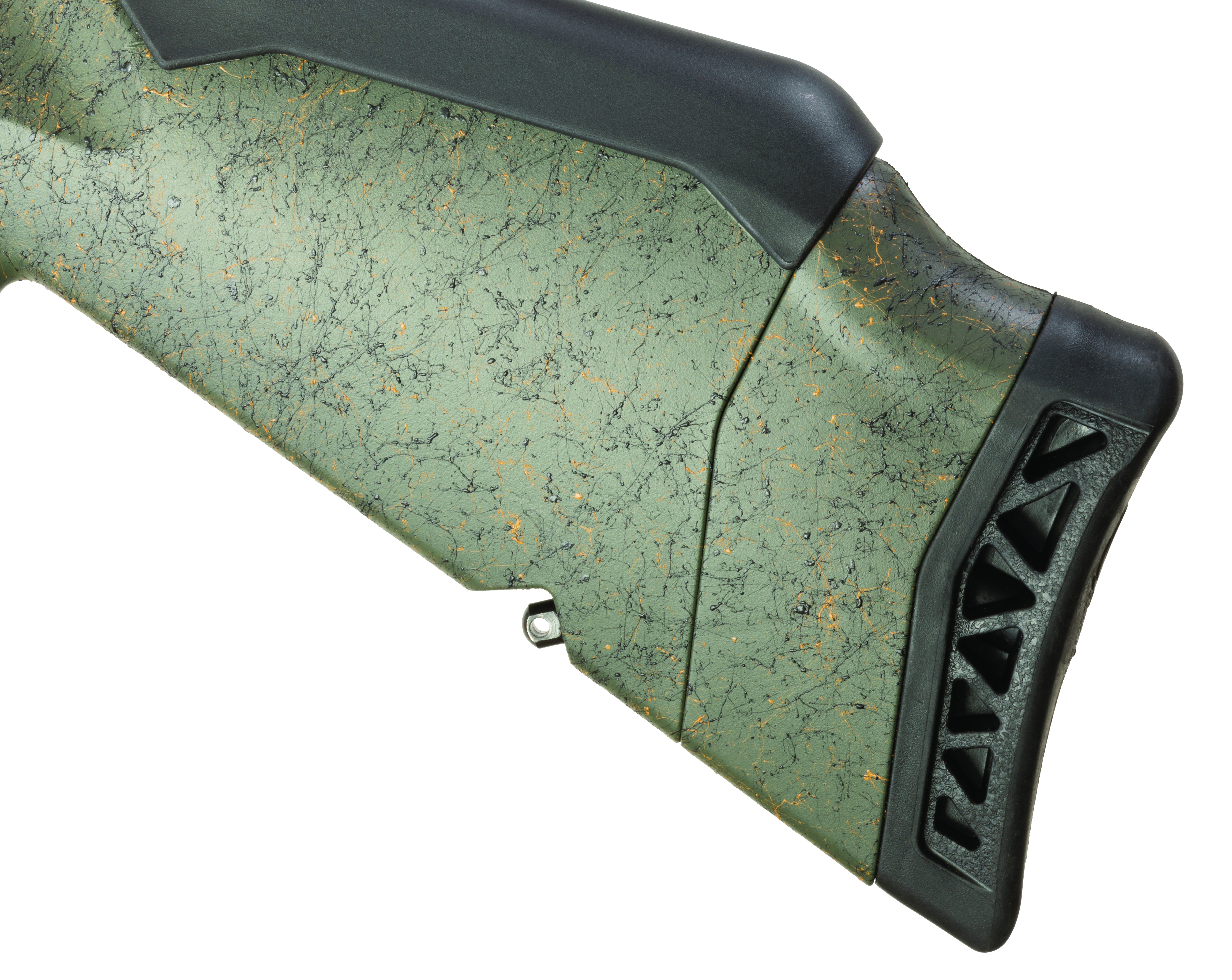
Shoulder a Gen II and the difference is noticeable. The stock is slightly more rigid than the original and wears an enhanced, no-nonsense, all-weather texturing. Predator hunting, after all, isn’t always a gentle pursuit.
With or without gloves you still get a solid purchase on the rifle. At the grip a generous palm swell and eight raised-relief bars are followed by an equally elevated triangle near the bottom.
A slight concave at the forend, just below the barrel, ensures a proper hold palpable enough for confirmation in the dark. Two slightly raised and textured surfaces there ensure owners acquire a positive grip, even in nasty weather.
Perhaps the biggest cosmetic change is the finish, which Ruger calls “Splatter.” The name fits and the look is attractive, yet it somehow still blends into surroundings with enviable dexterity.
To genuinely experience the effect, ask to handle a Ruger American Rifle Gen II the next time you’re in a gun store. Words and photos don’t do the finish justice.
In the meantime, envision a starving artist spraying multiple cans of Silly String onto the rifle’s fiber-reinforced polymer stock from 10 feet away. The pattern, which is created from a sort of synthetic capable of taking field abuse — not a children’s toy — is even, but random. Every gun likely has a subtly different look. The gun’s receiver, barrel and all workings are mounted later, so critical components are not part of that canvas, so to speak.
More importantly, the finish adds grip. When cured it isn’t completely flush with the stock. It’s a pleasant-to-the-touch surface relief that makes every inch of the gun more solid in hand without being dirt-collecting sticky or abrasive.
New Adjustability
Ruger listened to enthusiasts and added adjustability to the Gen II stock. It now comes wearing a removable comb riser that provides enhanced sight alignment with many magnified optics. Simply remove it when it does not prove optimal for any setup.
Length of pull can also be altered by removing a stock spacer. Doing so reduces LOP from 13.75 inches to 12.
Gen II Predator Specifics
Ruger introduced the American Gen II Predator version in March 2024. The one sent for review was chambered in 6.5 Creedmoor and wears all the above-listed enhancements. The color palette is tailored for predator hunting, but the performance and chambering make it a viable candidate for big-game hunting.
The splatter effect on the green stock is very nice, with thin and random streaks of black and copper. In the right light the latter matches the receiver’s burnt-bronze Cerakote finish nicely.
Barrel and Receiver
Ruger’s Power Bedding block anchors the receiver — which is CNC machined from 4140 steel — solidly in the stock. The 22-inch, medium-contour barrel is spiral fluted and free-floated. The Cerakote finish on the sample sent for testing was even throughout, blemish free and exceptionally good. A 6-inch, 14 groove Picatinny rail rides atop the receiver.
Rate of rifling in the cold-hammer-forged barrel is one full twist every 8 inches. The rifle ships with a radial muzzle brake installed.
A one-piece, CNC-machined tri-lug bolt ensures smooth and trouble-free operation. It has a 70-degree throw. In testing there were no failures to feed or extraction problems. Cycling wasn’t quite up to the buttery-smooth operation often found on expensive custom bolt actions, but it was much better than most rifles at this price point. It was a pleasure to work. The oversized bolt knob can be replaced, if wanted, with any aftermarket model with a 5/16-24 thread pattern.
Marksman Adjustable Trigger
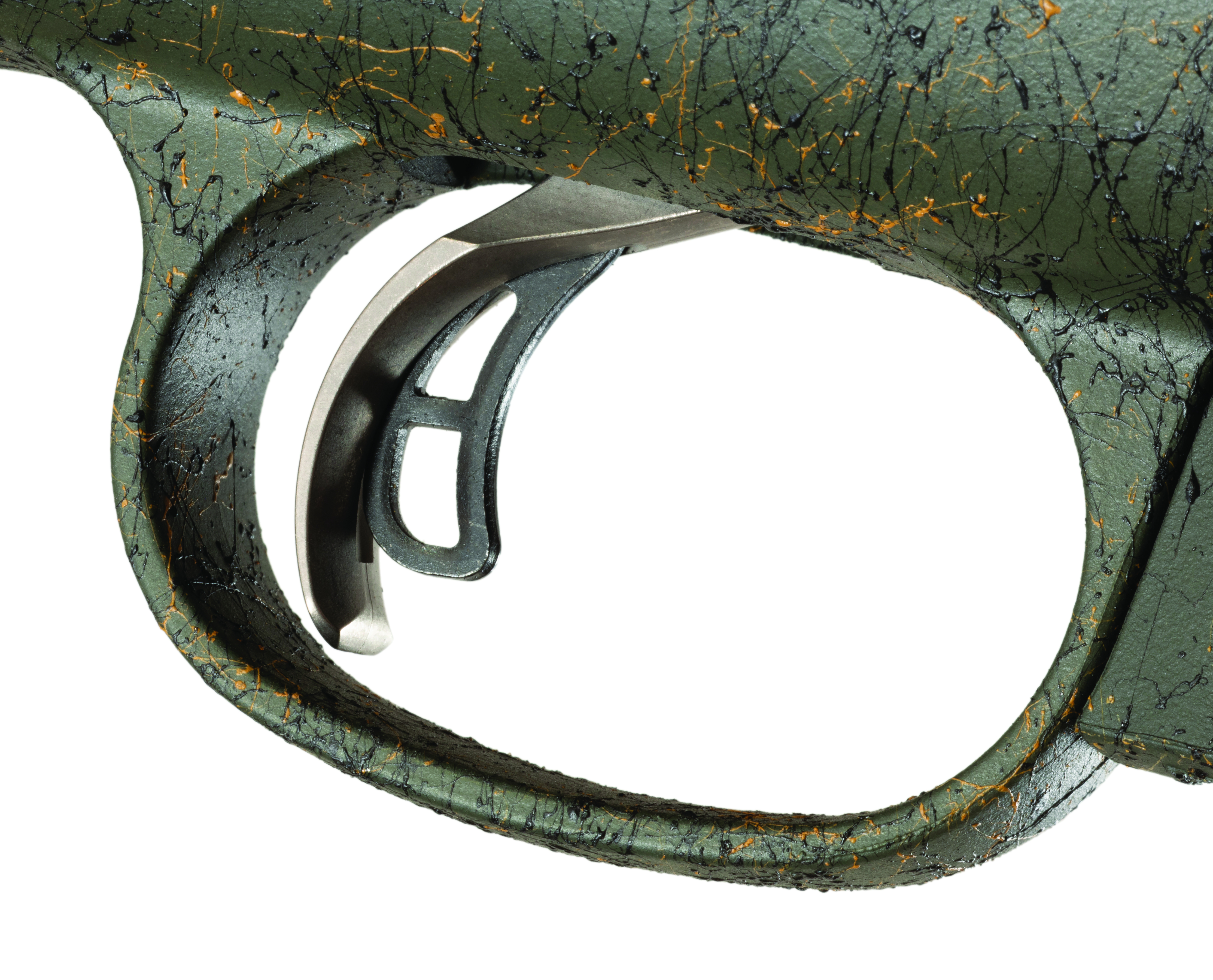
The Gen II kept one of its predecessor’s best components. That Ruger Marksman Adjustable trigger always tests creep free and crisp. It didn’t fail to impress on the Predator.
Using a Lyman Electronic Digital Trigger Pull Gauge, average let-off weight — after 10 tries — was 3.42 pounds. More importantly, the largest variance from that figure in any pull was only .15 pounds. That’s owner-pleasing consistency.
Gun owners prefer the ability to fine tune their setup, though. Ruger’s Marksman adjustable trigger let-off weight can be adjusted to anywhere from 3 to 5 pounds with a simple turn of an Allen bolt at the back of the trigger assembly. In the Predator’s case, the stock needs to be removed for the procedure. It’s a simple task and keeping the mechanism relatively sheltered from the elements is a smart choice considering how often unpleasant weather dumps on predator hunts.
At the Firing Line
Accuracy results were good for any rifle, but surprisingly so for a budget-priced gun, factory fresh, in unfamiliar hands. It doesn’t seem to have a huge preference, whether it’s fed select premium ammunition or pocketbook-friendly fodder either.
At 100 yards, in 40 degrees with a steady breeze ranging from 5 to 10 mph — quarter value — Federal’s American Eagle 123-grain OTM loads printed the tightest group at .59-inch. After five three-shot groups its average grew to .74-inch — an unwanted swelling that makes my shortcomings obvious.
Norma’s 130-grain BTHP 6.5 Creedmoor load printed one group that came close to claiming top honors. After the 15-round volley it did, however, turn in the best average at .67-inch. Hornady’s American Gunner 140-grain BTHPs came close at .69-inch, with most groups hovering near that figure.
Testing was conducted from a prone, sandbagged position. A German Precision Optics Centuri Compact 3-12x44i riflescope was mounted for the session.
Tame Recoil
The 6.5 Creedmoor cartridge is relatively tame. The generous recoil pad that ships on the Gen II Predator made the range session a pleasure. The .223 Rem. chambering the rifle is available in could convince more than a few shoulders they are behind a rimfire.
A factory-installed muzzle brake up front helps, but it makes the gun bark a little louder for bystanders. Behind the trigger, with hearing protection, it’s not noticeable. The radial design will lift leaves and dirt aloft when shooting from the prone position. It’s not a big deal, although in dusty regions where follow-up shots are common — coyotes in the desert Southwest, for example — it’s worth noting.
Other Features
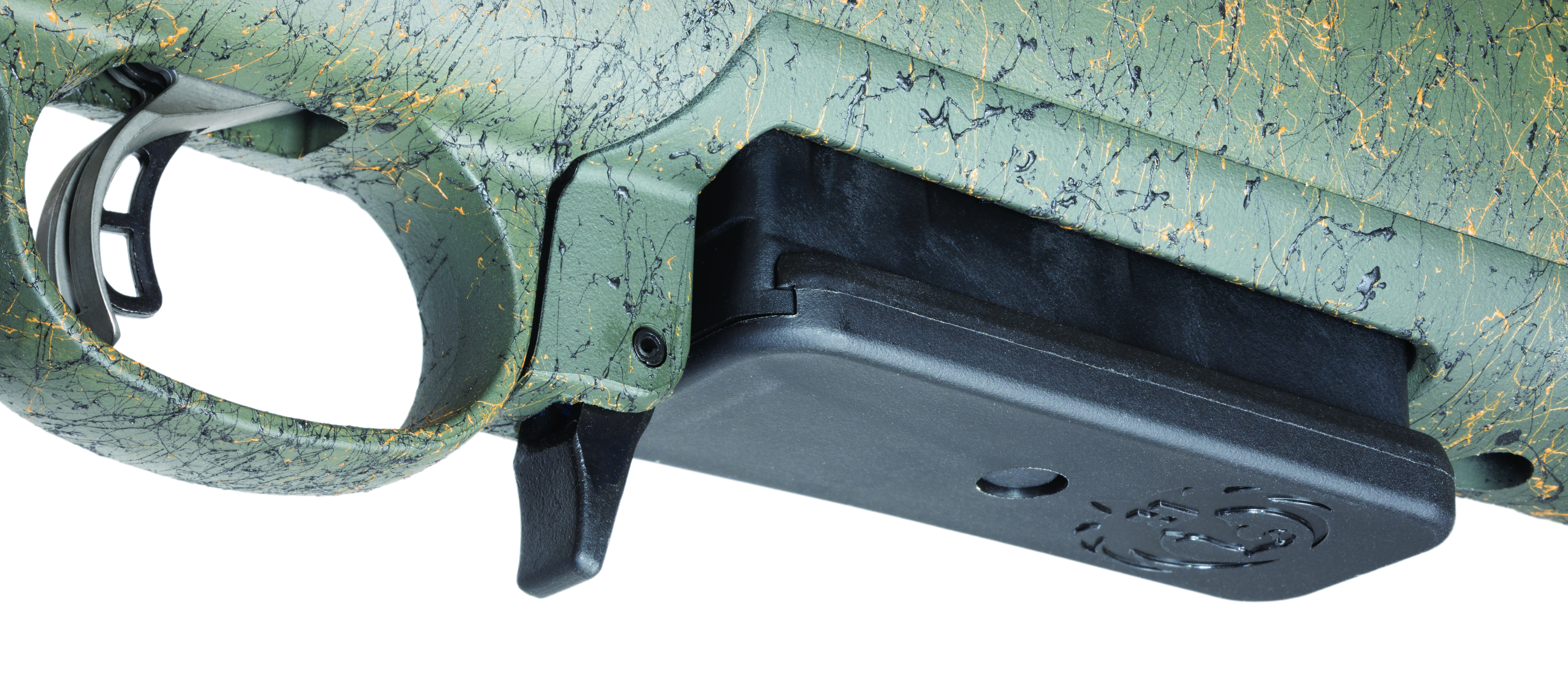
The rifle ships with an AI-style box magazine with a three-round capacity. It is released by applying forward pressure on the large vertical bar in front of the trigger guard. The magazine stayed put during testing until the floorplate was given a slight tug. That could change with use.
A pair of sling swivel studs are found fore and aft on the stock. The rifle ships with a trigger lock and manual.
Overall Impression
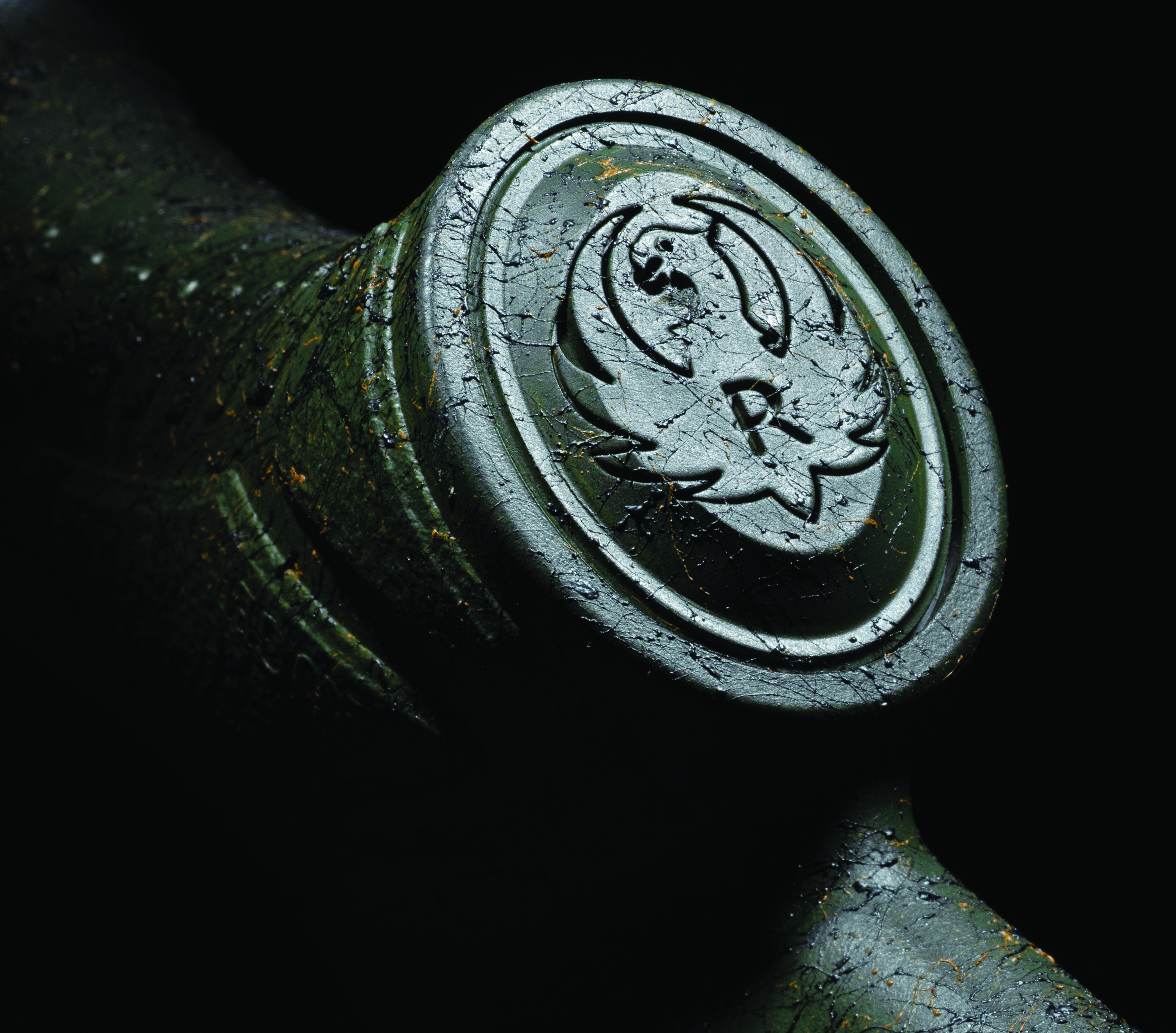
Cosmetically, this rifle is a winner in two different ways. It blends in, easily, when afield. The “splatter” finish works so well that even up close it’s tough to see the Ruger logo moulded into the stock at the bottom of the grip. The treatment soaks up light like a black hole nearly all the time.
The lone exception might be with a direct setting or rising sun at its back. That’s when those non-metallic copper streaks show best. Of course, the sky usually glows orange at that time, so it’s not giving away your position, anyway.
The left side of the receiver does, however, wear the Ruger American name. It’s not gaudy, doesn’t really jump out when afield. In the right light on the Burnt Bronze Cerakote, however, it’s an elegant statement on a pocketbook-friendly gun designed for field use and abuse.
The Ruger American Rifle Gen II is already dominating bolt-action sales, and it shows no signs of slowing. It’s there for all the right reasons, too. Predator hunters looking for a rifle that performs well out of the box and packs every quality that made the original a favorite while adding requested versatility need to take a close look at this one. Its predecessor was a solid choice. This version is even better.
Specifications
Ruger American Rifle Generation II Predator
Manufacturer: Sturm Ruger
Chambering: 6.5 Creedmoor tested (also available in .204 Ruger, .22 ARC, .223 Rem., 6mm ARC, 6mm Creedmoor, .243 Win., 6.5 Grendel, 6.5 PRC, 7mm-’08 Win., 7mm PRC, .270 Win., .308 Win., .30-‘06 Sprg., .300 Win. Mag., .350 Legend, .400 Legend and .450 Bushmaster)
Method of Operation: Bolt Action
Overall Length: 43.25 inches (with stock spacer installed)
Weight: 6.7 pounds (empty without optic)
Trigger Let-Off Weight: 3.42 pounds (tested, but the Ruger Marksman is adjustable between 3 and 5 pounds)
Barrel: 22 inches, spiral fluted
Receiver: 4140 alloy steel
Rifling: 1 in 8, right hand
Safety: Three position
Stock: Fiber-reinforced polymer
Magazine: Three cartridge capacity, AI-style polymer
Accessories: Trigger lock, manual
MSRP: $769
Website: www.ruger.com