
There’s an old saying most hunters have heard: “Hunt when the animals are out.” It’s simple, practical wisdom — the kind that sticks because it’s true. Animals are easiest to hunt when they’re active and exposing themselves in ways that make them visible and predictable. For several of the species I hunt with an air rifle, that prime window opens after dark.
Night hunting for most traditional game animals is off-limits, and in many states night hunting is illegal altogether. But when you’re targeting pests, predators or invasive species, the rules can be different. Darkness becomes an advantage. Animals often move more freely and with less caution, giving the prepared hunter an opportunity to be far more effective than during daylight hours.
I’ve spent years hunting raccoons, rabbits (legal in Texas; always check your local regulations), predators and wild hogs with airguns after dark. I’ve done it on foot, from the back of a truck and out of blinds. Through trial, error and a whole lot of field time, I’ve refined two night-hunting rigs that cover everything from barnyard pests to big, mean feral hogs. What follows is a breakdown of those setups, how they’re configured and why I’ve come to rely on them when the only light comes from the moon or a thermal screen.
The MicroStrike: A Compact Night Rig for Small Game — When you’re hunting smaller pest species at night — rats, rabbits, pigeons or raccoons — you’re often working in tight quarters where ranges are short and shots can come quickly. Accuracy and maneuverability matter more here than raw power, while a high shot count and fast cycling keep you in the game when targets are active.
My go-to setup is built around the Air Venturi MicroStrike, a subcompact PCP that can be configured as either a handgun or a slick little carbine. Mine is the .25-caliber version, set up as a carbine, and it’s a surprisingly capable shooter. It generates a bit over 30 foot-pounds of energy, which is more than enough for the small-game and pest species I’m targeting. It’s accurate out to 50 yards, while the adjustable regulator keeps it consistent from shot to shot.
The MicroStrike’s folding stock adjusts for length of pull, and the whole gun weighs only 4.5 pounds without an optic. With the stock extended, it’s just 29 inches long — small enough to maneuver inside barns, sheds, tight blinds or the bed of a pickup. The 80cc air cylinder fills to 300 bar and gives me around 30 usable shots per fill, though I usually top off after three magazines to keep things consistent.
The gun has a little bark to it (still far quieter than a .22 LR), but the threaded muzzle lets you mount a suppressor to tame the report even further. When you’re shooting around livestock, buildings or neighbors, that matters.
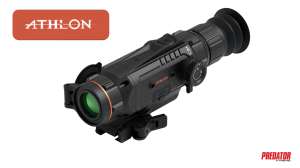
Thermal Vision in Tight Quarters — For night work, I run an ATN THOR-4 thermal scope on this gun. It uses the 384-resolution sensor, which is more than enough for the ranges I shoot with the MicroStrike. The THOR-4 has since been replaced by the THOR-6 line, but it still shines for its long battery life, onboard video recording, Wi-Fi/Bluetooth connectivity and intuitive controls.
The combination of a compact, fast-cycling airgun and a thermal optic that lets me see clearly in pitch-black conditions is hard to beat. I can slip a pellet or slug exactly where it needs to go, even when I can’t see the target with the naked eye.
This rig works for me because it does a lot without being cumbersome. It’s quiet enough for the places I use it, easy to shoot and plenty accurate for the job. Whether I’m shooting offhand or from a rest, the ergonomics just work. When I’m hunting tight spaces or dealing with quick-moving pests, it’s the perfect tool.
The Sidewinder: A Heavy-Hitting Rig for Predators and Hogs — When the quarry gets bigger and meaner, you need more gun. For predators and hogs, my night-hunting rig is the Western Airguns Sidewinder, a .30-caliber semi-automatic PCP that hits like a hammer.
The Sidewinder is actually a select-fire rifle, meaning it can fire in semi-auto or full-auto modes via a breech-block selector. I don’t use the auto mode for hunting, but it is a plinker’s dream! This gun can produce up to 125 foot-pounds of energy, which puts it squarely in hog-hunting territory. The regulated action and TJ hammer-forged barrel deliver excellent accuracy with both pellets and slugs. A velocity wheel lets me tune the gun for everything from quiet backyard plinking to dropping hogs in the bean fields.
The rifle uses a 12-shot removable magazine, a 580cc air bottle and a full Picatinny rail system for optics and accessories. It also accepts AR-style grips, which makes it easy to customize. At 35.5 inches long and 7.7 pounds, it’s compact enough for fast handling but substantial enough to stay steady on target.
Long-Range Thermal Precision — I run another THOR-4 on this rifle, but this one uses the higher-resolution 640 sensor. It’s capable of resolving targets at distances far beyond what I’d ever attempt with the Sidewinder, but the image quality is noticeably sharper. When I’m scanning fields or timber edges for coyotes or hogs, that extra clarity matters.
With this setup, I’m comfortable taking predators out to 125 yards. For hogs, I keep things tighter — 75 yards or less — and rely on precise head shots. The Sidewinder gives me the energy I need, and its semi-auto action lets me take immediate follow-up shots. When a sounder of hogs comes barreling in or a pair of coyotes shows up, that fast cycling is worth its weight in gold.
Pellets, Slugs and the Importance of Matching Ammo to Quarry — Ammunition selection depends on the quarry and where I’m hunting. With the MicroStrike, I often use JSB Hades pellets for rats and rabbits. Their hollowpoint design delivers excellent terminal performance on light-bodied animals while reducing the risk of overpenetration, which is important when shooting around structures.
For raccoons, I switch to slugs. NSA swaged slugs with domed heads have proven extremely accurate and provide the penetration I want on heavier-bodied critters. With the Sidewinder, I use slugs exclusively. I’m generally shooting at longer distances and at tougher animals, so the added energy matters. They give me the accuracy and terminal performance I’m looking for when hunting predators and hogs.
Keeping the Guns Aired Up: The Nomad Nano Compressor — For field air supply, I’ve been using the Air Venturi Nomad Nano since it came out this past year. It’s a portable PCP compressor capable of filling airguns up to 4,500 psi. It runs on household power or a 12-volt car battery, and the adjustable auto-shutoff lets me set the target pressure and walk away.
I’ll sometimes carry a carbon fiber tank for short trips, but on longer outings, the Nano is my constant backup. It doesn’t take up much room in the truck and has proven reliable for keeping both guns topped off.
Why Airguns Shine After Dark — Air rifles offer some real advantages for night hunting, starting with their relatively quiet report when working around livestock or neighbors. They’re also well suited for pest control around structures, where precision matters and shots tend to be close. Minimal recoil is another plus when using thermal or night-vision optics.
With my two-gun battery — the MicroStrike for small pests and the Sidewinder for predators and hogs — I’m equipped to handle everything from barnyard rats to monster tuskers after dark. These rigs have earned their place in my truck, and when the sun goes down, they’re the tools I trust.