
After more than four decades of bowhunting experiences in my memory hard drive, one aspect stands out above the rest: be flexible. Traditional tactics stand out for all hunts, such as waiting invisibly along a food plot for whitetails, or bugling to a vocal herd bull elk in the next stand of pines. Those tactics work on occasion. Trust me. Nevertheless, improvising and adapting to the changing situations also pays off in big dividends.
Fact: Four of my best big-game trophies came about by being flexible and changing hunting tactics on the fly. When hunting hours are waning or your current strategy is falling short, it could be time to freelance your bowhunting attack.
1: Pronghorn Summer School
Knee pads, leather gloves, a couple of 2-D pronghorn decoys, several ground blinds and blind chairs — check that off my gear list. These items, along with food, water and hunting clothes bags, were stacked up outside my horse trailer (redneck camper) as I wrestled the provisions into every nook and cranny for the upcoming Wyoming pronghorn hunt. Since 1991, when I put an arrow in my first pronghorn, their homelands, behavior and uniqueness (no relatives in North America) have fascinated me. Even more intriguing is the fact you can bowhunt pronghorn with so many different tactics.
My first pronghorn fell to the deception of a Mel Dutton adolescent buck decoy. Dutton, a pioneer in the decoy world, crafted a folding decoy that although a bit heavy, fooled rut-frenzied mature bucks into believing a satellite buck was sneaking in with lustful aspirations. Even young bucks, like my first, were riveted to the riveted plastic facsimile.
In addition to decoying, blind hunting over water is a top tactic because pronghorn territory is notoriously arid. The rut is a particularly good time to sit water as breeding athletes require frequent hydration for the proliferation of the species.
Lastly, stalking accounts for many pronghorn freezer moments every fall. Stealthy bowhunters who use terrain, wind and the knowledge that you can draw on a pronghorn only when those bulging eyes are pointed directly away, do find success.
After setting camp on a plateau overlooking miles of Bureau of Land Management parcels, I used stalking to not only speed-scout for the highest density of pronghorn, but possibly free an arrow for a finale ending. A couple of days into my stalks I decided to add a decoy into the hikes. This hunt (like most of mine for this species) took place in late August just as testosterone was beginning to peak in pronghorn bucks. They might want to visit another buck out of curiosity or to set the pecking order.

Halfway through the hunt a summer heatwave hit, and those long hikes began to take a toll on my fading energy and enthusiasm. Fortunately, I prepped several waterside loungers (ground blinds with chairs) during breaks in my stalks. They would be ideal for recuperation and meeting up with a watering hole regular.
A couple of days later I had passed on a trio of young bucks, but the tall-horned buck 300 yards out eyeing my blind and the water was now on the hit list. He smacked his lips for nearly 10 minutes as he scrutinized the out-of-ordinary blind, but finally started his slow approach to water, eerily like how giraffes, the closest living relative to the pronghorn, approach water in Africa.
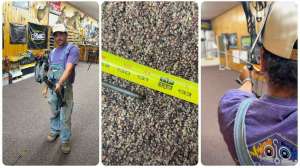
It took the nervous buck a few minutes to finally settle and begin the speedy glugging of the turbid water. When I believed the buck was fully committed to refilling, I ranged him again and set my HHA single-pin sight for 36 yards. He never saw or heard the draw, but he definitely felt the thwack of the arrow. At nearly 16 inches, heavy and with good prongs, the buck’s horns (top photo) touched the edge of Boone and Crockett awards acceptance. Lesson learned — rotate through your pronghorn strategies for the one that works.
2: Mule Deer With a Whitetail Mindset
“I know you’re thinking we’ll stalk mule deer like we’ve done through hunts in the past, but I’ve got a new plan based on some of the activity I’ve been watching,” said outfitter Doug Gardner of Gardner Ranch Outfitters. Doug and I have been good friends for more than a decade. Heck, he even helped me acquire a Montana guide license to help him by guiding clients. When Doug said he had a plan, I was all ears.
During preseason scouting and before I arrived, Doug had been watching a bachelor group of mule deer bucks feed voraciously on a winter wheat field, then escape back into an island of pines on a new ranch he had recently purchased. What stood out to Doug was the fact the bucks used the same offramp into the pines daily. Seeing that pattern, he placed a treestand in the drainage with confidence one of the older bucks would walk within archery range of the trap.
We attempted a day or two of stalking other bachelor groups of mule deer before Doug sprung the surprise on me, and after his comprehensive explanation of all the reconnaissance and planning that went into the ambush, I gave him the thumbs up for a try. It was unconventional, but when your outfitter, with more than 30 years of experience, not counting his previous years of personal hunting, tells you he has a plan, there’s no need for questions other than “should I pack a sandwich?”
It’s common knowledge that the first sit in a new treestand or ground blind tends to be the best. Knowing that fact, my confidence surged while walking to the stand in the predawn dimness. After securing the safety harness, I did a pregame check of my bow and its settings before hooking it to the hanger. Mule deer have a habit of slipping back to morning cover quickly, especially when nearby human activity begins humming. On this sit, an adjacent county road would ensure they left the field at daybreak, if not sooner.
Like clockwork, soon after shooting light, muley bucks began appearing on the horizon. They assembled at the head of the draw that led to my high hide. Of course, there’s always a hitch. At first, they moved down the draw single file. Minutes later, the small band of brothers began spreading out in the draw, browsing their way down it, and their widening path was growing with each step. Would any pass within 50 yards or so of my tree?
I kept my eyes glued to the most exceptional of the group and by chance, he stayed on course. My last rangefinder confirmation put him at 43 yards as I settled the pin. The entire group exploded after the shot, and an hour later I stood before the non-typical trophy buckled in a patch of brush. To this day I have never placed a tape on him as there is no need; he stands above the rest of all my mule deer archery memories and all because of swapping tradition for whitetail strategy.

3: Elk On Your Own
Three weeks into elk season and skipping a comfortable camp setup with a front-seat truck bed to move speedily between locations was all taking a toll on my body. Rewind three weeks and the elk season kicked off with some hope, but bugles ceased as hunting pressure increased. Elk, notorious for their ability to leave town without a clue, were doing a better job than usual of disappearing than in previous years, hence the reason I moved between locations rapidly. Once at a new area, I’d offload my ATV, bounce to a new trailhead and hike until the heat or exhaustion, or both, did me in.
As I crawled into my sleeping bag flopped across the front seat of my old Dodge diesel, I decided to give it one more day and then either take a couple days off or maybe even call it quits for the season. Early under starlight I rolled out of the cab of my truck after another restless night of sleep. Winds were beginning to kick up as I made my way to an adjacent, deep canyon. Even with the wind ticking up by the minute, this morning felt different and it all started with a bugle in the dark.
Not wasting a second, I sprinted to cross the canyon to where the bugle emanated as the wind began gusting even higher. Once there, I strained to hear another and did, but curses! It was back on the side where I started. The herd and I had passed each other in the morning darkness. With my binocular, I was able to pick out the herd moving toward heavier timber and even snapped a couple of fuzzy photos, but the wind was so strong now I could only see the bull stretch his neck to bugle; I couldn’t hear it above the gale.
Ducking into another ribbon of timber, I jogged to the elk and soon was downwind 50 yards of a satellite bull. I passed as I could see the herd bull watering below with the herd. Unexpectedly, a bugle ripped right above me and its origins were obvious: another hunter!
The lead cow threw her head up and stared in the direction of the hunter’s bugle, then whirled with the rest of the herd following. Seeing his herd in getaway mode, the mature bull bugled twice and then chased after.
The hunter above me went into band-camp practice after hearing two more bugles, but the herd’s negative reaction convinced me to stow my own bugle call and follow in silence. Through deductions and clues, I unbelievably caught up with the herd, and when the bull stepped into the clear, I launched an arrow. The hit appeared good, but it took me another hour to kneel before the giant while gripping his antlers. Had I not seen firsthand the herd’s reaction to the other hunter, I would also have continued bugling and likely not be able to appreciate the 380-class bull in my trophy room today.

4: Whitetail Wishy-Washy
“He showed up again and not just once,” my farm-owning hunting partner stressed during the dinner-hour phone call. The “he” in question was a mature, stocky and heavy-antlered buck that I tried to hunt in Kansas, but after he disappeared, I decided to test my luck in nearby Iowa. The phone call could not have been timed better. The whitetails in Iowa suddenly decided to give me the same cold shoulder. Because the two locations were separated only by a late-night drive, I hung up, explained the situation to my Iowa host and after a thank you, pointed my truck west for a Mountain Dew drive back to Kansas.
Some might call me crazy for bouncing back and forth between two equally great whitetail states, but you know the old saying, “a bird in the hand is better than two in the bush.” Whenever possible I also follow a credo that life is short so you better play ball when opportunities arise. Back in Kansas things got interesting fast. First, my buddy filmed the buck so after the first day of hunting we watched him on the big screen. My conservative score put him at more than 160 points … easily. He had so much mass though, it was truly deceiving.
The next day trail cameras revealed the buck didn’t visit the food plot portion of the farm where I set up but instead opted for a timber love stroll. Instead of changing course like I did by leaving Iowa for a return to Kansas, I held tight. He would revisit the upland food plot eventually to check for a hot doe.
November 7 was my third day back in Kansas, and although cameras confirmed the big buck was around, I still hadn’t seen him. A doe and fawn fed past my blind on their way to nibble through several acres of food plot when I could not believe my eyes. The big buck walked out of the cedars and was seconds from passing by me at less than 20 yards.
I grabbed my bow and drew simultaneously as he paused to sniff the ground where a doe just stood. I worried that my arrow caught him a bit back, but the shot was quartering-away, and as he bolted, I could see the exit was perfect, so perfect I watched him crumple under a cedar tree 120 yards away. His rack only grew as I approached him and later that evening we green scored him at 180 gross inches.

That whitetail reminded me to always chase your dreams, even if it means leaving one state to hunt another when the stars align. When they don’t align, be flexible and freelance your way to your next trophy.
Sidebar: Gear Always Within Arm’s Length
I always pack resourcefully and in fact, overpack my truck any time I am not flying. For starters, I always bring along ample deer scent, odor-eliminating products and laundry detergent. Many of my hunts overextend their stay and the new Scent Killer Gold Laundry Detergent Ultra-Concentrated Detergent Strips save space and are easy to fly with since it’s not liquid.
Next, decoys and calls always go along. For decoys I tend to rely on photo-realistic Montana Decoy Company 2-D foldable decoys for efficiency. Rocky Mountain Hunting Calls lead my vocalization efforts for elk, deer and pronghorn.
Lastly, for elk, deer and even pronghorn, I pack at least one lightweight treestand setup and at least one pop-up ground blind. My favorites are made by Muddy Outdoors. When you discover a pattern that works for ambush, you won’t have time to run to Walmart, nor do you want a bargain basement product when the trophy of a lifetime could be on the line.
Photos by Mark Kayser