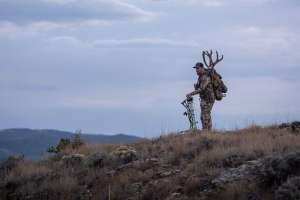

When you spend countless hours sweltering in a ground blind as the temperature approaches triple digits, your mind tends to wander. After the first few hours you go into siege mode, and it’s easy to start thinking weird thoughts. You know, stuff like, Why is it that the closer to the horizon the moon gets it appears larger, but the closer to the horizon a ball gets, the smaller it looks? Or, How did the Vikings, in those little ships with no charts, no GPS, no maps, no tide tables, crappy food and not enough fresh water, successfully and safely navigate the North Sea, using only the stars — but I can’t find my keys? Things like that.
The last week of August 2024 found my buddy, Grand View Outdoors President Derrick Nawrocki, and me occupying different ground blinds near Douglas, Wyoming, hunting with Table Mountain Outfitters, an excellent outfit with whom I have hunted many times over the past two decades. We were both hoping to have big pronghorn bucks come to get a drink and offer us a close-range opportunity.
Bowhunting like this is a little different than sitting in a blind or treestand in pursuit of deer or elk, in that these other species all tend to move best early and late in the day, with little action expected during the midday heat. Pronghorn? They’re morning and evening animals, too, but they tend to wander around the prairie at all hours during hot weather — especially to get a quick drink. You’re just as likely to get a shot over a waterhole at midday as you are at sunrise or sunset. And so, you sit and wait.
For Derrick it was over quickly, and he tagged out day one. For me, it was a slow 12-hour day. All I had was a couple of small groups of does and young ones come through. In our camp of 12 hunters, seven hunters tagged bucks the first day.
The next day us unlucky hunters were at it again. All the others were done by noon, and when it got to be two hours before sundown, and I still had not had a good buck show up, Keeden Denny, son of TMO owners Scott and Angie Denny, picked me up in his truck.
“Let’s just go shoot one,” he said. And so, off we went, spotting a good buck right off, and parking the truck below a small rise. I hopped out and made a quick, circular stalk that took about 30 minutes, giving me a 35-yard shot. Boom! The camp was now 100 percent tagged out.
Such success is not unusual when hunting with a top-notch outfit on private land when employing blinds over water or a high-quality food source.

The Magnificent Pronghorn
I’ve been pursuing pronghorn with firearms and bows since the 1970s, and it is truly one of the hunting trips I love most. And while I enjoy rifle hunting, it is bowhunting Antilocapra americana that really gets my juices flowing.
First, a question: Why do some people call them “antelope?” Even the Wyoming hunting regulation booklet refers to them as “pronghorn antelope.” Pronghorn, however, are not related to antelope, goats or sheep, but instead are the sole remaining member of an ancient artiodactyl (even-toed, hoofed) family dating back 20 million years. As such, they even are their own scientific genus.
They are also the second fastest land mammal in the world — only the cheetah is faster — able to attain speeds of nearly 60 mph over short distances, and able to hold half that speed for miles. They have adapted physically for this, with long limbs, lightweight bones, a small digestive tract to use less energy during locomotion, and large tracheae, lungs, and heart for rapid intake of oxygen and increased rate and power of circulation. They have pointed double hooves, with cartilaginous padding to cushion shock when running over hard ground and rocks, with the front hooves larger than the back ones that carry most of the weight while the animal is running.
Historically, pronghorn have ranged from southern Alberta and Saskatchewan south to northern Mexico, and from the Mississippi River and Gulf Coast of Texas in the east to California and Oregon in the west. Today, the highest populations are found in Wyoming and Montana. They are found primarily in shrub lands, Mediterranean-type shrubby vegetation, grassland and temperate desert — though deserts support less than 1 percent of the population — and are associated most frequently with treeless, flat terrain, and short-grass prairies. They are also found in steppe-like terrain with vegetation ranging 5-30 inches in height. Animals have been found from near sea level to 11,000 feet elevation, but most live in elevations ranging from 3,000-8,000 feet.
Both sexes have horns — not antlers. Male horns range from 10-20 inches in length, though an “average” buck will have 12-13-inch horns, and anything measuring over 16 inches is considered truly exceptional. Female horns rarely exceed 4 inches. The horns are fully developed by 3 years of age, and are coal black and composed of a permanent, bony interior knob covered by a keratinous sheath, which is shed annually like antlers. The typical horn is lyre shaped, curving back and slightly inward near conical tips, each with one broad, short prong that juts forward and slightly upward approximately halfway from the base.
The pronghorn relies primarily on its keen sense of sight for defense. They have large protruding eyes that appear to be located on the side of the head but are oriented forward enough to allow limited binocular vision. They have the largest eyes of any North American ungulate in relation to body size; each eyeball is about 1.5 inches in diameter. They have nearly a 300-degree arc of vision without moving head or eyes, and can detect movement up to 4 miles away. They also have a keen sense of smell. Also, for many years the dictum was that pronghorn cannot jump over obstacles like fences, which they try and go under instead. Yet while they indeed prefer going under the wire, I have seen them jump barbed-wire fences more than once.
Bowhunting Pronghorn
It is this amazing vision that makes stalking within bow range of pronghorn so difficult. I arrowed my first pronghorn in the early 1980s in western Montana on a spot-and-stalk hunt where I tried all sorts of things to get a shot. I blew exactly nine different attempts before making it happen, but when it did, I crowed like the baddest rooster in the Madison River valley. I’ve been hooked on bowhunting them since.
That initial bowhunt taught me that, though it is what I prefer to do, spot-and-stalk hunting is a very low percentage game. To even have a chance you have to select broken terrain with enough folds and cuts along with sagebrush, tall cactus or other flora that can provide some cover to hide behind. Trying to stalk pronghorn in flat tablelands with little brush is like trying to sneak the sunrise past a rooster — it simply ain’t gonna happen. Generally there are a lot of animals around, and if even the smallest yearling sees or smells you, then the alarm is sounded and it’s all over. And just because they can see like they have Superman’s X-Ray vision don’t think they won’t smell you, because they will, so make sure the wind is right.
Also, stalkers should be prepared to shoot at extended distances, which most archers truthfully cannot. I have a good friend last season who killed a buck at 72 yards after a successful stalk — but this young man shoots almost every day and can make that kind of shot pretty much every time. Most bowhunters cannot. And you often have to deal with windy conditions, a common occurrence in pronghorn country.
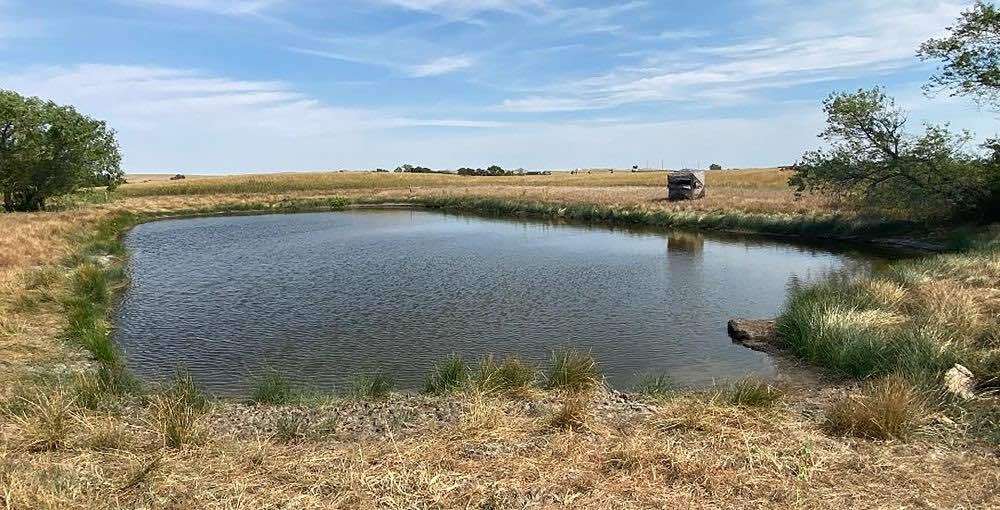
For this reason, the high-percentage way to bowhunt pronghorn is to employ something that wasn’t around when I started hunting them way back when — the pop-up ground blind. Properly employed ground blinds will hide you in the shadows, allowing you to draw and shoot unseen at a calm animal that’s ideally stationary and broadside with its head down drinking. I like to set my blinds so my shot is somewhere between 15 and 30 yards, and before hunting I do a lot of practice shooting from the same chair I’ll be sitting on while in the blind.
Unlike whitetails, pronghorn don’t seem terrified by a pop-up blind that’s been erected near a favorite water source a day or two before you hunt it. Still, I prefer to scout water sources early using scouting cameras and/or glassing from afar, setting a blind up on water that’s being used frequently by a buck I want, then give it a few days before hunting it if I have that kind of time.
My buddy Jim Velasquez did just that back in 2018 when, after decades of applying, he drew a California pronghorn tag. On public land he found a waterhole that pronghorn had tracked up, so he set a ground blind and, mid-morning on day two, arrowed a dandy buck with his recurve.
When the animals are rutting, using a life-sized buck decoy can often bring a territorial buck on in a big rush. When it works, I have seen them come running as fast as they can from a half-mile, stopping in a cloud of dust anywhere from 10 to 50 yards away and stare at the intruder. Your job, of course, is to get the bow drawn while hidden behind the decoy, then rise over the top and shoot before the buck turns himself inside out to escape. The biggest problem with this technique is the buck is alert, looking in your direction and probably facing head-on, all of which increase the chance of the animal jumping the string, resulting in a miss or worse — a poor hit.
One final note: Just because they’re relatively small, never underestimate their toughness. One of the toughest animals I have ever hunted, they are extremely tenacious, and if hit poorly, will run like the wind and refuse to go down. So take your time when making your shot.
Final Thoughts
Pronghorn hunts are a great “starter” hunt for those who have never hunted the West but want to. There’s lots of public land hunting available for the DIY hunter, though in states where tags are plentiful, expect stiff competition from others. In terms of guided hunts, prices are much less than deer and elk hunts, and success rates much higher. As a bonus, the meat is some of the tastiest you’ll ever try. So why not give it a go?
Sidebar: Gearing Up
All good outfitters will provide you with a list of essential gear to bring. If you’re going to be hunting from a ground blind in hot weather, there are some little things that will make your hunt more comfortable, including reading material, a compact power pack for keeping your phone charged so you can kill time playing games, snacks, a small cooler with liquids, and toilet paper. When driving to camp, I bring my own blind chair because I’m used to shooting from it and I know it’s in A-1 condition.
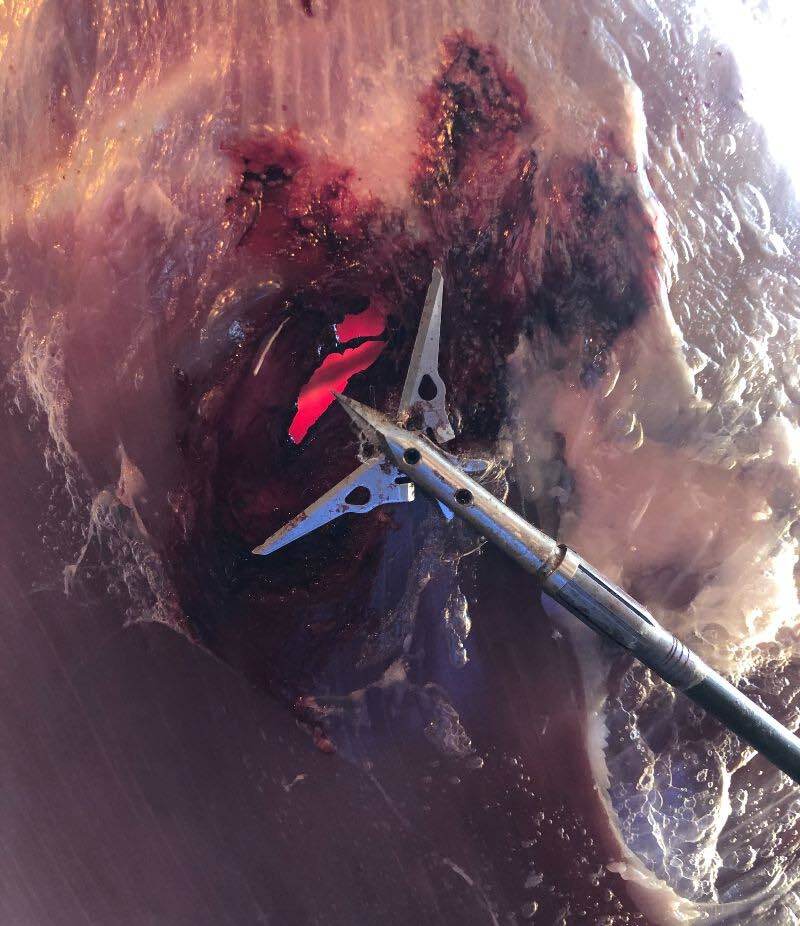
In terms of archery gear, your whitetail hunting rig will work just fine. On this hunt, I field-tested both the new SEVR 4-blade mechanical broadhead with devastating results, and employed a Burris Signature HD LRF 10x42 Laser Rangefinding Binocular for both glassing at dialing up the distance. It’s a great product, and a laser rangefinder of some type is essential.
On spot-and-stalk hunts, two things I never leave home without are sunblock and camouflage that will completely cover every inch of my body, especially hands and shiny face.
If I’m flying, I will pack my bow, arrows, broadheads and accessories in a soft bow case inside a hard case along with whatever else I can cram in there, and my clothing in an ice chest with a duffel bag inside. That way, I will have a way to bring my meat home as excess baggage — a cheaper option than having it processed and shipped later.

Sidebar: What Do Outfitted Hunts Cost?
While the cost of guided hunting has gone through the roof in recent years, pronghorn hunts remain relatively reasonably priced. Most outfitted hunts conducted from ground blinds over water in states such as Wyoming and Montana, where tags are drawn through the general drawing process, last 3-4 days and run $2,500 to $3,500, plus license and tag. In states where landowner tags are involved, like New Mexico, the cost will be substantially higher, though trophy quality can be a bit better. And in “big buck” states with hard-to-draw tags like Arizona (I am currently sitting on 24 preference points and haven’t drawn yet), costs will escalate.
Sidebar: Pronghorn By The Numbers
- Scientific name: Antilocapra americana. The name means "antelope-goat," but it is not related to antelope, goats, or sheep, but instead the sole remaining member of an ancient family dating back 20 million years.
- Height: 35-41 inches at shoulder
- Length: 49-57 inches
- Weight: Bucks: 90-140 pounds; does, 75-105 pounds
- Color: Upper body, outside of legs a pale or reddish-tan; sides, chest, belly, inner legs, rump patch white. Two broad white blazes across the tan throat. Cheeks, lower jaw white. Bucks have a broad, black band from the eyes down the snout to a black nose, neck patch. Short erectile mane, about 2.5-4.5 inches long.
- Horns: Bucks (mature): From 10 up to 20 inches in length, although any over 16 inches are exceptional. Horns are lyre shaped, curving back and slightly inwards near conical tips, which may be polished an ivory color. Each has one broad, short prong jutting forward about half-way from the base. Does: no more than 3-4 inches long, with no prong. Horns -- not antlers, but true horns -- are made from keratin (as are human fingernails.)
- Habitat: Grassland; grassland/brushland mix; bunch grass-sagebrush areas. In most areas, sagebrush is the most important browse. Grass is used to a lesser extent, but important in spring. Alfalfa is a favored food when available.
- Water: Amount needed depends upon availability of succulent green vegetation and season. One California study showed a daily consumption rate of 0.34 quart/day in May, and 4.8 quart/day in August.
- Range: Southern Alberta and Saskatchewan south to California, Arizona, New Mexico, and West Texas, northern Mexico. The Missouri River marks a general eastern geographic boundary, with populations extending west in California and southern Oregon.
- Activity patterns: Mostly crepuscular, but may be active day or night. Peak feeding time is shortly after sunrise and shortly before sunset.