
The phone rang and my buddy Jimmy said, “You bored this weekend? I know just how to liven things up — let’s go call in a big black bear!” I thought he was nuts. Now, we’d spent many a weekend in the southern Arizona desert calling coyotes and bobcats, but black bears?
This was more than three decades ago, when I was a true black bear hunting neophyte, a guy who had shot a handful of bears but really didn’t understand what it takes to become a serious bear hunter. But I was game for anything to do with predator hunting, so off we went. That evening found us overlooking a giant patch of Arizona’s semi-desert foothill country. I had never thought of such an area as being a good place for black bears, but in truth this region holds some of the country’s biggest bears. Jim assured me that there were several good bears there.
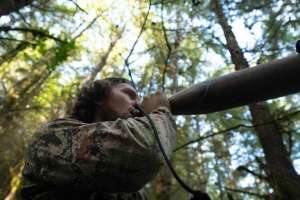
We glassed for a while and didn’t see anything, so Jimmy began using his dying rabbit predator call. It was just like calling coyotes. We were camouflaged up and ready to have at it. About 30 minutes later, a very large black bear showed itself. I couldn’t believe it! The bruin made a beeline toward our station, sniffing the air and leaving no doubt what was on its mind — supper — and we were on the menu! The closer it got, the more its hackles stood at attention. This guy was ready to rumble!
When the bear went out of sight at the base of our hill, Jim stopped calling and picked up his .30-06. I had my bow, and was starting to get worried. It was deathly quiet when, all of a sudden, the bear popped up not 20 yards away, heading right for Jimmy. I drew my bow and shot it through the chest, which diverted its attention from my buddy, who had the rifle up and the safety off. The bear whirled and ran down the hill, where it expired.
Both Jimmy and I were shaking like leaves. “Holy mackerel, Batman!” I said. Or something like that. “This bear calling can be scary!” My friend just shook his head and grinned. “Yeah,” he said. “When they come to the predator call, they are not making a social visit. They are ready to eat the caller!”
A decade or so later, I moved to Alaska, where black bear hunting became a real passion. Limits were generous and the bear population huge, so opportunities abounded to experiment with different hunting techniques. I ran bait stations and did spot-and-stalk hunts from boats along the coastal tidal basins as well as foot-slogs deep in the mountains. A couple of calls always came along, a dying rabbit and a fawn bleat. I learned a lot about calling bears.
Calling Black Bears
Yes, black bears can be called, and it makes little difference if you are pursuing Ursus americanus in Eastern hardwoods, over bait cached in the Canadian bush or along the mountainous slopes in the Far West. And it can be more than a little exciting; in fact, it can be downright dangerous, if you’re not buttoned up. I learned right away that you never call bears just for giggles. When they come to the call they want to find the critter making those sounds and eat it. Pretty much every time.
They’re omnivores, really little more than giant food processors that will eat just about anything, including lots of meat whenever they can catch it or find a fresh carcass. As an example, research has shown that black bears are the No. 1 killer of newborn elk calves in many Rocky Mountain areas. In areas where there are lots of rabbits, they will come to the dying rabbit call as readily as any predator will. And the fawn distress call can be a bear hunter’s secret weapon, as I first learned when hunting them in Alaska.
Like all game calling, bears will not come to the call every time they hear it. I have also found more success by first spotting a bear at long distance, then calling it to me, than calling blind. The exception is if I know there is a bear in the area, in which case I might try some blind calling. I have also noticed that bears lose interest in the call quickly. By that I mean that as long as you are calling they will come to you. Stop blowing the call, however, and they are just as apt to sit down as keep coming. Steady calling is important. And of course, where legal, using your e-caller can be magic.
Because black bears are curious creatures, I’ve found you can call them up with odd things, too. One time I was sitting in a treestand in the Finger Lakes region of New York state, bowhunting whitetails. I tried some rattling, and when I heard a branch break I got pumped up. It was not a big buck, however, but a big black bear! It walked past at 20 yards, went down the deer trail and stopped. I used the grunt call, and its ears perked up. Then it vanished, and I thought it was all over. Next thing I knew, the bear was right under my tree, looking up at me! Fortunately, I was able to shoo it off. Now when I call black bears while bowhunting, where legal I always have a “hammer” with me. You know, a large-caliber handgun, rifle or pepper spray.
It should go without saying that keeping the wind right is everything in this game. Black bears have an incredible sense of smell, and their hearing is acute as well. When moving to a calling location, I treat the approach as if I were hunting the wariest whitetail or coyote, moving in silently and always checking the breeze. If it’s not right, I back off. You cannot fool their nose. Ever.
Wanna give it a try? Here are 10 tips that will help you become a successful black bear caller.