
It had been one of those marathon mornings. Into my favorite bigwoods rut stand in the inky pre-dawn, with no deer encountered on the long, winding hike in. Avoiding deer was no small victory in this spot near a prime aspen-regrowth bedding area, and I grinned at the thought on the way up into my stand. My trap was set. But now, about 10 a.m., the calm, clear and crisp morning was lacking one very important ingredient: deer.
With no special sights or sounds to quicken my pulse, I passed the morn daydreaming about all the other more-productive places I could, or should, be hunting. Little did I know things would change dramatically after just one more hard-fought hour. And how.
I’m not fanatical when it comes to hunting favorable moon phases—typically I hunt hard when I can. But the previous evening’s check of the forecasted moon phase info in my HuntStand app showed the day’s peak game activity stretching from 11 a.m. to 2 p.m. Knowing this, I vowed to give it to at least noon, maybe even 1 p.m., before any stand switch.
The activity forecast proved eerily accurate. Just 5 minutes after 11 a.m. all hell broke loose. First a pine squirrel came bolting out of the woods and up the tree next to me, 2 feet away, its loud scolding piercing the silence. Two minutes later I jumped again. Sudden, crazy-loud thrashing had erupted from the thick aspen stand just to the east. An unseen buck had snuck in and was battling the brush not 20 yards away!
I had just enough time to grab my bow from its hook, pivot on stand and draw — as the corner of my right eye caught a brown blob topped with serious headgear. I’d bent sharply at the waist and held steady as the rutty buck disappeared again — hidden behind the neighboring pine. Then, more heavy footfalls as the buck strode directly toward me. There was just one thin trail down there and so that’s where I held, as a deer brisket suddenly appeared — then stopped. He was right below me. I recall pivoting to my right, watching the sight pin move slowly from brisket to shoulder to chest, then pausing. The buck was 3 yards away.
At the shot, mayhem. First the solid thunk of a good chest hit; the buck whirling, crashing, sprinting back 15 yards, maybe 20 — then hitting the brakes. It staggered and stumbled, paused a good while, then limped, slowly, away down the trail. Soon it was out of sight, swallowed by the thick aspens. Glancing below me I caught the glint of my shiny arrow, stuck vertically in dirt and painted a glistening bright red.
Hunting bigwoods deer has been a passion of mine since I first began whitetailing some 40 years ago, and the excitement still hasn’t waned. I know I’m not alone. As proof, I spoke recently with three bigwoods fanatics willing to share their hard-earned secrets for success.
Kyle Herr
lthough relatively new to the bigwoods game, Herr, 42, has caught on quickly, and it’s no wonder. I’ve written before in these pages about Kyle and his father Mark, both of whom are masters at ambushing trophy bucks in suburban settings—skills honed on the outskirts of their hometown, just outside sprawling Minneapolis, MN. But a relatively recent move has given Kyle easy access to the big woods of both Minnesota and Wisconsin, and he’s been making the most of it.

“For me, goal number one is getting away from pressure,” Herr said. “I’m looking for areas where bucks are comfortable moving in daylight; I just don’t want guys walking in and out to affect the deer in my area. And in those big woods areas it’s not necessarily deer hunters. If an area is getting heavy pressure from grouse hunters, I think mature bucks avoid those areas. And if they can’t, in my opinion, it’s likely they’re going to be nocturnal.”
To find prime isolated areas Herr studies maps and takes note of any roads or two-tracks that might allow too-easy access; he also notes areas where ATV use is prohibited, a definite plus.
Natural Funnels in Hilly Terrain
“I’m also looking for terrain features that will funnel deer into your lap; I really like hilly terrain,” Herr said. “When you have plenty of steep hills with ravines and washouts, those things not only keep out other hunters, they help predict where deer will be traveling. I’m a big fan of isolated ridges that neck down, with fingers that shoot off into the bottoms. If you can get an area where a few of those fingers come together, those are good areas. During the rut bucks will be cruising for hot does along the downwind sides of those fingers, beginning late morning, once the local does have bedded down.” In flatter terrain Herr looks for prominent edges, including the edges of isolated balsam thickets and ash swamps. Another favorite is beaver dams. “Cruising deer just seem to be drawn to those wetland areas with beaver dams,” Herr said. “If you have two big chunks of woods separated by a swamp, the deer will travel those swamp edges and they’ll typically cross over at any available beaver dam. I’ve killed a couple bucks like that.”
Aaron Warbritton
Warbritton, 36, of Missouri is one of 10 hunters who comprise The Hunting Public team that chronicles its hunting adventures on YouTube. One goal is to show others that “everyman” work-a-day hunters can score big on both public and private lands.

A good part of figuring out successful hunting strategies in the big woods and other remote stretches, Warbritton says, comes from familiarity with how bucks relate to specific terrain features. And the more you hunt a certain area the more helpful intel you uncover.
“Every hunt we make we go into with an open mindset, and try to learn about it,” Warbritton said. “And that type of optimistic, curious attitude creates a snowball effect. Over time, you keep gathering info and data on an area, and eventually that puts you ahead of everyone else.
“The hunter that’s been there for 40 years, those are the ones who are going to have the knowledge to get around that area like no one else. It’s a big advantage.”
Warbritton says learning an area with maps is great, but there is no substitute for boots-on-the-ground scouting and research.
On-Site Scouting Points the Way
“There are all kinds of factors, and fine details, that you can only see by being there on site,” he said. “Time spent out there is learning, and if you go in there with that mindset, and ask yourself, ‘What did I learn today?’ There are all kinds of details you’ll discover that can be important to success.”
Warbritton knows that big woods hunting can be daunting to some, and many times, simply require some good old-fashioned hard work. If you need inspiration, it might be helpful knowing many hunters aren’t willing to expend the extra effort required in the big woods.
“Sometimes we try to work harder, and sometimes we try to work smarter,” Warbritton said. “Ultimately, it’s all about the landscape and the holes that are in it. We’ve had some great hunts that were within sight of the parking area, that most people walk right by. It might be a thicket that can hold only two-three deer, but if a doe in heat is in there it can hold a great buck.”
Brad Kuhnert
Kuhnert has lived in far northern Wisconsin for the past 40 years, and has bagged some very impressive bucks there. Now in his 60s, Kuhnert has worked with Lone Wolf Custom Gear to develop a saddle-hunting platform he perfected in the bigwoods, and this year they’ve introduced an all-new saddle harness he believes will greatly simplify that specialized pursuit.
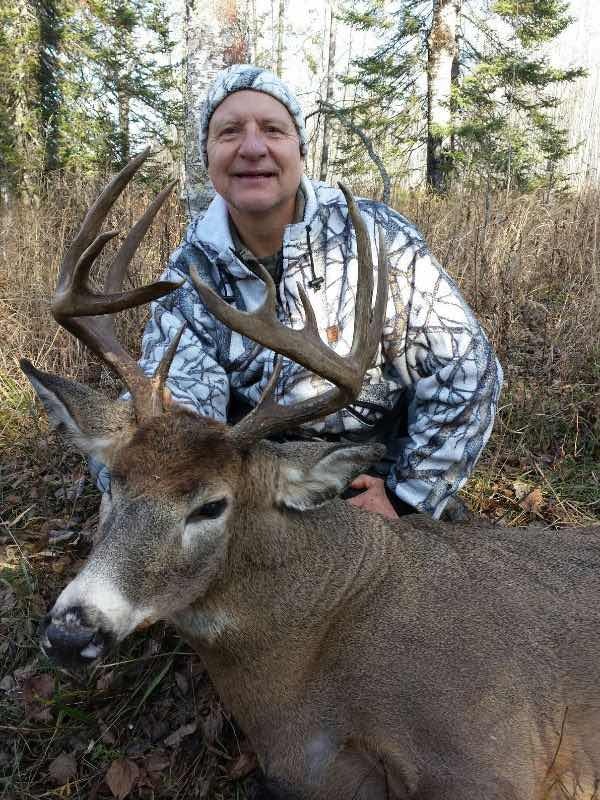
Like many big-buck experts, Kuhnert is adept at reading sign, and he knows the difference between hunting where you have your best chances for success, versus where a tree will let you. That’s why Kuhnert was a pioneer of saddle hunting back in the 80s—a tactic he continues to promote today.
“A lot of the areas I was hunting in northern Wisconsin, were slashings [clearcuts] next to hardwoods, and out in those slashings it’s hard to find a tree that can support a hang-on,” Kuhnert explained. “But with a saddle and small platform, I can get in most any tree in the woods.”
Kuhnert says ultimate stealth is a huge factor in ambushing cagey mature bigwoods bucks, and smart access that prevents the local deer from knowing he’s around is critical.
“Once I find an area I want to hunt, one of the key things is getting in and out undetected,” Kuhnert advises. When locating those prime areas Kuhnert leans on his well-honed ability to read and interpret available sign. “What I like to do is narrow down a spot, from everything that I can see, where my best shot at this buck will be within a 100-yard area,” Kuhnert said. “Once I narrow that down, then I’ll see, what is my best access?”
The next step for Kuhnert is setting up three to five stand locations, which consider all wind directions. “Then I’ll hunt that area, day in and day out, especially in the pre rut. Up here, I believe bucks are on a three to five-day cycle, or rotation, through their core area, and you’ve just got to wait them out.”
One of Kuhnert’s tell-tale signs that he’s found a mature bigwoods buck is track size. And although you likely can find hunters who believe large tracks don’t automatically equate to a large buck—or even a buck versus a doe—that’s not been Kuhnert’s experience. In Kuhnert’s bigwoods haunts big tracks mean big bucks, and once found it’s time to piece together preferred trails and travel patterns.
A Favorite Strategy
Many hunters struggle with bigwoods stand placement, but Kuhnert uses a unique strategy to tip the odds in his favor. In the spring, when he finds what he believes is a big-buck trail, Kuhnert will use downed branches and logs to block a portion of the trail, to force the deer using it to travel north and south for several yards. “The reason I want the buck to travel north and south, is because the prevailing wind in my hunting area is from the west,” Kuhnert explained. “So I can set up on the east side of that trail but if things change I can just take my saddle and in 10-15 minutes, move to the west side. You don’t often find areas where those big mature deer are traveling crosswind, but with this setup I have a real advantage.”
Patience Is a Must
Kuhnert stresses there are few shortcuts to big-buck encounters in the big woods, and patience is critical. “When you hunt the big woods you’ve got to be willing to not see deer every day, but still have confidence that if you did your scouting right, things will happen,” Kuhnert says. “I’ve always believed that if I was in a well-chosen stand from morning to dark, for five days in a row, I would more than likely see the deer I had targeted.”
Late Can be Great
Logging many hours on stand in the big woods during the rut—for several consecutive days— can test the mettle of the toughest hunters. By late November physical and mental burnout can be a real factor. But if your tag remains unfilled Kuhnert warns against hanging up your big woods gear too soon.
“After the gun deer season the second rut can hit around the middle of December,” Kuhnert advised. “This is a great time to be out bowhunting, for several reasons. There is very little hunting pressure at this time, and the bigger bucks seem to be up on their feet feeding more during daylight—and they’re looking for those last does that haven’t been bred.”


Final Thoughts
Are you ready for the bigwoods challenge? Take heart that it will likely be a rollercoaster run of highs and lows, but in the end, if you do your part, as satisfying a hunt as there is. Case is point is my recent buck encounter detailed earlier. Despite what appeared to be a slam-dunk recovery, the hard-hit buck had other ideas. After bumping the deer from its first bed, the blood trail petered out and the deer moved further into the surrounding sea of cat-hair thick aspen regrowth. After combing the area for most of 2 days and coming up empty, my travel schedule prevented more searching, but redemption loomed.
In March I returned to find the cleaned carcass and heavy, palmated 9-point rack of that 5.5-year-old bigwoods buck; the area was so thick I’d walked within 30 yards of its final bed a few times in the days after it was shot. Then another surprise: I soon recognized it as the same buck I’d captured on trail camera 2 years previous, as an impressive 3.5 year old. It remains one of my favorite bowhunting trophies, and I’ll be back out there this fall looking for another.
Sidebar: Proven Bigwoods Gear
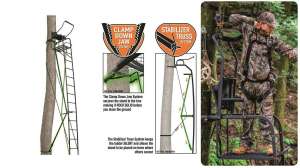
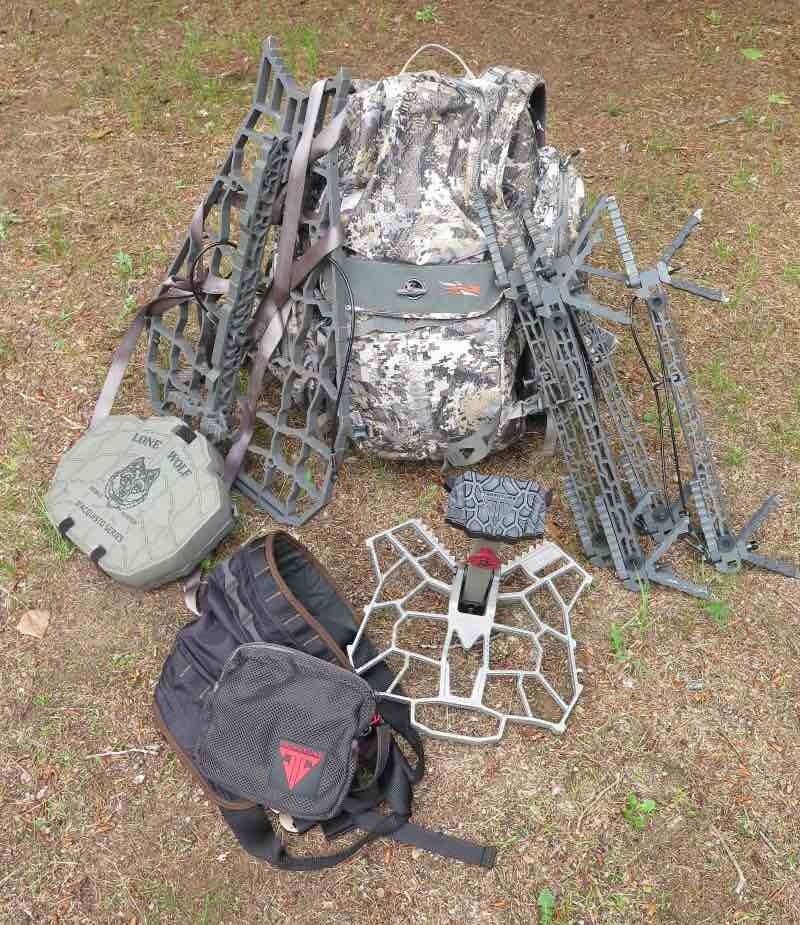
Like many whitetailers I like to stay mobile when hunting bigwoods areas, which means compact hang-ons and climbing sticks, and saddle systems (photo above).
One of my all-time favorite hang-ons, a great mix of compact roominess and light weight, is the Lone Wolf Custom Gear D’Acquisto Series Hang-On 1.0 ($599.99), which weighs 8.1 pounds and is constructed of 6061 American Made Metal. Those looking for further weight savings should check out the company’s similarly constructed .75 Hang-On (7.5 pounds) and .5 Hang-on (5.8 pounds). I pair my 1.0 with LWCG Compact Climbing Sticks ($109 each) that I also use with my saddle.
When I need a truly ultralight option, over the last couple seasons I’ve been very impressed with Trophyline’s Venatic Saddle ($319.99), the lightest and most comfortable I’ve used. I simply wear it while on the way to where I’m going and half the time forget it’s there. The ultralight ripstop fabric is so thin it almost appears fragile, yet is tough as nails.
I’ve been pairing my Venatic with the Trophyline EDP Platform ($189.99) that’s another good mix of light weight (3 lb. 13 oz.) and compact size (13.5 wide by 13 inches deep).
For hauling around either stand/saddle option I’ve been impressed with the roominess (2,200 cubic inches) and versatility of the Sitka Cargo Box pack ($419.99). With 23 storage compartments you have room for all your hunt accessories plus rain gear and lunch, but I really like the unique way this smart design holds either a hang-on or saddle platform in comfort and silence, while easily toting four climbing sticks.