
Bowhunters who pursue wild turkeys must choose whether they’ll aim for a bird’s head/neck or another part of the body (lungs, drumsticks, etc.). This decision drives the choice of broadhead. (Click here to read my article on why I prefer head/neck shots.)
Prior to 2026, every turkey I’d killed with a head/neck shot was with the proven 125-grain Magnus Bullhead. This spring, however, I tried a new broadhead called the Dirty Bird from G5 Outdoors.
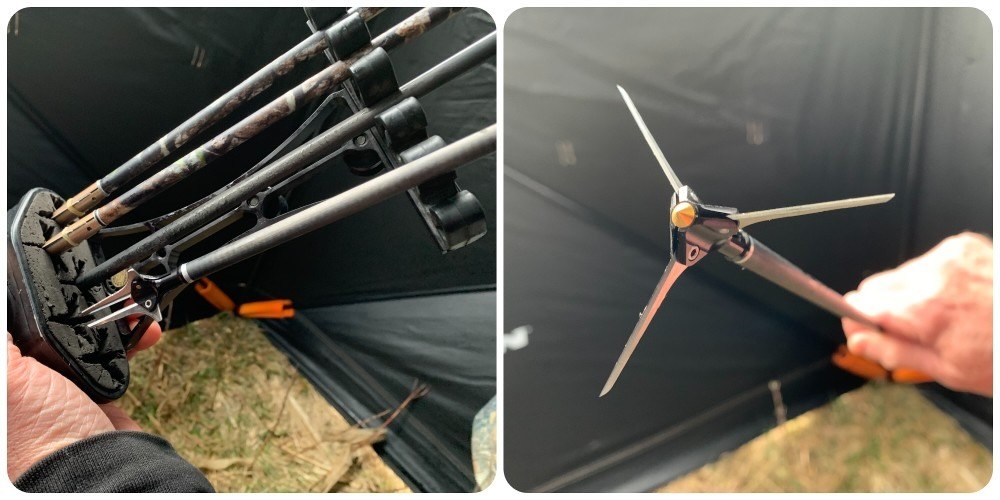
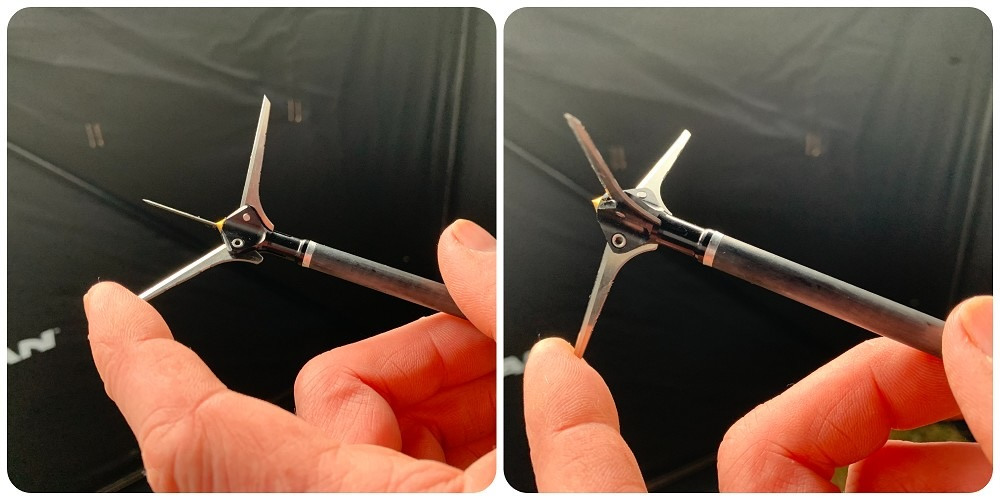
Developed in collaboration with well-known bowhunter Chris Bee, the 125-grain Dirty Bird from G5 Outdoors is the only decapitation-style broadhead on the market featuring a Magnetic Retention System. This innovative design enables you to store the closed three-blade broadhead securely in a standard quiver and then manually open the blades when it’s time to hunt. A blunt-impact tip and three razor-sharp stainless-steel blades (replaceable) produce a 3-inch cutting diameter.
The Dirty Bird was in development/testing for 2.5 years, and the results I saw on a couple of YouTube videos looked impressive. I was excited to give it a try during spring 2026.
First Impressions
To be honest, my first impressions after opening the two-pack were mixed. The 125-grain Dirty Bird appeared to be well-made, but I was surprised at how much smaller the cutting diameter was compared to a 125-grain Magnus Bullhead. The Dirty bird has a 3-inch cutting diameter while the Bullhead is 3.75 inches. That might not sound like much, but when you hold them side by side, it’s noticeable. A 3-inch cutting diameter is still very large, however, and at the distances I shoot at turkeys with a bow — 7 to 12 yards — I was confident I could hit a bird’s head/neck area.
I immediately loved how the Dirty Bird fit into my quiver due to the folding blades. And prior to my hunt, I did take one practice shot with the new broadhead into a specialized target to confirm it flew well from my bow. For an arrow, I choose a full-length, four-fletched (4-inch feathers) Victory 300 Elite arrow (spine for 55-65 pound draw weight).
By “specialized target” I mean a homemade one that doesn’t damage broadheads designed for head/neck shots on turkeys. Watch YouTube and you’ll see a few different DIY target ideas.
My DIY target is easy, fast, free and works great. I save an empty water softener salt bag, stuff it full of packaging material, then press the full salt bag into a cardboard box of similar size (see photo below). For an aiming point, I use a 6-inch-long piece of duct tape; it replicates the head/neck of an alert jake or tom. If my broadhead slices the tape from 10 yards, then I’m ready to go hunting. My test shot with the Dirty Bird was perfect so my confidence was high that a close-range turkey would be in trouble.

Prairie Pursuit
My good friend Bill and I were hiding in a pop-up ground blind on the South Dakota prairie. We’d seen a few toms, jakes and hens in the distance shortly after fly-down time, but nothing had wandered over to check out our decoy spread. Bill had filled his tag the morning before, so he was playing the role of Sherpa for my hunt. We’d hiked in a bit more than a half-mile to this spot, and it’s nice to have extra help when hauling a blind, chairs, decoys, bow, etc.
A couple of hours after sunrise we heard some gobbles in the distance to the north (farther onto the prairie), so Bill tried talking to them with his slate call. Finally we could see a group of six jakes slowly heading our direction, but we needed them to cross under a five-strand barded-wire fence to interact with our decoys. They weren’t fired up, and when it looked like they’d hung up at 30 yards (still on the other side of the fence), I said to Bill, “Try some aggressive purring.”
That sound changed their mood instantly! Two of the birds started looking for a good spot to dip under the fence, and soon all six birds were on our side of the fence and walking toward our decoys. They weren’t hustling but moving steadily. When the lead jake hit the 15-yard mark, I drew my bow and waited for the scene to unfold.
The group continued closing the distance until they stopped a couple yards beyond my jake decoy, which was positioned at 8 yards over a bedded/breeding hen. Suddenly, I heard a gobble rip through the wind just north of us on the prairie (out of sight), and the jakes changed their mood again.
Sensing that they’d walk away now — maybe afraid of an approaching gobbler? — I picked out a jake that was holding his head still, aimed for the middle of his neck and released the string.
The Dirty Bird broadhead hit exactly where I was aiming, and a split-second later, before the bird’s body fell to the ground, I saw the jake’s head cartwheel one way while its body went the other. In other words, the jake was dead before his feathers touched the prairie grass.
I’ve taken the heads off a few turkeys in the past, and this one, like all the others, flopped for a few seconds before expiring. The other five jakes quickly dipped under the fence and then walked away.
Bill and I peeked out a side window of the blind in the direction of the earlier gobble and we spotted two toms at 75 yards trailing a hen. Would they have come into our decoys? Probably not. FYI: I’m never one to apologize for killing a jake. Any turkey — especially with a bow — is a well-earned prize, and this one would provide fine dining for me and my family.
Dirty Bird Performance — 3 Top Takeaways
Bill and I left the blind to check out the scene. I’m not gonna lie: Killing a turkey this way results in a lot of blood on the ground, but that’s a good thing. In terms of pristine meat for the table, there’s no better way to harvest a bird.
The shot distance was 11 yards, and my arrow was laying 15 yards beyond the jake. I couldn’t believe my eyes as I picked up the arrow and examined the Dirty Bird. I fully expected at least one of the three blades to be missing, broken or severely bent. Not so.
All three blades were dirty from blood and/or prairie grass, but they were in like-new condition. I even folded the blades closed to examine them further. Again, they looked perfect.
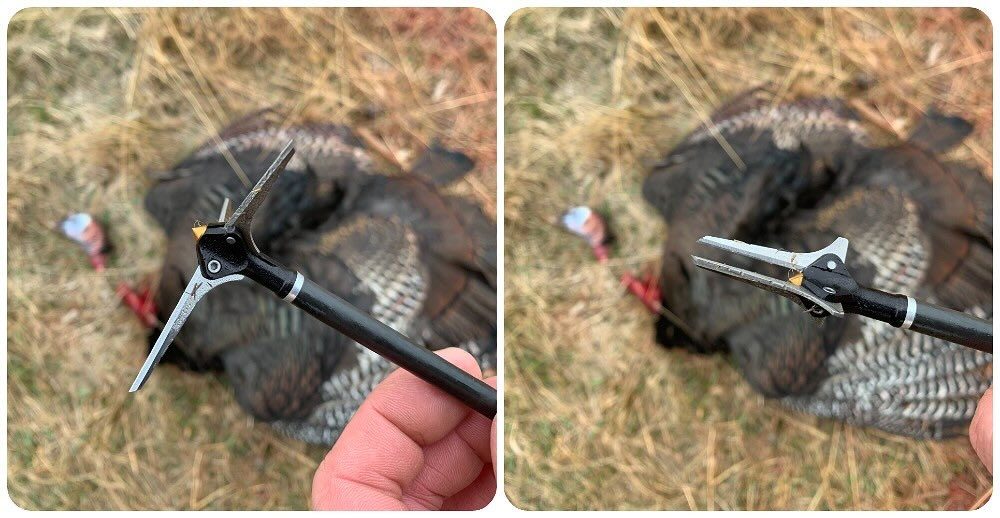
How was that possible? I’d just watched the broadhead decapitate a turkey; how could that incredible force not result in at least minor blade damage?
As the photos here show, the only way to distinguish between a brand-new Dirty Bird (never even shot into my DIY packaging-paper soft target) and the one that killed my SoDak jake (pictured) was the blood smear.
At dinner that night, Bill and I talked with our two other buddies in archery turkey camp to discuss the Dirty Bird performance. We agreed on these three top takeaways why any archery turkey hunter should give serious consideration to purchasing this new broadhead.
1: The Dirty Bird’s innovative Magnetic Retention System works as well as advertised. You can quickly and easily store the closed three-blade broadhead securely in a standard quiver and then manually open the blades when you’re ready to hunt.
2: When the Dirty Bird is opened, the base of each stainless-steel blade is supported by a “shoulder” made of the same material. In other words, the blades are narrow at the tip and midsection, but they are wider where the blades join the ferrule. This shoulder provides a super-strong base.
3: The stainless-steel blades are very sharp. And our group believes that this fact when combined with reason No. 2 (above) caused my Dirty Bird to slice through my jake’s neck with minimal resistance.
I can’t believe I’m writing this, but I feel 100% confident using this identical broadhead the next time I bowhunt turkeys. After I washed off the blood and grass from the blades, it’s basically new. Crazy!
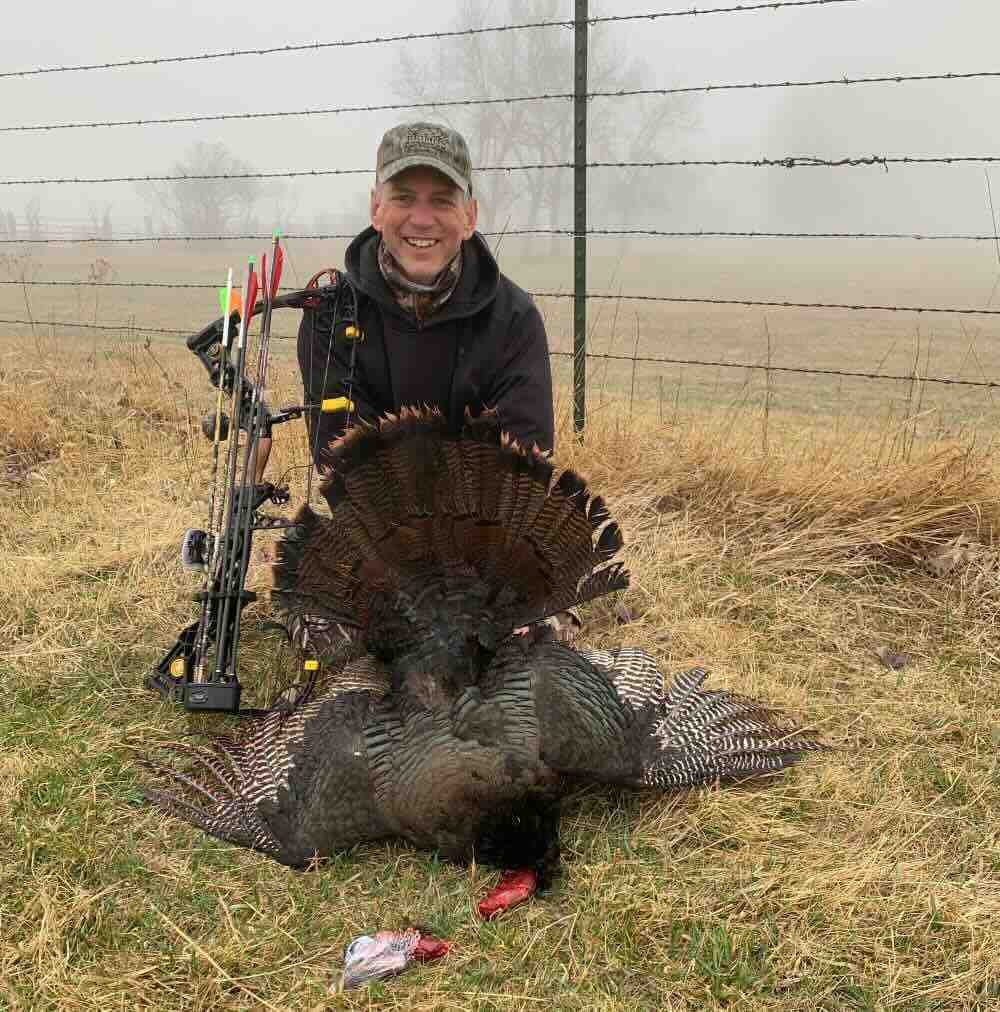
For more information on the Dirty Bird turkey broadhead, visit g5outdoors.com. They are sold in a two-pack that includes a matching 125-grain field point. MSRP: $71.95/two pack.