
Since the fall of 1999, I’ve had the opportunity to bowhunt whitetails on a wonderful half-mile-long river-bottom in South Dakota. The 160 acres includes a thick bedding area (about 10 acres) on its south-east corner, as well a few other thick pockets scattered throughout its length.
When I first started hunting the property, I made the mistake of placing treestands and building natural ground blinds everywhere I discovered good buck sign. Because two-thirds of the property is open (think CRP) and one third is forested (a spring-fed creek runs through the middle of the forested third), I was really only hunting about 60 acres. This is not a misprint: At one point in the past, I had 30 ambush sites (treestands and blinds) dotted throughout the 60 acres. Not only was I ready for any wind direction, at any time of the 3.5-month whitetail season, but I could often see three or four of my other ambush spots when sitting on a specific stand. In a word — overkill. I even had two treestands set up in the 10-acre bedding thicket.
Yes, even though I wasn’t hunting smart, I still killed some mature bucks through the years. I was over-pressuring those bucks that bedded on the 160 acres, but because many more bucks bedded in nearby standing cornfields (within a few miles), those deer were forced into the river-bottom when farmers harvested the corn. Those “strangers” hadn’t felt my pressure during September and October, so they didn’t know better. Plus, with the rut’s seeking phase kicking in in late October, then the chasing phase in early November, I couldn’t help but stumble into a close-range opportunity at a decent-size buck.
Another factor that helped “stupid me” during these early years on the property: Any bucks that lived in the surrounding wetland areas (cattail swamps, etc.), were forced to head for the forested river-bottom after significant snow arrived, typically in early to mid November. This led to even more “strangers” cruising the river-bottom looking for a doe in heat.


A Better Gameplan
It was about 5 years ago when I finally realized that hunting less was better, in addition to greatly minimizing the number of stands and blinds. No longer do I have ambush locations scattered throughout the property; now I hunt only the edges, avoiding any thick areas that might hold bedded deer (bucks or does). And I removed the two treestands from the 10-acre bedding thicket; now I call it “The Sanctuary" and treat it as such.
By “hunting less” I mean staying off the 160-acre property entirely during September and October. I’ll visit the land with a helper or two in mid August to clear shooting lanes and place trail cams, but then I won't step foot on it again until my rut vacation bowhunt, which in 2024 took place starting November 2. Those bucks that choose to live on the land during summer have no reason to abandon their home range during fall. To them, the entire 160 acres is a sanctuary, and my trail cams reveal that they feel comfortable walking around during daylight hours throughout the fall. Fact: No pressure = better hunting!
Big Buck Bonanza
Leading up to our 2024 whitetail rut hunt, my oldest son, Elliott, and I were enjoying seeing pics of numerous bucks living on the 160, including a handful of real good ones. We had two non-cell cams that wouldn’t be checked until after deer season, but six cell cams sent pics to our phones twice a day (8 a.m, and 8 p.m.). On most days, Elliott, who was away from home attending college, would check his phone app for pics before me, then send a text with attached big buck images. It was fantastic to see his excitement about our upcoming SoDak deer hunt.
You might be asking: How did you avoid the temptation of hunting the 160 during September and October, especially when seeing pics of big bucks on their feet during daylight? Well, I also bowhunt whitetails in Wisconsin (public and private land), and that’s my opportunity to share time in the woods with my dad (87), brother and nephews. I’m not sitting at home on the couch wishing I was in the woods. As for Elliott, he and his buddies are diehard duck hunters, so his September and October weekends are filled with scouting birds on public land and then grinding out a few.
And this is key: We KNOW that by staying off the river-bottom that our local bucks will be there when we finally arrive for our rut hunt. Our patience will pay off.
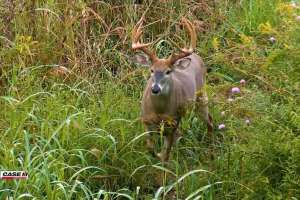
Among the handful of mature bucks that regularly showed up on our cell cams in August, September and October, two were better than the rest. Elliott would often text me pics of a tall-tined 6x5, plus a big-bodied 5x5 with good mass and numerous stickers near his brows. My best guess was the tall 6x5 was a 3.5-year-old, possibly 4.5; and the heavy 5x5 was probably a 4.5-year-old, possibly older.
Realistic Expectations
Because of his heavy workload as a chemical engineering student, Elliott could get away from college to bowhunt whitetails on 3-day weekends, but couldn’t take off a full week, which was my plan. I’d be in the SoDak woods from November 2-10, then if I was unsuccessful I’d return for November 15-17, November 22-24, and so on.
Leading up to our time in the river-bottom, Elliott and I had discussed our goals. I’ve never been a hardcore trophy hunter; I wanted to shoot one of the better bucks in the area, but wasn’t going to hold out for the tall 6x5 or heavy 5x5. I would be happy putting my tag on one of a dozen or so different bucks we’d seen on cell cams. I hoped to get a close-range shot at a 125-class, 3-year-old buck — anything bigger or older than that would be icing on the cake.
Elliott’s goal was similar. Sure, he would love to get a crack at one of the two giants, but he understood that those biggest bucks could leave our river-bottom during the rut and be locked down with a doe in heat a mile or more away.
November Magic
I passed on numerous bucks during my November 2-10 vacation, including a couple that really tempted me. I simply didn't want my bow season to end so abruptly, and I had many more November days available to hunt. Elliott was in the woods November 2-3, then again November 9-10, and he also hadn’t released an arrow. To that point, we’d continued to capture pics of numerous big bucks, including our two biggest ones, but thus far hadn’t seen either one in person.
Elliott was able to take November 15 off from school, so we traveled to South Dakota the night before for a 3-day weekend. The forecast for 15th was for fairly warm temperatures, but during the rut, anything can happen.
In the predawn darkness, I climbed into a portable hang-on stand on a steep hillside. The strong south wind would push my human scent up and out of the river-bottom, which runs east/west. My only shot from this stand was to a well-worn deer trail 10 yards south (downhill) from the stand. This stand is in a good spot, but due to the shape of the oak tree and numerous branches, the platform is only 12 feet off the ground. When deer walk the trail below the stand, they are in-your-face close!
During the morning, I had a 2-year-old 4x4 walk directly under my stand at first light, and also watched a heavy 5x5 walk behind me, higher on the hill, where the trees end and the CRP begins. I didn’t get a great look at his rack, but he was big!
I also saw a tall-tined 4x4 west of me at 75 yards; he was chasing a hot doe. He eventually disappeared into a bedding thicket farther west on the fenceline, but I was hopeful he might show up later.
At 11 a.m., Elliott and I checked in with each other via text. He was on the far east edge of the property, where I was on the far west edge; we were nearly a half-mile apart. I told him I planned to sit on stand all day, and his plan was the same. (We both packed food and water.) He had seen several deer, including one big buck in the distance. He thought it could have been the heavy 5x5 that we drooled over via trail cam pics.
By 11:40 a.m., I was thinking of digging in my pack for lunch, when suddenly I spotted a big buck standing in the creek 70 yards below me. He was facing my way (north), so he was coming to my side of the creek. He slowly walked up the hill, closing the distance to 60, but all the while I figured he’d turn 90 degrees and head west to check out the bedding thicket on the fenceline.
When he stepped behind a large tree, I stood in my treestand and grabbed my bow. He slowly climbed the hillside, walking toward me, and he was just a bit west of my location. The situation wasn’t ideal because he wasn’t on an established trail; he was bushwacking, and facing me.
He finally stopped at 20 yards, again facing me, and I needed him to turn left (west) or right (east) to offer a broadside shot. I hadn’t moved a muscle.
After 5 seconds of looking side to side, the big buck chose to go east on the deer trail right below my stand — perfect! The trick would be getting my bow drawn without him spotting me, because I didn’t have a good backdrop based on his angle.
I froze in the tree as he walked broadside, right to left, through my first wide shooting lane at 12 yards. If I moved, I knew he’d bust me.
I let him walk farther east, to my left, and when his head passed by some very thin screening brush, I drew my bow and quickly found my anchor. I won’t lie — I was quite surprised he didn’t see me move. This secondary shooting lane was narrow, no more than 5 feet wide. I swung my bow to the left to track my bowsight’s top pin on his chest, and just before he exited the lane I bleated. The split-second he stopped, my arrow was on its way. The range was only 10 yards.
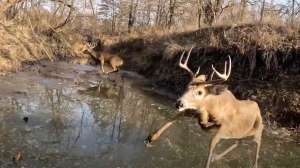
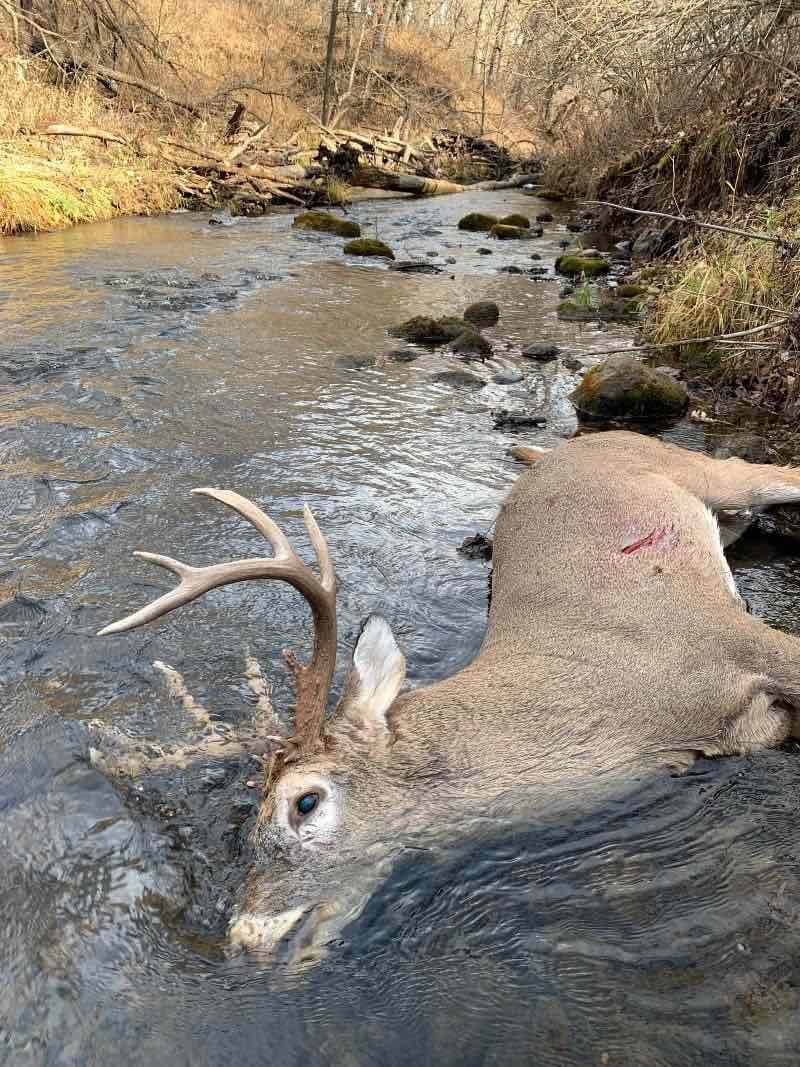
The Magnus Stinger Buzzcut broadhead sliced through him, and he fled south to the creek, quickly crossing it and climbing a mud/dirt cliff on the opposite side. I thought I could see blood on his exit side as he stood at the top of the cliff. Would he run again? Would he sneak off out of sight? Suddenly, he started to rock back and forth in place, and a moment later he tumbled backward over the cliff, crashing 30 feet into the shallow creek below.
He lifted his head once in the 6-inch-deep riffle, then it was over. Total time from arrow impact until his last breath was no more than 15 seconds.
Surprise, Surprise
Everything had happened so fast that I didn’t know anything about this buck. He had a big frame and big body, so I shot him. I never had time to look at him in my bino when he first appeared.
I immediately climbed down and walked to the creek. Was he a 4x4, 5x4?
Half of the buck’s rack was submerged, and it was only when I lifted it that realized this was the heavy 5x5 we captured on cell cams throughout the fall. I wasn’t holding out for him, but he was mine just the same.

Elliott’s Change of Luck
Because I needed help getting my buck out of the creek and out of the river-bottom, I picked up Elliott near his treestand in my truck. When we finished dragging the animal and taking photos, I dropped him off at the same stand. Total time he was gone was 2 hours — noon to 2 p.m. — but trail cams would later show that a big 4x4 had walked by his stand at 1:30 p.m. Dang!
The next day, November 16, Elliott decided to sit in the same treestand. As I waited in the truck, simply glassing the property from a vantage point on a nearby gravel road, I thought about the close-calls he’d had earlier in November. A handful of times he watched big bucks walk by nearby treestands — 60 to 100 yards from his chosen location. Just once luck had to turn in his favor, right?
I’d eaten lunch in the truck and was just about to doze off when my cell phone rang at 1:52 p.m. — it was Elliott.
“Dad, I think I shot the 6x5!” he whisper-yelled.
I could hardly believe what he was saying.
“The buck was steadily walking the half hill above me, at about 60 yards, heading toward The Sanctuary, when he turned and started coming down the hill right toward my stand. I could tell he was the big 6x5 right away. He stopped at 15 yards, facing me, so I didn’t move. Then he started to head toward The Sanctuary again, so I drew, bleated, he stopped, and I think I drilled him! My arrow is laying 15 yards from my stand. I hope I made a good shot!”
Elliott explained how the 6x5 charged up the hill and into The Sanctuary, out of sight. We waited 45 minutes before slowly taking up the blood trail, and 100 yards later Elliott walked up on the massive buck. His arrow had been perfectly placed.
I was certainly very happy to kill my heavy 5x5, but Elliott killing the tall 6x5 will go down near the very top of my favorite hunting moments. November 15 and 16 of 2024 will never be forgotten in our family!


Sidebar: One Season With the Bowtech Core SS and Accessories
I adhere closely to the “if it ain’t broke, then don’t fix it” philosophy. So changing a bow setup for me isn’t an annual affair, even though that’s certainly an opportunity as the editor of Bowhunting World and Archery Business magazines. During the 2024 Archery Trade Association (ATA) Show in St. Louis, Missouri, I tested a number of compound bows, but none of them impressed me like the Bowtech Core SS. My No. 1 attribute in a compound is silky smoothness during the draw, and the Core SS was built for this purpose — the “SS” literally means Super Smooth. In addition, I love that the Core SS has a solid back wall and virtually no hand shock. Upon release, the arrow is simply gone; hand shock is as close to zero as I’ve ever experienced.

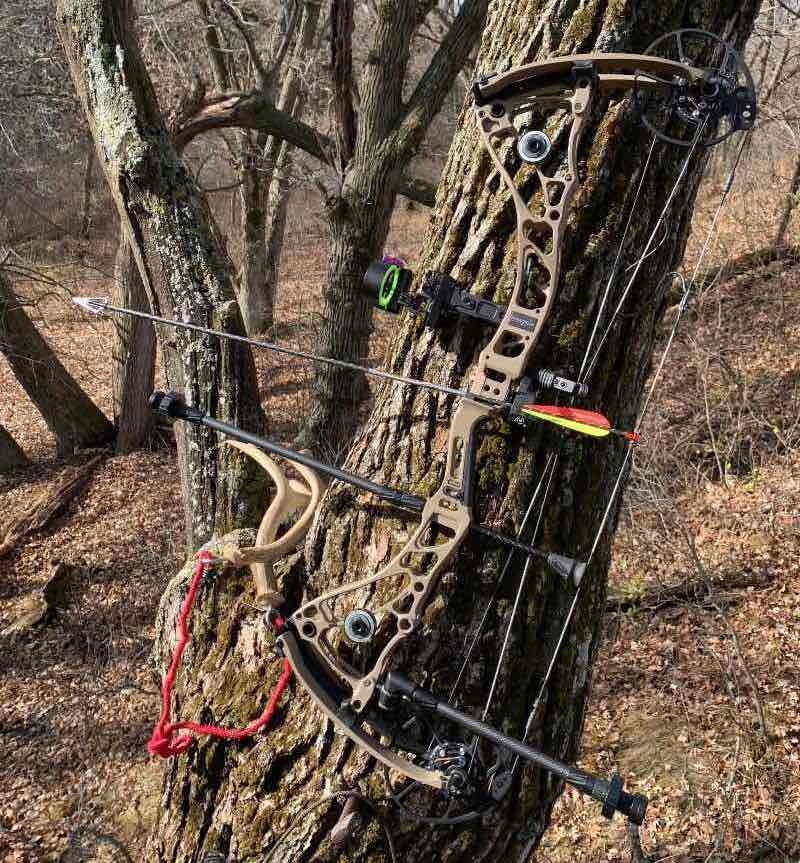
Specifically, here’s the new gear I used during my 2024 whitetail bowhunts:
- Bowtech Core SS; right hand; 60-pound; 27.5-inch draw length; color Flat Dark Earth
- Ripcord Ratchet Limb Driven arrowrest; right hand; micro adjustable; IMS mounting system
- CenterMass Pro Hunter bowsight; right hand; 3 pin
- CenterMass 4-Arrow Quiver; color Flat Dark Earth
- CenterMass Stabilizers (two); one 12-inch and one 8-inch
- CenterMass Back Bar Mount; with CenterMass mount option
- CenterMass Quick Disconnect
- Bowtech Soft Case
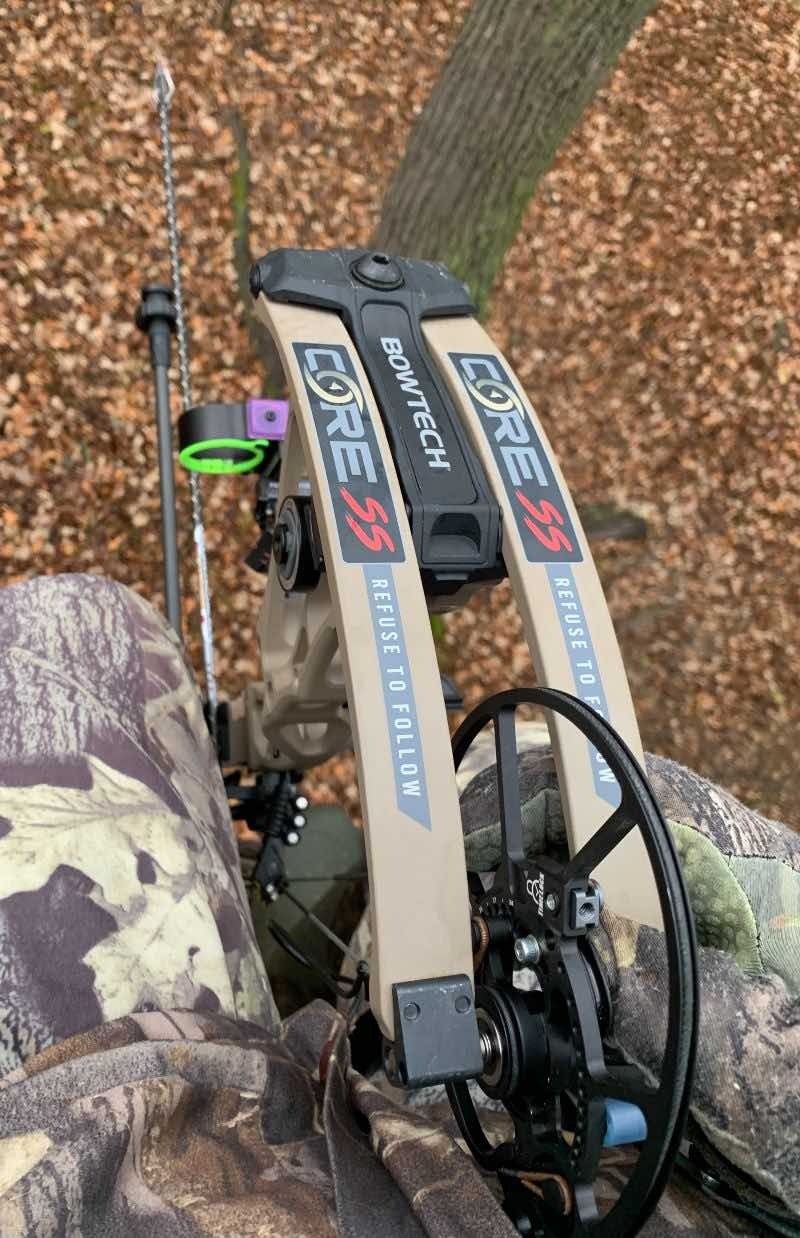
I won’t do a deep-dive into all of these components, but I will say they all worked together to deliver flawless performance at the range and in the field. A few highlights:
- The CenterMass Pro Hunter bowsight is made by Black Gold, a brand I’ve relied on for 25 years; it’s crazy-good.
- The CenterMass 4-Arrow Quiver is made by TightSpot, a brand that has won Gold in Bowhunting World’s Readers’ Choice Awards every year that I can remember.
- The Ripcord Ratchet arrowrest provided outstanding arrow flight from day No. 1 and never needed to be touched again.
- This was my first time shooting a 12-inch stabilizer in front plus an 8-inch one in back. At first, I thought I’d use the two in combo on the range, then go with only an 8-incher in front during deer season. Wrong! I shot so well with this system that I didn’t want to change a thing, and at no point did the combo seem too long or bulky. In fact, the back bar really comes in handy for resting the bow against my waist while waiting for a shooting opportunity.
- The Quick Disconnect accessory works great for fast and simple removal of the 12-inch stabilizer, which I did when placing the Core SS in the Bowtech soft case. I carried this stabilizer in the case’s front zippered pouch.
In addition to the new bow and accessories listed above, my 2024 gear list did include three products that I’ve relied on for decades — literally — namely my Scott index-style release, Easton arrows and Magnus broadheads.
- Scott Archery now offers “a modern upgrade with its new auto-return roller seat trigger” with its Little Goose RTS version. I bought my first Scott Little Goose in the late 1990s, and when it stopped functioning properly in 2015-ish, I called my identical backup release into service, then bought another new Little Goose for a backup.
- I’ve relied on Easton 5MM FMJ arrows for nearly 20 years; specifically, I use size 400 shafts, which weigh 10.2 grains per inch. (FYI: My draw length is 27.5 inches, and I pull 55 pounds.)
- Lastly, I’ve used 125-grain Magnus Stinger Buzzcut broadheadsfor as long as I’ve been using the FMJ arrows. I prefer the four-blade option. I have a buddy who is a wizard at resharpening them, which means a single head can stay in my mix for many years.