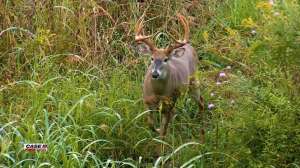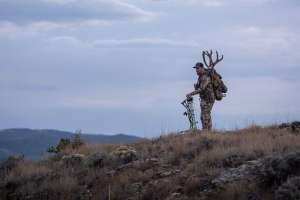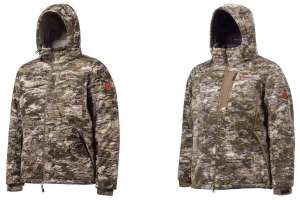

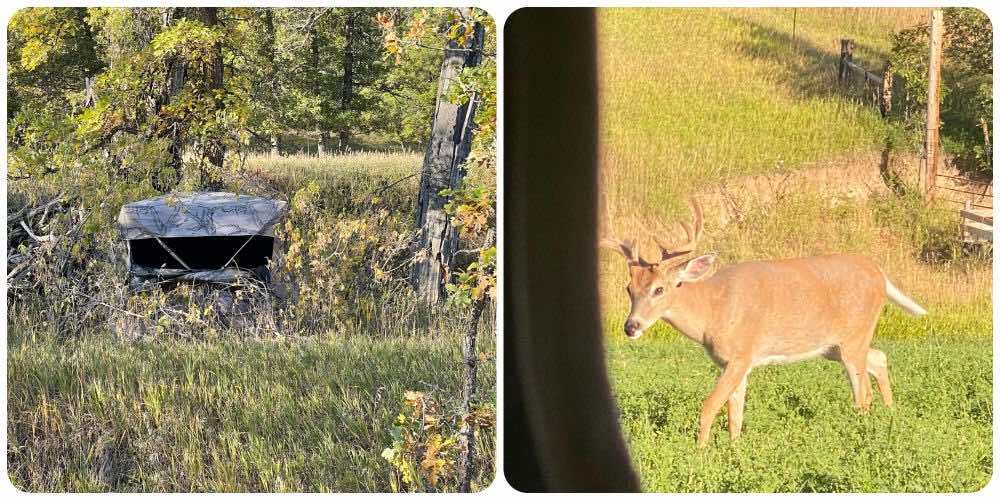
It was hot — real hot. The little thermometer attached to my daypack was approaching triple digits, and my cameraman, David Gilane, and I were stripped down to T-shirts as we sat in a ground blind baked by the Labor Day sun. And yet, Wyoming whitetails started trickling out of the woods a good 3 hours before sundown, making their way to a nearby alfalfa field. An hour later a trio of bachelor bucks could be seen back in the trees, heading our way. I nocked an arrow, they came out of trees directly in front of us at 60 yards, hit the edge of the field, and turned left — 41 yards.
“I’m on him,” David said, and a moment later I sent the arrow on its way. Just like that, we had a velvet 5x5 down. It was day one of a 5-day hunt, and the fifth straight year in which I’d taken an early season archery whitetail buck hunting this same area.
The majestic Devils Tower National Monument was visible in the distance. That, and the history of the Old West that permeates the region (the “Wild Bunch” once terrorized the area, for example), as well as the abundance of whitetails — these are just three reasons I love this place.
As someone who, for decades, has traveled extensively throughout the country bowhunting whitetails, I’ve come to understand that different regions offer different experiences. One travels to the big buck states in the Midwest, for example, looking for a dream buck with eye-popping antlers and a massive body. Texas hunters often sit in blinds or on elevated platforms near feeders. Big woods hunting in the Northeast is far different from the swamps of the bayou country. You get the picture. In most of these scenarios, one understands that success during a week’s hunt is never guaranteed; indeed, it can be relatively low.
When I want to hunt an area where I am going to see a lot of deer every stand shift, success rates are extremely high, and the hunting is more fun than drudgery, there’s one region I’ve gone back to on a regular basis — the extreme northeast corner of Wyoming. Historically, whitetail numbers here are so high you have to use extreme caution when driving after dark to avoid deer/vehicle collisions. The Devils Tower National Monument, near the towns of Hulett and Sundance — rising 1,267 feet above the Belle Fourche River and standing 867 feet from summit to base — is the de facto hub. It was the first-ever United States National Monument, established by President Theodore Roosevelt back in 1906.
Decades of Hunting the Region
I made my first hunt in this area — encompassing Wyoming deer game management units 1-6 — over 4 decades ago. In recent years it has been a near-annual trip, for the reasons described earlier. I like to hunt the early season, which opens September 1. The days are long, the weather mild (with the exception of the occasional thunderstorm and rain), and bucks are still running in small bachelor groups that can be patterned. (Click here to get started on planning your own trip.)
Deer populations remain high despite a 2021 die-off due primarily to epizootic hemorrhagic disease, or EHD. As the numbers continue to bounce back, game managers have recommended more generous hunting seasons and harvest quotas to help prevent rapid population growth. It has not been an uncommon occurrence for me to see dozens of deer every stand shift, with multiple bucks in the mix.
“We’ve had a series of pretty mild winters and no disease since the die-off,” said Ralph Dampman of Trophy Ridge Outfitters (trophyridgeoutfitters.com), with whom I’ve successfully hunted this area many times. “They’ve been coming back strong.”
Private vs Public Land
The one downside, if it can be called such, for the traveling hunter is the fact that the vast majority of whitetail deer occupy private lands. The notable exception is the Black Hills where, as whitetail numbers continue to increase following the 2021 die-off, more and more are moving onto public tracts near private land agriculture holds. That being said, success rates for public land hunters are nothing like those for those hunting the private ground. This means your best chances for success will be employing the services of a reputable outfitter — and there are many to choose from. In addition to Trophy Ridge, you can find a list of other area outfitters by visiting the website of the Wyoming Outfitters and Guides Association (wyoga.org), and searching the Casper and Sheridan regions under their “Find Your Wyoming Outfitter” tab.
For those who wish to explore public land options, there are a handful of public land hunting areas controlled by the Wyoming Game & Fish Department in Region A, which encompasses game management units 1-6, with hunting open for both big and small game. Information on all things hunting and fishing in Wyoming can be found at wgfd.wyo.gov.
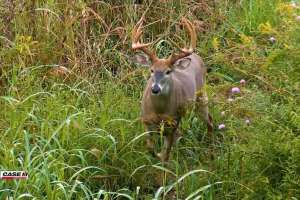
How about trophy quality? While whitetail numbers here are high, you cannot expect to take a buck with antlers the size of those you’d find in well-known big buck states like those in the Midwest. Here, a reasonable expectation would be a mature 4x4 or 5x5 buck green-scoring in the 110-130 Pope and Young point class, with the occasional larger buck taken. Body sizes are also smaller, with the average mature buck weighing perhaps 150 pounds on the hoof.

Tactics and Gear
Bowhunting tactics are pretty straightforward. Guides will have pre-scouted ground blinds and/or treestands set up on or near water or agriculture where you’ll wait in ambush. During early season, afternoon shifts are definitely more productive than morning shifts, though I have had success in the morning setting up in a travel corridor far off ag fields waiting for deer returning to bedding thickets.
Crossbows are legal for archery hunting in Wyoming, and more and more traveling bowhunters are using them in this area. “We really like the crossbow guys,” Dampman told me. “They can use shooting sticks in the ground blind, which helps them make an accurate shot, even if the distance is a little longer than they’d be comfortable with when using a compound bow.” This can be a big benefit when hunting in and around the region’s huge agricultural fields.
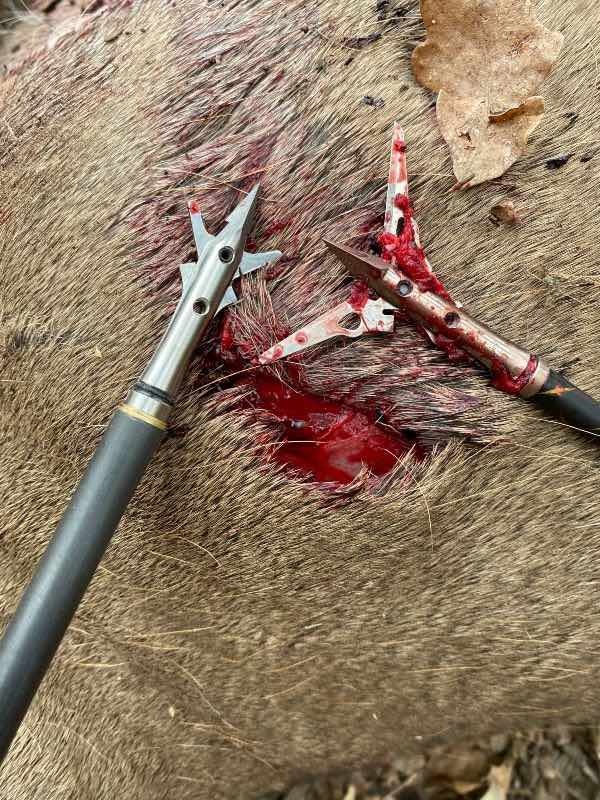
Other than that, it’s business as usual when selecting bowhunting-related gear. I’m a big fan of mechanical broadheads with a wide cutting diameter for whitetail hunting; I’ve had outstanding success recently with SEVR broadheads. As for optics, I never travel without a 10X binocular and laser rangefinder. For hot weather early season hunting, I bring a small rechargeable fan to help keep me cool during those long afternoon sits.
Licenses and Tags
All Wyoming big game tags are issued via the draw, and it is complicated. The application process for deer tags opens in early January, with the deadline in 2025 being May 31. Nonresident applicants must submit a $15 nonrefundable application fee. There is a regular and a special draw for nonresident elk, deer and pronghorn in Wyoming, with the general deer tag costing $374, while the nonresident special deer tag costs an eye-popping $1,200. The licenses are exactly the same. Wyoming has used this strategy to improve the odds in the special draw, working under the presumption that fewer applicants are willing to pay a higher price, thus increasing odds. Under this program, 60 percent of the nonresident licenses for each hunt are given to the regular draw, with 40 percent given to the special draw. Personally, I refuse to play this game, and always apply for the lower-priced license. I have never not drawn a tag for whitetail hunting in the Devil’s Tower area.
In addition to the deer tag, archers need an annual conservation stamp ($12.50) and archery license ($72 adult, $12 youth), as well as proof of completion of a hunter education course if born after Jan. 1, 1966. Your outfitter can assist you in the application process.

A Great Road Trip
The area is filled with history. Traveling hunters often fly into the Rapid City, South Dakota, regional airport, which is just a 2-hour drive from Devils Tower. Along the way you can visit Mount Rushmore, the historic Old West town of Deadwood (where Wild Bill Hickock was killed), and the South Dakota portion of the Custer National Forest, where they hold an annual
Buffalo roundup — usually in late September — that attracts thousands of visitors. It makes a great road trip for the entire family.
I’m already planning my 2026 trip.

Sidebar: Make It a Combo
One way to extend your visit to this region is by making it a combination hunt. The area is home to solid numbers of both pronghorn and Merriam’s turkeys. Pronghorn populations in the Casper region have fluctuated in recent years. According to the Wyoming Game Department, some herds around Casper have remained at or near population objectives, while herds to the northeast from Douglas to Lusk to Sundance are still below objective. The good news is that following better fawn production and survival in 2024, most herds have begun to recover. Despite this, hunters should experience average to high pronghorn harvest success as buck ratios remain strong, and license issuance is structured in an attempt to ensure high success for hunters. Tags are issued via the draw. Most archery hunting is done from a ground blind adjacent to a water source.
Merriam’s turkey hunting can be excellent, with the Black Hills being Wyoming’s best public land turkey hunting area — though success odds are always higher on private lands. The fall season runs September 1-December 31, and the $74 nonresident tag can be purchased over-the-counter. It’s super fun. In 2023 I took my first-ever bearded Merriam’s hen after punching my deer tag with Trophy Ridge Outfitters. It was awesome!
There are also elk and mule deer in the region. Elk hunting in limited-quota areas is good, and mule deer hunting very dependent on the exact locale. Interested hunters should discuss these possibilities with outfitters before committing.
Photos by Bob Robb