
It was a frosty November morning in southwestern Kansas, and I had climbed into my river-bottom stand 2 hours before daybreak. The reason for the extra-early arrival was I’d decided to try something relatively new, at least for me – using a deer decoy.
Now, this was back in the days when the Dewey Decimal System (look it up) was used as my primary library research tool, not Google or DuckDuckGo. It was well before the food plot craze, trail cameras, QDM and the explosion of YouTube videos and a plethora of hunting TV shows on cable. Yes, before the internet. So everything I did was a trial-and-error thing, and this was to be no different.
By today’s standards, the life-sized doe decoy I had was crude, and I really didn’t know what I was doing. So I set it up 20 yards upwind from my tree and got ready. At very first light, a dandy 4x4 stud buck came cruising down the cottonwood bottom, saw that decoy, and slammed on the brakes. His hair bristled up, he pawed the ground, and circled the decoy with bugged-out eyes. I was so amped that when the buck came up behind the decoy, I rushed the shot, and my arrow flew right over his back. Lord, was I hooked!
My Early Education
To serious whitetail hunters of my generation, the name Gary Clancy is a familiar one. Minnesota native Clancy was one serious outdoorsman and whitetail hunter who was taken from us far too early in 2016 by cancer, which was caused by Agent Orange when he served as an infantry point man in Vietnam in 1969-70.
Gary, a quiet guy with a quick laugh, never talked about all that. What he did talk about was how using life-sized deer decoys during the whitetail rut could be a game-changer. He detailed his tactics and techniques in his classic 200-plus page book, “Rattling, Calling & Decoying Whitetails.” As a pioneer, he learned by making mistakes, and what he learned, and shared with me, fueled an interest in using decoys that lives to this day. His simple yet effective techniques are even more deadly when using modern decoys that are lifelike and can have added motion.
Secrets to Success
While there are several nuances to using decoys successfully, Clancy stressed three things above all else:
- The most important part of the plan is decoy placement. “The wind must always be blowing from the decoy to your stand, right?,” Clancy said. “You don’t want a deer coming in downwind of you. Also, always place a buck decoy facing toward or slightly quartering-to your stand, and a doe decoy facing away or slightly quartering-away from your stand. Never mind all of that ‘sage’ advice that says to never face a decoy towards your stand, that doing so will naturally draw an approaching buck’s eyes to where you’re trying to hide. When a buck deer approaches a buck decoy, it will virtually always circle downwind of the decoy until it is nose-to-nose. When that happens, the buck is facing away from you and giving you the shot angle you need. Conversely, a buck deer will almost always approach a doe decoy from the rear, checking her for estrous.”
- Don’t scrimp on scent products. Clancy recommended that, after setting up the decoy, to liberally spray it down with an odor-neutralizing spray. “Using a decoy that smells like a human won’t cut it,” Clancy said. “If you can, wear rubber gloves when handling the decoy, then after it is in position, spray it down liberally.”
- Don’t surprise the deer. “The more visible and the greater distance at which the decoy is visible to an approaching buck, the better the odds he will commit,” Clancy said. “Decoys in heavy cover scare more deer than they attract.” Field edges, dry creek-bottoms and sloughs, and fence lines are great decoy spots, as are open stands of mature woods. In fields, place the decoy up on a small mound, especially if you are hunting a depression or hollow, so it will be visible to deer no matter where they enter the area.
What’s the Best Time?
Though I’ve used decoys at various times of the deer season, like Clancy, my experience has been that the chances of having a mature buck come visit a decoy are best during the 10- to 14-day period just prior to the first estrus. During this time, bucks are actively scraping and roaming, and often respond to both grunting and rattling, which is a very effective way to draw a buck’s attention to a decoy it might otherwise not see. During the peak of the rut, when most mature bucks have already found does to breed, bucks still come to a decoy, but I’ve mostly had immature bucks come then. However, a mature buck that is between does might also commit, but everything has to be “just right.”
I like using decoys in the afternoons, especially if I can set up in the corner of a field I know does are using regularly. However, I’ve had my best luck with decoys during morning sits, when bucks return to bedding areas after an unsuccessful night of seeking out a hot doe. I call a “morning” sit during the rut one that extends from daybreak until 3-4 hours before sunset. This sometimes means I might hunt a stand in a funnel or known travel corridor between food and bedding areas from sunup until early afternoon, when I might then move my stand location to near a food plot or other agriculture area where doe groups are known to appear for an evening meal.
Setup Tips
Using some of today’s full-body decoys can be a pain in the petunias when you have to haul it into your hunting area quietly in the dark, then setting it up without sounding like a marching band. This is especially true for big decoys that have to be assembled before they’re set up. There are a couple ways to help alleviate this problem.
The first is to simply bring the decoy to the hunt area during midday, assemble it, drive the stakes into the ground, and leave the decoy itself lying on the ground nearby when you’re not hunting that spot. When I leave mine in the woods, I carry them a short distance from the stand and stash them in a blowdown, brush pile or small depression, and cover them up with some burlap, or maybe some brush. (I tried plastic tarps, but they are just too noisy.) A decoy glistening with frost in the morning will spook deer. You can quickly uncover it and set it up quietly before climbing into your stand. Putting a bright eye or spraying the decoy stakes and/or decoy stand with a fluorescent paint that shines brightly in your headlamp makes them easy to find. The second is to haul the assembled decoy to your stand sight on the kind of wheeled deer cart designed to haul out a dead deer. In the right terrain you can do this quietly as well.

When using a buck decoy, set it up where its appearance won’t threaten other deer when they first see it. That means when hunting an open field, set up away from the areas the most deer are known to enter the field. That gives does and youngsters a chance to get comfortable in its presence. And don’t worry about missing a shot opportunity by setting up on the wrong side of the field. When a mature buck spots the decoy and wants to challenge it, he’ll eventually make his way across the field, usually displaying his aggressive posture of bristled hairs and crazy eyes and that often-intimidating side-step as he comes nose-to-nose with the intruder.
Once I get the decoy set up, I spray it down with a no-scent spray, then add some real deer scent to the mix. If the decoy doesn’t have a place for scent, I take a small stick, jab it into the ground underneath the deer’s belly, and place a scent wick on the stick. When using a buck decoy, I use both rutting buck and a doe estrous scent on separate wicks. I also like to run a drag line from near my vehicle to the decoy’s location.

Buck or Doe, One or More?
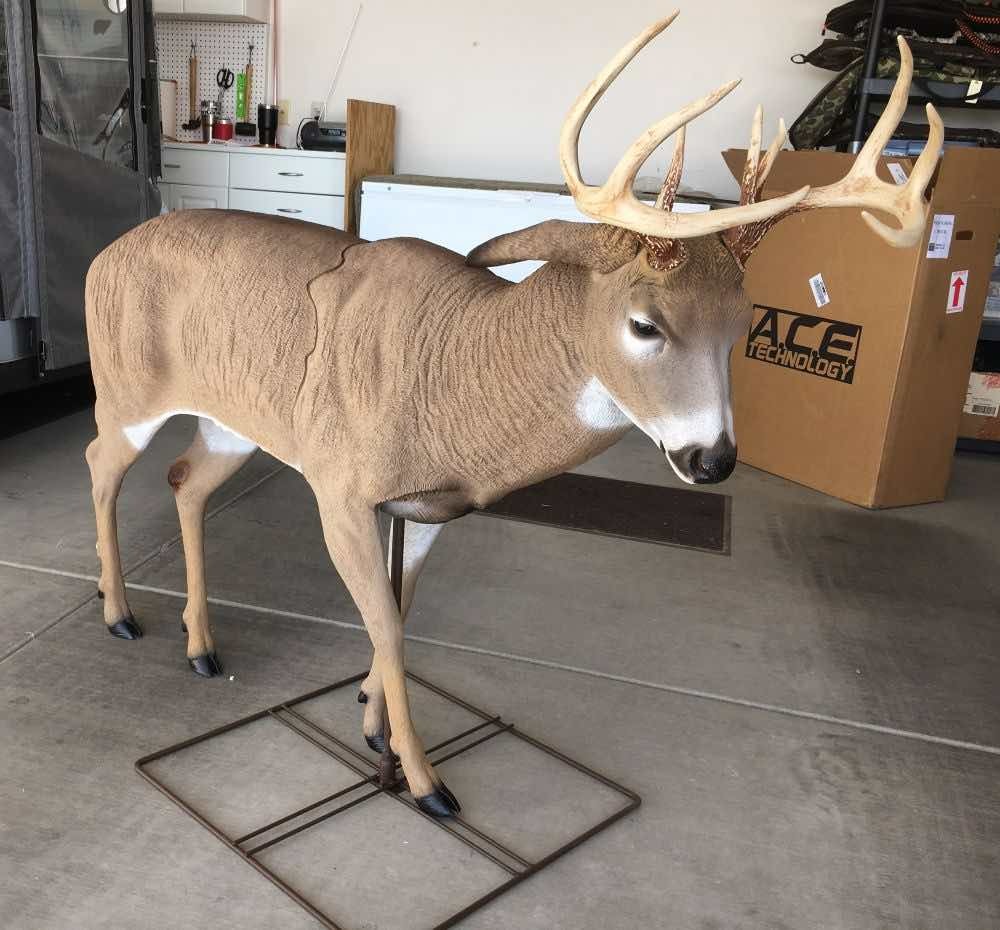
A widely accepted rule of thumb is a doe decoy can be effective during all three phases of the rut, while a buck decoy is most effective during the mid- to late pre-rut into the full rut. Doe decoys with their head in the full upright position — all we had early on — have never worked well for me. Better is a doe decoy with its head in a feeding position, or a bedded doe. Using doe decoys means you’re trying to attract a buck out cruising looking for love, and once he spots her, he'll come over to pay his respects. And sometimes they do just that.
For me, I much prefer using a buck decoy. When a mature cruiser sees another buck — especially one he thinks he can give a whipping to — and he’s in full rut mode, he’s coming. And when he comes, I am going to get a shot. Where I’m hunting dictates the size of the rack I’ll use on my decoy. I want it to be mature, but not so large as to be intimidating to most of the bucks in the area. I have friends who swear by using only one antler, thinking that a missing beam indicates a vulnerable buck that has already taken a licking, and is ripe for more.
What about multiple decoys? Using more than one decoy can be a major hassle, especially if you are hunting solo. But there are times when adding a doe decoy to your buck can make a big difference. When I do this, I generally like to place the buck where it is most visible to cruising deer and where I want to make the shot, and place a doe decoy off to the side. Ideally this is on the edge of the woods if I’m on a field, partially hidden by some flora or a bump in the landscape. One killer setup is using a rutting buck decoy hovering near a bedded doe decoy.
Add Some Realism
All game animals, from ducks to turkeys to deer, are more readily drawn to a decoy that exhibits some motion. In the old days, I used a number of things to try to impart movement to my deer decoys, including toilet paper, and fluffy white cloth strips hanging from the ears and tail of my full-bodied decoys.
Today, of course, there are decoys with built-in motion. Some of it is conveyed simply, with parts that flap and sway in the breeze. Some decoys have electronic motors that allow the tail and neck to move on command from a hand-held control (they are not legal in all states, so check your local regulations before using one). There are even heads and tails that can be moved with a string pulled by the hunter. One thing I do today is take a real deer’s tail — one that I cut off last year’s deer, skinned and fleshed out, and cured with salt and Borax — and attach it to the decoy’s butt end with a small nail. That tail wiggling in a breeze really seems to get them going! Adding motion adds realism — and that translates into more effectiveness.
When using decoys, I also do some calling, everything from rattling to using grunts and bleats. How aggressively I call depends on my feel for how the deer are acting on a given day. Some days I’ll be boisterously loud, others soft and alluring. There is one given for me, though. If I see a buck cruising out of range that obviously isn’t coming my way, I’ll call loudly enough so I can hopefully get him to stop and look my way — and a snort/wheeze can be dynamite. If he sees the decoy, then I’ve got a chance. One time I yelled “Stop!” as loudly as I could to stop a buck, which turned to see what that was all about, spotted my decoy, and it was game on. I figure, if he’s cruising by and I do not stop him, he’s gone anyway, so what do I have to lose?
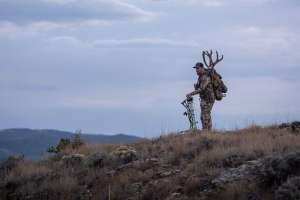
If you’re trying to stalk a buck, or run and gun hunting, the Ultimate Predator Whitetail Stalker Decoy is a solid option. Weighing just under 9 ounces, it mounts to your bow and provides you with a shot window, so you don’t have to peek around the side of the decoy when you draw, allowing you to stay hidden when a buck trots into range. It’s a unique tool and one that is gaining increasing popularity in many areas, especially those west of the Mississippi River.

Making the Shot
When a buck heads for your decoy, don’t rush the shot! One of the advantages of using a decoy is deer will usually parade around the decoy and give you plenty of time to draw and make a good shot once the buck has presented a broadside or quartering-away angle.
Of course, this is easier said than done. When a big buck is all bristled up and starts strutting sideways around your decoy, breathing fire with his eyes bugged out, keeping your wits about you is anything but easy. Get your release attached and be ready. You’ve already used your laser rangefinder to pre-measure distances to and around the decoy, so be prepared to draw and shoot when the window of opportunity opens. However, don’t dawdle. I once had a good-sized buck doing the dance around my decoy until, without warning, he viciously attacked it, knocking it to the ground. When that happened, he was so startled he blasted off to the woods, never to be seen again.
Decoying deer — when it works, it’s like calling in a big bull elk or a strutting tom turkey — the excitement is unparalleled. But it doesn’t always work, and sometimes can scare deer off. Which is why I love it and hate it, all at the same time. But I still do it. A lot.
Sidebar: 8 Top Decoy Manufacturers
Deer decoys vary widely in terms of price, as well as structure — from two-dimensional fabric designs to 3-D models that look incredibly real. Buying tip: Check out Facebook Marketplace to see if someone local is selling a decoy; you can often buy a seldom-used one for less than half the price as new.
- Come Alive Decoy Products: www.tail-wagger.com
- Dave Smith Decoys: www.davesmithdecoys.com
- Flambeau Outdoors: www.flambeauoutdoors.com/Hunting/Big-Game/Decoys
- Montana Decoy: www.montanadecoy.com
- Primos: www.primos.com/accessories-and-gear/deer-decoys
- Renzo’s: www.gamecalls.net/huntingproducts/renzos_decoys.html
- Rinehart: www.rinehart3d.com/rinehart-doloma-series-doe-decoy/
- Ultimate Predator Whitetail Stalker: www.ultimatepredatorgear.com/whitetail-deer-stalker-decoy/
Sidebar: Safety First
Bowhunting World Editor Dave Maas shares my love of decoying deer. He offers this insight regarding decoy placement: “The No. 1 concern with decoying deer is safety,” Maas said. “I decoy deer ONLY on private land during archery season, and even then I’m careful to avoid placing a decoy (doe or buck) where it can be spotted from any road. In my opinion, it’s simply too risky to set a deer decoy where a poacher can find it in a riflescope and then send a bullet in my direction.”