
An experience recently in the Wisconsin woods reminded me of a tremendously effective wild turkey technique that’s often forgotten in these days of call, call, call and call some more.
It was late April, and I was playing the role of Sherpa for my dad (87) on his 160 acres in Wisconsin. Dad doesn’t hike long and far anymore, so our pre-dawn plan was to drive his John Deere Gator into the heart of his property, then simply sit and listen for gobbles. His land isn’t home to the best roost trees, but he does have a few food plot fields (half-acre to 2 acres) that turkeys will occasionally visit.
At least two toms were gobbling hard 30 minutes before sunrise, and they were roosted only 100-150 yards off Dad’s southeast corner. We also heard lone gobblers far in the distance (off his property) in all directions. I figured our best chance was to set up in a 2-acre field near Dad’s east property line and hope we could coax the roosted toms our direction after fly-down.
As happens 95 percent of the time when pursuing turkeys, it quickly became apparent that the toms — now on the ground, gobbling occasionally — were drifting away from us. Plan A was a bust, and our hunt wasn’t yet an hour old.
Dad is a diehard whitetail hunter, so sitting in ambush comes second nature to him. He would have been fine to sit there on the food plot and stare at his jake and hen decoys for at least 3 hours, but I was antsy.
A lone tom was gobbling sporadically north of Dad’s property — 400 yards from us was my guess — and I wanted to sneak in that direction to check it out. I thought about leaving Dad on the field with his decoys and going solo on a recon mission (I didn’t have a tag), but due to the cold temperature (34 degrees), I figured he would welcome a stretch and a little walking.
We had stashed the side-by-side in some thick cover 150 yards from our morning ambush spot, so I hiked to retrieve it and then drove to pick up Dad and his gear. I knew that we could drive north on a logging road toward the gobbling bird to reduce the distance, then sneak quietly from there.
“You carry your gun and I’ll grab your chair and shooting stick,” I whispered to Dad after parking the UTV. I’d driven 200 yards north toward the lone tom, and guessed it would still be another 200 yards farther north.
Canada geese continued to fly over Dad’s 160 as we slowly slipped north on his logging road, and thankfully the lone tom gobbled a few times at the honking to help me guess-timate his position. The neighbor to the north had his land clear-cut a few years prior, leaving no roost trees, but I suspected the tom was strutting and gobbling on a wide logging road that ended just 25 yards from Dad’s north property line. Maybe I could call the tom south onto Dad’s land? It was worth a shot.
We slipped north through the hardwoods along a deer trail beside two 1-acre ponds (below). White pines rim the ponds, and the fallen needles allowed for quiet sneaking.

I caught movement to the west — close! Two trumpeter swans were swimming off the shoreline only 15 yards from us. I’d never been that close to a swan before, so I stopped and pointed them out to Dad. He shook his head in amazement. The swans saw us, but maybe because we were dressed head to toe in camo, with faces covered by neck gaiters, they thought we were whitetails? Who knows. But they didn’t freak out; instead, they simply swam slowly away toward the middle of the small pond.
Based on the lone tom’s last gobble, I figured he was still at least 200 yards north of us, and I was looking 20-50 yards ahead for a decent spot for Dad and I to sit. As I scanned the terrain, I suddenly spotted a turkey skylined to the north on the top of the hill at 100 yards. I froze, and thankfully Dad did the same.
The bird was standing like a statue, facing us, and I think it was on a stump or fallen log because I could see it from head to toe. It was a big bird, too. Had it seen us? Was this the lone tom that had been gobbling sporadically? I feared the worst.
Suddenly, a goose flew overhead, honking, and the tom shock-gobbled. It was our bird! My guess of the tom’s distance was off by 100-ish yards. Another honk and another gobble. Even though I was watching the tom stick out his neck to gobble in our direction, he sounded as if he were 200 yards away, but I had proof he was half as far. Crazy!
The good news was the tom wasn’t spooked. And based on the fact he hadn’t taken a step for nearly 5 minutes, I was thinking he was alone.
Because Dad was behind me, he couldn’t see the tom. Several big maples and oaks at 15 to 30 yards blocked his view — which was a good thing because that meant the tom couldn’t see him, either. As I stood there trying to think of our next move, I noticed that if I leaned to the east (my right), I could hide behind a 12-inch-diameter maple that was 15 yards between me and the distant tom. It wasn’t much cover but would have to do.
I leaned forward, confirmed I couldn’t see the tom, then whispered to Dad, “Here’s your chair. Quietly set it on the ground by your right foot and slowly sit down.”
As he moved, I placed his monopod, which stands on its own due to a wide base, in front of his chair.
Once Dad was stationary, I leaned back to the west and peeked north. The tom hadn’t moved. I leaned back to the east, confirmed I couldn’t see the tom, then slowly crouched, then crawled around Dad’s chair, scraping the ground and tossing leaves like a feeding turkey. I finally got on my knees behind him and whispered in his ear: “Big tom is 100 yards north of us. I know you can’t see him. I’ll try calling.”
I made three moderately loud yelps with my mouth call and the tom fired back with a gobble. I smiled under my mask. Game on!
A few seconds later, Dad and I watched the tom walk slowly to the west on the skyline. I knew the neighbor’s logging road headed in that direction, so I still wasn’t confident the bird would come our direction. There’s quite a bit of thick cover down the hill (toward us) from the logging road, and I wasn’t confident the tom would be willing to navigate through it. I stayed quiet, playing hard to get.
Not 30 seconds later, the tom was descending the hill, heading toward us, picking his way through the briars and blowdowns. “He’s coming!” I whisper-yelled in Dad’s ear.
We soon lost sight of the tom in the hardwood trees and didn’t know if he’d hug the pond edge to our northwest, or walk the ridge to our northeast. I stayed quiet. In my experience, if a tom is making his way toward you, no matter the distance, it’s best to shut up.
Dad’s 50-year-old Browning Citori was resting on his monopod and pointed due north, and I used it as a reference when I whispered, “The tom is at 1 o-clock, 40 yards, behind a fallen tree.”
I knew that Dad could see the bird, too, when his gun slowly panned to 1 o-clock.
The tom was looking for the hen, his head turning side to side. But now he wasn’t moving. I waited 30 seconds for him to make a move, and when he didn’t, I risked a few soft yelps.
He didn’t gobble but immediately went into full strut, so I gave him a couple more soft notes and also scratched the ground. The tom was moving again, now 2 o-clock, and the distance was 35-ish yards.
“He’s within range,” I whispered. “But don’t force it through the brush.”
Now the tom was at 30 yards, but the forest and ground cover was thick enough that Dad didn’t have a clear shot. The tom continued to drift south, moving toward 3 o-clock.
Finally, the tom’s head cleared a big oak and I prepped for the bang. Instead, Dad whispered, “The glare is blinding me. I can’t aim!”
Dang! After our morning sit, I had changed from a beanie to a baseball cap, but Dad was still wearing his knit hat, which had only a tiny brim. The rising sun on this bluebird morning was directly behind our bird.
Again, the tom stopped, so I rolled the dice and yelped quietly twice. Maybe I could get the tom to take a few more steps to get away from the sun.
Dad’s gun panned right as the tom took a few more steps, and now at 25 yards, the bird was at an ideal range but behind the large trunk of an oak. We needed him to walk 2 more feet south.
As the tom’s head cleared the oak, Dad’s sight picture changed dramatically when the bird jumped up on a 12-inch-diameter blowdown. “Kill him! Kill him!” I begged.
Bang!
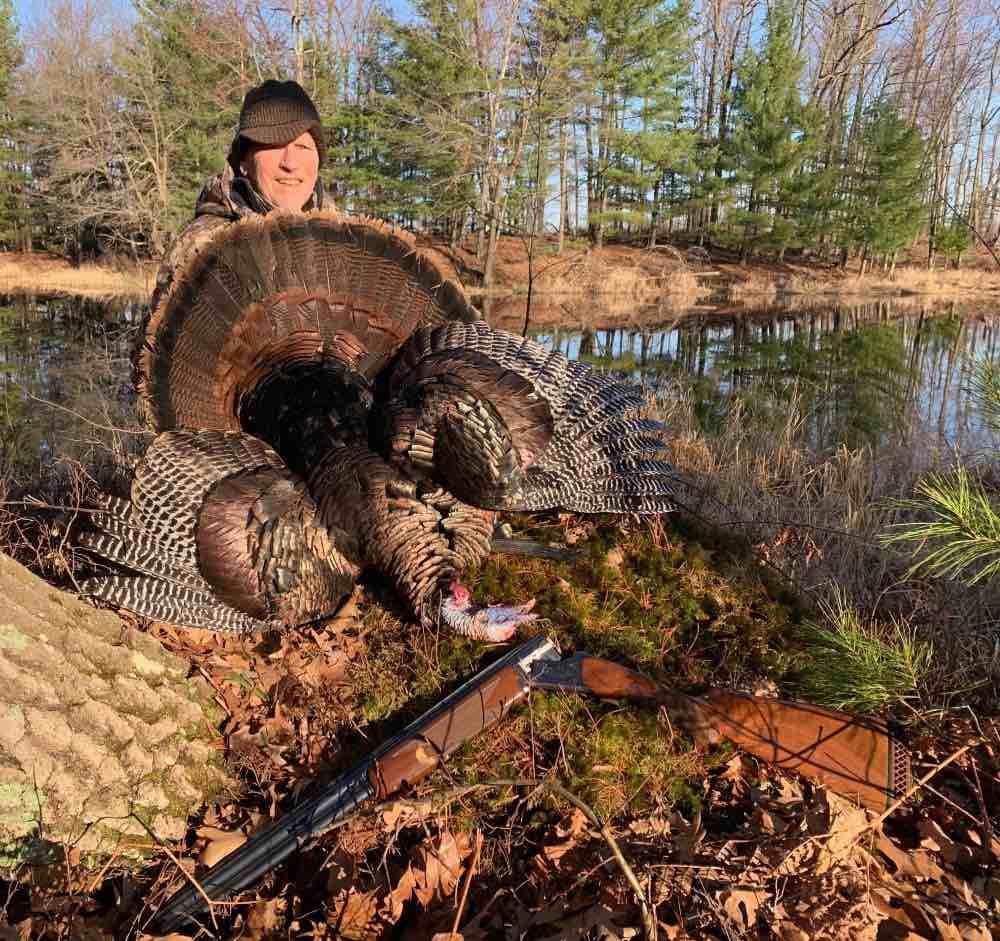
The tom hit the forest floor, but a split-second later he was running east to west (right to left) through the hardwoods. Thankfully, the tom was moving at 10 mph instead of max speed due to the first trigger pull, and Dad’s second shot rolled him.
As I carried the big tom back to Dad, he kneeled, looked to heaven, said a short prayer of thanks and made the sign of the cross. This father/son hunt was indeed a gift from God!
Lesson Learned
When thinking back over our morning in the Wisconsin woods, the biggest key to Dad’s success in killing the lone tom was slipping into the bird’s “bubble” before calling. The tom had probably been strutting and gobbling from that same living-room size spot on the neighbor’s logging road for 90 minutes. He was trying to lure a hen to his spot with his gobbling, and when he finally heard one —me! — suddenly show up at 100 yards but just out of sight, it was too much for him to handle. At that point, he had to check it out.
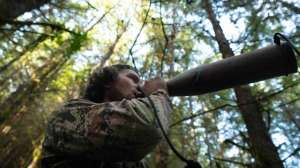
I spend the vast majority of my time these days bowhunting turkeys, where decoys and pop-up blinds are so often the keys to success. But when run-and-gun hunting with a firearm, my favorite technique is slipping in silently on a gobbling tom, one anchored in position just like my Dad’s bird. Dad and I had the luxury of honking geese to keep his bird gobbling sporadically, but I’ve been able to locate a lone tom well after sunrise and keep him vocal by using a crow call.
The key is slipping within 100-ish yards, and 75 is better when cover allows, before making a hen call for the first time. And if the tom gobbles in response, shut up and play hard to get. If the morning is relatively calm, as it was on my Dad’s hunt, a little ground scratching can be just enough to help close the deal.