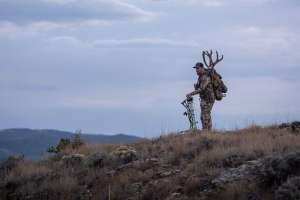

As the top of the young aspen patch became visible, the leaves gently quivering in the west wind, I went into stealth mode. Keeping a juniper between the aspens and me, I crawled forward, knowing that a few mule deer, including two mature bucks, were taking shelter from the climbing heat under the aspens. Fully exposed to the sweltering sun, I coveted their shade.
About 35 yards from the aspens, I was close enough. Now, I needed one of the two big bucks to stand and mosey into an opening. With an arrow nocked, I planned to stay as long as it took to get a shot, but the wind suddenly shifted 180 degrees — it was strange because I was on the highest hill in the vicinity and no front was moving in. Instantly, the tall 3x4 stood, looked straight at me, then bolted. The others, including his wide, old 2x2 running mate, followed.
That was the first stalk of my 2024 Colorado public land archery deer hunt, and it stung to be so close and have the encounter fall apart at no fault of my own. But that’s bowhunting. Allow me to set the stage for how this hunt came to be, and then we’ll get back to the story.
Sitting on Points, Settling on a Hunt
Annually, I buy preference and bonus points for several species in several western states. As Colorado’s 2024 big game draw deadline approached, I felt it was time to cash in my six deer points and embark on a DIY public land mule deer hunt. But, where?
I’d been studying a unit, but according to my GoHunt Insider research, I had strong odds of drawing but wasn’t guaranteed. I checked with one of my Colorado pals, and he said, “Why don’t you try unit ____ right next door? You’d draw that one for sure.” He also shared some tidbits and a few glassing spots to get me started. The hunt would be on BLM ground and potentially a chunk of state ground.
e-Scouting
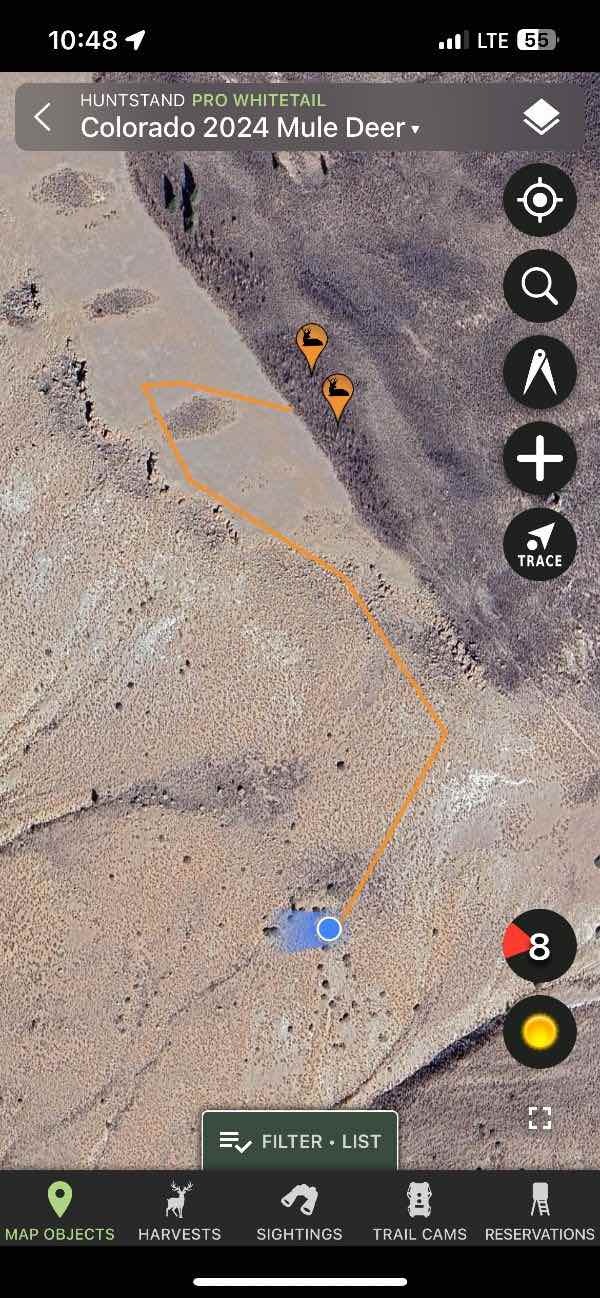
I drew the tag and began scouring HuntStand Pro to supplement my buddy’s map markers with my own. Most of the unit is the highest of the low country, with elevations around 9,000 feet. My best odds of finding and patterning a mature buck would be best around the September 2 opener. The area’s average temperatures during September are hot, and with the hills covered in open sage, I knew the key to finding deer would be to locate shade-tree pockets near water sources.
Utilizing HuntStand Pro’s Natural Atlas base map made larger water sources obvious, and the high-resolution Hybrid base map helped me uncover smaller ponds and waterholes near tree cover. Next, I employed the 3D feature, which allows you to tilt the map and pan around. This helped me identify ideal glassing peaks and gave me an idea of what I’d see from those spots. If you’re planning a Western spot-and-stalk hunt, HuntStand Pro’s 3D feature is priceless and gives you an in-person perspective of the terrain and visibility.
Next Stop, Colorado
I’d been shooting my Mathews Lift 29.5 extremely well all summer in preparation for the hunt, and the day before leaving for Colorado, a broadhead-tipped arrow shot from 90 yards that hit exactly where I was aiming had my shooting confidence soaring — not that I’d shoot that far at a deer, but ya know.
About 5 days before the opener, my wife, Becca, and I hooked up our travel trailer and aimed west. After 2.5 days of driving, we reached our destination, checked in at an RV park, and got our little home-away-from-home situated.
Scouting Begins
The first morning at one of my buddy’s glassing markers was a solid observation outing. I spotted a young buck and several does and fawns. I also spotted several other deer here and there. When I expected that all of the deer had bedded and that my morning was done, the east slope of a mile-long hilltop, which was more than a mile away, begged for a closer look. Down in the sage and heading uphill toward some young aspens were the two bucks mentioned earlier. Both had swayed backs and potbellies, and their antlers were pretty nice.
We scouted the next few days. We saw some deer and elk, and one morning, when Becca stayed back, I even saw a female mountain lion with her two young ones slinking through the sage. I’ve hunted out West for 20-some years, and these were the first lions I’d ever seen.
We didn’t find any better bucks than the tall 3x4 and wide 2x2, until it was nearly dark the night before the opener. I was glassing a completely different area when I spotted what appeared to be a monster buck’s antlers sticking above the sage. In the waning light, I would’ve bet a hundred bucks I was looking at big velvet deer antlers. I knew where I was hunting opening morning.
The Opener
When daylight spilled onto the sage flat where my spotting scope had been fixed the evening prior, I hoped to see a world-class velvet buck slipping back to bed. Instead, I saw a funky-shaped sage bush, which I had mistaken for antlers the previous evening. Bummed, I didn’t see any deer, and opening morning was over. Well, not quite. On my way out, I chased up two coyotes, which ran in separate directions.
One coyote stopped, and I ranged it at 120 yards. Having practiced at 140 yards, I nocked an arrow and dialed my UV Slider sight to 120 yards. The coyote stared as I drew my bow, settled my pin, and pushed and pulled until the shot broke. The arrow’s arc seemed too high, but it lobbed right in through the coyote’s ribs.
He ran erratically through the sage, and a huge blood spot on his side confirmed a great hit. After running in a couple of circles, it went down. Finding my kill took me a while because the sage was tall. Seeing the fruits of my summer practice was awesome. Of course, I’d never take an initial shot at a big game animal at that distance, but I practice out to such long distances just in case I need to finish a wounded animal.

Stalking Bucks
Over 7 days, I stalked the big 2x2 and 3x4 three times, and I stalked another bachelor group led by a solid 155-inch buck in a different area one morning. All were bedded beneath shade trees. I got close enough to shoot on all four stalks, but the wind shifted 180 degrees while waiting for a shot in each scenario.
The neatest part of stalking the 2x2 and 3x4, particularly, is that they taught me a ton about mature mule deer bucks. Many hunters misconceive that once a mature buck blows out after smelling them that the hunt for that individual buck is over. But, even though these bucks caught my wind, I always turned them up on the same mile-long mountain in my Maven spotter.
I suspect it was for two reasons. First, that mountaintop had pockets of dark timber and young aspens — plenty of shade-tree bedding options for different winds. Second, bedding on that hill worked. Three times they smelled me and exited alive.
Day 8
On the morning of September 9, more than a mile away, I glassed the bucks silhouetted atop the mile-long mountain. Once the temps began rising, they went over the hill to bed on the west slope rather than the east slope, as they had been. That seemed odd because the west slope gets full sun exposure during the hottest part of the day, and it has very few shade trees. I couldn't see where they bedded, but I identified a landmark where they had dipped over the hill.
I drove to the mountain’s base and began the arduous climb. About a mile and a half later, I was where the bucks had dipped over the hill. Carefully, I tiptoed to the edge of some sheer cliffs and worked south, glassing every little nook and cranny, but didn’t find the bucks. There were a few juniper shade trees, but I couldn’t distinguish any ears or antler tips. I didn’t know it then, but I was very close to the bucks at that point. Eventually, I found some fresh mature buck tracks (obviously from the bucks I was stalking), but once they left the loose soil and entered the rocky sheep-like cliffs, I lost them. Eventually, I assumed the bucks had somehow moved on without me knowing it, and I hiked down to the truck.

After getting some water, I drove around the mountain and glassed the west slope from the highway. If the bucks were up where I had just been searching, they’d be under a shade tree, of which there were only a handful of suitable options. Soon, I spotted the tall 3x4 beneath a juniper. I had glassed that tree from the top less than 2 hours earlier, but the steep decline had not provided the view needed to see the bedded buck. With the temperatures now sweltering, I determined to make a 2-mile hike back up and across the mountain, slip in, and kill this buck. I marked the juniper on HuntStand, which helped substantially once I was stalking.
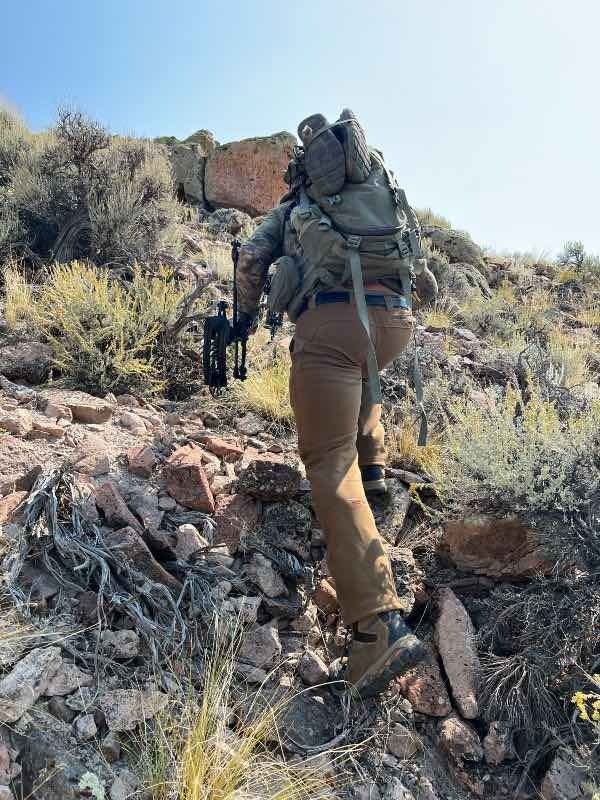
I drove around to the south base of the mile-long mountain, shot a couple of practice arrows, then started climbing the rugged sheep-like country. On top, it’s like a mile-long flat football field, so I covered lots of ground fast and bumped into a big pronghorn buck. Once within 400 yards of the juniper, I kept tabs on my HuntStand marker, ensuring to stay on track as I entered the cliffy country where the buck was bedded. The closer I got, the harder it became to pick my way through the steep, rocky terrain. Once I knew the buck was 100 yards away, I began moving loose rocks out of the way so I wouldn’t bump them and cause a slide. It was the most finicky stalk I’ve ever attempted. Inadvertently kicking even one small rock would immediately blow the stalk.
Finally, I saw antler tips underneath the juniper. I was 60 yards away, but I knew I had time until the buck would stand, so I continued stalking, again moving loose rocks aside and moving inches at a time. At 43 yards, trying to get closer seemed foolish, especially because I knew the entire time that the big 2x2 was tucked in somewhere nearby. With an arrow nocked, I just needed the 3x4 to stand.
The west wind held, and while watching the 3x4’s antler tips, the giant 2x2 suddenly walked out broadside between the 3x4 and me — he had been bedded on the other side of the juniper. A rock was covering his vitals, but he continued browsing from right to left and was soon in the wide open, 33 yards away and clueless to my existence. When he lowered and turned his head downhill, I drew my Mathews Lift. I settled the pin, and after 8 long, hot days of hunting, this was the opportunity I’d endured the long miles and punishing heat for.
Upon the arrow’s arrival, the buck dropped and turned away, causing it to hit above the spine. Disgusted, I watched him run 700 yards downhill to within 100 yards of the highway. Agitated, he kicked up dust and spun in circles. I saw a big blood spot atop his back, clearly too high to have gotten the lungs or artery; I was sick. With darkness less than 2 hours away, I had to get down there and shoot him again, otherwise he’d likely move by morning and be impossible to relocate.
The Lord guided my stalk to within 79 yards of the buck. He was bedded and facing me with his head turned left; I waited to see if he’d stand. Afraid of the darkness coming, I dialed my sight to 79 yards and held at the base of his neck, which was a small target. I shot, and the buck sprang up and ran, stopping 114 yards away. I later learned that my arrow had just grazed his chest a few inches right of where I’d aimed.
I didn’t skip a beat. I wouldn’t shoot that far at an unwounded deer, elk or pronghorn, but to finish what I started, I dialed my sight to 114 yards and drew back on the broadside buck. My arrow connected in front of the buck’s shoulder in the neck. He ran toward me and bedded 40 yards away. An arrow through his ribs ended the unfortunate escapade with only minutes of legal shooting light remaining.
As I approached the buck, great sadness consumed me. I knelt in silence and shed a few tears before the reality that wild critters are string-jumpers brought me back to the “mission accomplished” mindset. No, it wasn’t a one-arrow kill, but the hunt was still a gift from God, and I was relieved that I was fortunate enough to finish the giant 2x2, my first velvet buck.

After marking the downed buck’s location on HuntStand, I walked the highway shoulder about 1.5 miles to the truck in the dark. The unpolluted sky with the mountain silhouettes was breathtaking. When I finally reached the truck and drove back to the buck, I had the most difficult 100-yard drag ever. His velvet antlers were extremely jagged and poky at the bases, and it hurt like heck to pull him by the antlers. Plus, the field-dressed animal was huge.
First, I had to drag him down and back up a steep dry creekbed. Then, I had to drag him through thick sage and cacti. Finally, I had to maneuver him underneath tightly strung barbed wire, including his wide frame. But that wasn’t it. I had to lift the enormous-bodied buck into the pickup bed.
It was after 11 p.m. when I finally reached the camper, where my smiling wife said, “That thing looks like an elk!” We stood there and admired the wide, velvet-clad antlers, which stuck above the truck bed.
Reflection
Looking back on the hunt, I’m glad I didn’t punch my tag in the aspen patch on day No. 2 (the hunt described in the opening paragraphs). I’ve hunted mule deer a lot on the prairies, but this was my first time hunting them in big, steep country. I learned a ton in 8 days of hunting, and got to experience a part of Colorado I’d never visited before. Lord willing, someday, I’ll return to the mile-long hill and hunt another mature mule deer buck.

Sidebar: Protect the Velvet
Velvet, love it or hate it, is a reality when you bowhunt deer at the beginning of September. If you do nothing, velvet will attract bugs and rot, and when it dries, it will split and peel. Anticipating that I’d kill a velvet buck, I brought a bottle of VelvaLok from Velvet Antler Technologies. It’s a preservative in a convenient spray bottle that repels bugs and preserves velvet in 72 hours. A spray bottle has enough contents to preserve 180 inches of antlers. Liberally douse the antlers and let them dry in the sun.
Now, I’ll admit that I had a couple of oversights while retrieving the buck that caused the velvet to split and peel in some spots before treating the antlers with VelvaLok. First, dragging the buck by the antlers was a mistake. Failing to avoid making contact with the antlers on the sage was my second mistake. Still, VelvaLok kept the bugs away and prevented further damage to the velvet. If you go on an early bowhunt, I suggest packing a bottle of VelvaLok and avoiding my mistakes.
Photos by Becca and Darron McDougal