
I’m far from a food plot expert, but I’m also not a rookie. With the help of family and friends, I’ve been building and maintaining food plots for 30 years. And that’s why this article — a confession of sorts — is embarrassing to write.
Let me set the scene. It’s late July 2025 in western Wisconsin, and I’m with my dad, brother, son (22) and three nephews (21, 16 and 14). We’ve worked on food plots many times before; it’s not the first rodeo for any of us.
My son and I drove 2 hours to visit our family hunting land, everyone else lives here. Our largest food plot is 2 acres, a couple are 1 acre, and most measure .25 acre to a half-acre. In total this afternoon, we’ll plant six plots.
In the week leading up to planting day, these fields were prepped by my brother and nephews with the use of Dad’s compact tractor (with tiller and disks). All of the food plots we will plant have been in use for many years.
So where did my family and I go wrong? When did the “crap hit the fan?”
It literally started with crap — cow manure to be exact.
1: Poor Timing With Manure
Even though I stay in regular contact with my dad and brother when it comes to our food plot strategy, somehow they forgot to tell me that they had a local dairy farmer spread a few loads of cow manure on three of our food plots. Or if they did tell me, I wasn’t listening close enough to consider the negative consequences.
On the morning my son and I arrived at our hunting land, my nephews had already tilled in manure on two small plots and were finishing up on a third. The bare dirt mixed with manure looked beautiful (to a food plotter), but as I watched one of my nephews till in the last of the manure, I was worried.
Let me back up a bit: Dad and I have been debating for decades about the pros and cons of working the soil prior to planting. He believes it’s best to broadcast seed on a perfectly manicured field, meaning plow (if necessary), then till or disk, then broadcast seed, and finish with a cultipacker. But I was taught by food plot industry experts that every time you plow, till or disk, you rob the soil of moisture and bring dormant weed seeds to the surface. In this case, I was worried about the act of tilling (bringing weed seeds to the surface) and also whether the manure itself would contain weed seeds (from grass eaten by the cows).

So what happened? The food plots where we spread manure and then tilled it into the soil were eventually overtaken by grasses and other weeds. Yes, the brassicas and other food plot seeds grew okay, too, but the grass was thicker and taller than the desirable forages at every stage of the late-summer and fall growing season.
Lesson learned? Manure is good to help improve food plot soil, but the timing must be right. In the future, we need to spread manure well before planting time. If we choose to work the manure into the soil with Dad’s tiller — which I’ve learned isn’t mandatory — we must wait long enough to allow the new grass to grow. Then we can kill it with glyphosate and then broadcast our food plot seeds.
2: Rushed Through Broadcasting Seed
I’m shaking my head in frustration as I begin writing the paragraph. While the manure mistake was largely out of my control, this one falls squarely on my shoulders. Let me explain.
It’s up to me to decide which seed we plant where, namely because I’ll be shooting photos of the process and then writing about the results on this website. During 2025 I was field testing various offerings from three seed company brands: Evolved, Magnet Outdoors and Mossy Oak BioLogic. I’ve planted Evolved and BioLogic in the past with outstanding results; this was my first time testing products from Magnet Outdoors, which is new to the food plot scene but owned by a veteran food plot expert.
I typically don’t plant more than one brand per food plot, but I almost always plant more than one blend on one field. For example, on the fields measuring 1 to 2 acres, I’ll divide the field into three, four or five smaller sections and then plant those areas with a specific blend.
Each seed bag explains how much acreage the enclosed seed will cover; for example, 3 pounds of Magnet Outdoors Brassica Binge North seed will cover a half acre. In general I’ll increase this planting rate a bit, but I’ve learned through experience that you don’t want to plant too heavy. To reach the maximum growth possible, each individual plant needs the right amount of space. Overcrowding isn’t smart.

I’m going into this amount of detail to convey it’s critical to broadcast the seed properly. And this is where our family failed miserably in late July 2025.
Here’s what happened: Our family uses a few different handheld broadcast seeders, and they’re old and don’t work well. (I’ll be purchasing new ones before we plant ANYTHING in 2026!) As you walk and turn the handle of the seeder, it’s supposed to throw the seed out somewhat evenly from side to side and in front of you. As you walk and turn the handle, you watch to see how far the seed is landing to each side, and that way you know how much to overlap when you make your next walking pass across the field. Each broadcast seeder has a setting for seed size, too.
Here’s how it’s supposed to go when performed correctly: Let’s say you’re planting a tiny seed such as clover, and you want to spread 3.5 pounds on a half acre plot. The person spreading the clover should adjust the broadcast seeder to the smallest opening (example: 1 out of 3, with 1 being the smallest opening), pour about 1 pound of clover in the seeder, and begin walking the field. The idea is to walk and broadcast 1 pound of clover over the entire field. If you run out of seed a bit before covering the entire field, that’s okay. You simply pour another pound of clover into the seeder and finish walking the field. The goal is to walk and broadcast over the entire field once and still have much of the 3.5 pounds left over.
The next step is to pour more clover into the seeder and walk the field again, this time from the opposite direction (90 degrees from the first passes). Ideally, you’ll cover the entire field again and still have some of the required 3.5 pounds left over. Finally, you can finish by pouring in the remainder of the 3.5 pounds and zig zag around the field to use up the remaining seed.
Done perfectly, you’ll end up with the 3.5 pounds of clover spread evenly across the half-acre field. Yes, it takes a lot of time to broadcast the seed this way because it requires a lot of walking, but following this procedure ensures the total amount of seed is spaced evenly throughout the entire field.
This is NOT what happened on our food plots during late-July 2025 planting day and I knew better. My excuses? We were in a hurry (had a lot of planting to do that day) and it was very hot, making it a struggle to walk the fields multiple times to ensure even seed coverage.
Instead of adjusting our broadcast seeders to 1 (the smallest setting), we chose the highest number (setting 3, the biggest opening) and tried to “time it”; in other words, we tried to spread 3.5 pounds of clover on a half acre by walking the field from end to end only one time. And that’s basically impossible.
To make matters worse, the herky/jerky handle operation of our ancient seeders blasted out a lot of seed at certain points of each handle rotation, and almost no seed at other portions of the handle rotation. And I don’t even know how this is possible, but somehow our seeders were blasting out seed sideways but not forward, so we ended up with a crazy checkerboard-like coverage (see photo below). Where the seed fell to the ground, it was WAY TOO HEAVY, and then large areas of soil didn’t receive any seed.
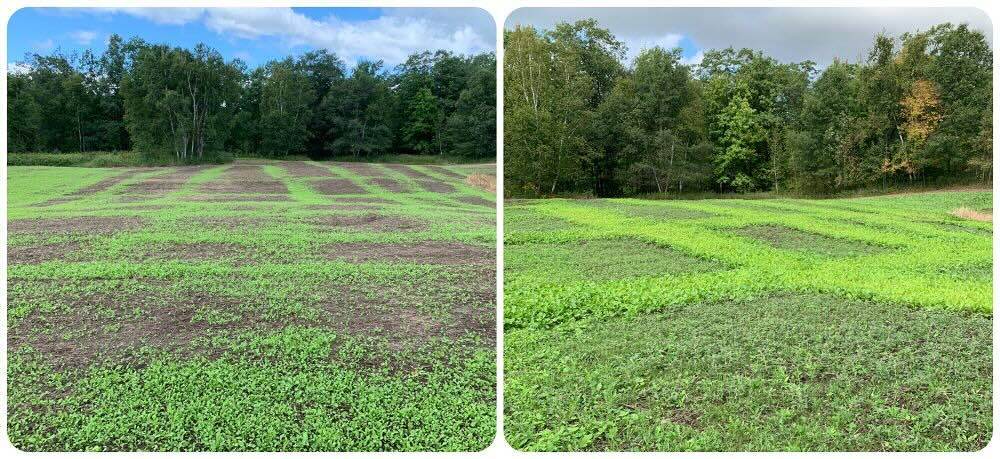
I discovered our broadcasting mistakes four weeks later, after our area had received timely rains and the new plants were a few inches tall. I could hardly believe my eyes. We did our best to fill in the holes of the checkerboards with additional seed without adding more seed to those areas that were already planted too heavy. What a nightmare!
And the nightmare continued: Over time it became clear that those areas initially planted too heavily (the edges of the checkerboard) wouldn’t grow well because the plants had no room; everything was stunted because of overcrowding.
It’s true our area in western Wisconsin didn’t receive any rain during the last week of August, and essentially none in September and early October. That said, we had three good weeks of moisture up until that point. Our food plots should have been in okay condition and produced a good amount of food for our local whitetails, but the mistakes with our broadcast seeders doomed us.
Top Takeaways
In 2026 when we work on our food plots, we’ll spread manure during winter, spring or early summer. Then we’ll wait for the inevitable grass to grow so we have time to spray and kill it before broadcasting our food plot seed in late July.
I’ll also throw away our old broadcast seeders and buy two new ones. And I’ll personally adjust the seeder openings before anyone in my family begins walking a field to broadcast. Regardless of the heat, we’ll go slow to ensure the recommended amount of seed is spread EVENLY across each field.
Learn from my mistakes — don’t take shortcuts.