
The idea for this article originated with a recent text exchange between me and a bowhunting buddy. He practices more than I do by a factor of a thousand, probably more. During spring and summer, he visits his local archery range a few times per week, peppering the target at 20 to 60 yards. Then, he shoots almost daily in weeks leading up to opening day of whitetail season in the Midwest. He also pays a daily use fee to shoot a wooded 3-D course maintained by a local archery club. During winter, he shoots once per week in an archery league at his local pro shop. You get the idea.
My buddy practices with his primary compound as well as a nearly identical backup bow, and both are set up with the same brand/model bowsight, a single-pin movable design. He uses this movable sight on the archery range and when bowhunting.
Me? I practice enough to be highly proficient at 25 yards and closer. Part of the reason I limit my reps is I’ve battled arm and shoulder issues (throwing too much batting practice to my sons when they were in high school), but the primary reason is I won’t shoot beyond 25 yards at a whitetail. Period. And actually, 99 percent of the shots I’ve taken at whitetails during my 47-year bowhunting career have been from 10 to 17 yards. I wait for close-range opportunities at broadside or slightly quartering-away deer, and if I don’t get that chance, then I don’t shoot.
My 25-yard maximum will no doubt seem too restrictive to most bowhunters. That’s fine. I generally live by the mantra, “watch your own bobber,” so I’m not here to criticize your behavior when it comes to maximum shooting distance.
As for a bowsight, I shoot a fixed three-pin design. Because I pull only 54 pounds and shoot a relatively heavy arrow/broadhead combo, my pins are set for 17, 25 and 30 yards. Why 17 yards? Because the vast majority of my treestands and ground blinds are set up for shots of 15 to 17 yards on whitetails. As I said before, my maximum is 25 yards on animals, thus the reason for my second pin. The 30-yard pin gets some work on the range, but I would never shoot that far on a deer; it’s reserved for coyotes.
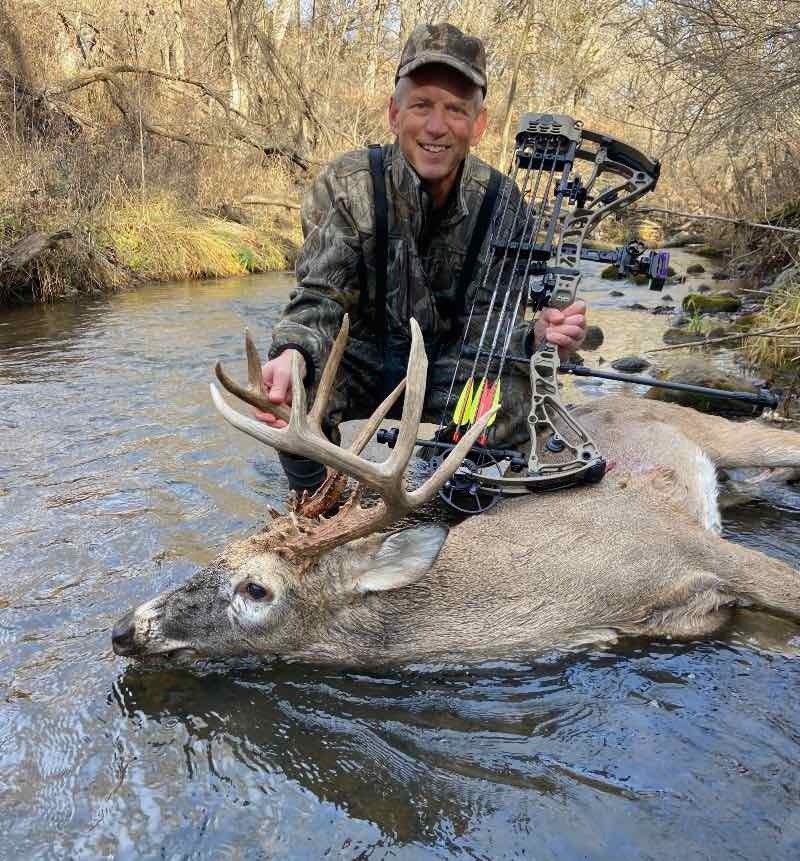
I mention the contrast between my own bowsight setup and that of my buddy because I’ve heard his first-hand accounts (we hunt together in two states) about times when his movable single-pin sight cost him a decent shot opportunity on a whitetail.
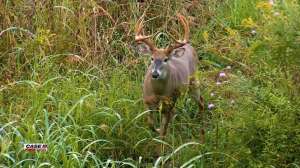
The story often goes like this: “Dave, I was expecting a buck to walk on the 25-yard trail, so I had my pin set for 25. A buck showed up chasing a doe, and instead of staying on the trail, they ended up at 35 yards. Earlier, I had ranged a tree next to where he stopped, so I knew the exact distance, but by the time I moved my pin from 25 to 35, they trotted away. Dang!”
Okay, he uses more colorful language than “dang,” but you understand.
If my buddy had simply used a five-pin bowsight, with yardages set for 20, 30, 40, 50 and 60 yards, he would’ve easily sent an arrow into the lungs of that rutting buck. Knowing the buck was stopped broadside at 35 yards, he would have bracketed the deer’s lungs between his 30- and 40-yard pins and quickly sent an arrow on its way.
If you won’t take my advice on using multi-pin bowsights for hunting, then perhaps legendary shooter/hunter Levi Morgan will convince you. Check out his short YouTube video below. He also provides a good tip on fiber-optic color choices on a multi-pin bowsight.
P.S. My buddy shot a decent buck from the ground this year on public land. He had his single pin set for 30 yards, but a buck approached from behind him, offering a quick 15-yard shot. Instead of adjusting his sight, he held the single pin low and shot. Well, he didn’t guess-timate quite right and hit the buck in the spine. A second arrow was needed to finish off the animal. Again, in my opinion, my buddy’s life would’ve been so much easier with a multi-pin bowsight. I’ll keep working on him to change.