
As archery deer season opens around the country, you’re probably getting eager to get out to your ground blind or treestand and sit for your first hunt of the season. If you’re a brand-new bowhunter, you’ll need to get set up with the right bow at your local archery shop. From draw weight and draw length, to compound, traditional bows and crossbows, our tips below will help you select the right bow for your ultimate experience.
Draw Length
Your draw length is the wingspan distance between the tip of your middle finger on one hand and the tip of your middle finger on the other hand when you hold your arms out in a “T” shape, divided by 2.5. If you have a wingspan distance of 70 inches, your draw length would be 28 inches. This determines how far you can pull back your bow. This measurement is the distance from your nocking point on your face, along your jawline, to the deepest part of your grip on the riser — also known as the “pivot point” — plus 1.75 inches.
A correct draw length ensures that your body is in proper alignment when you’re at full draw. Your non-dominant hand should be able to hold the bow with your arm comfortably stretched out straight, without locking your elbow, while your dominant hand is pulling back the bowstring to the anchor point on your face. A draw length that is too long will cause you to overstretch and pull the bowstring past your jaw. A draw length that is too short will cause the bowstring to stop in front of your face. Each of these would cause improper form, which would misdirect the arrow from the target, so having the right draw length is important for success.
Draw Weight
Your draw weight is the amount of force you can pull back with the bowstring, measured in pounds. The heavier the draw weight, the faster the arrow will go. This is why states set a minimum draw weight in their hunting regulations. A draw weight that is too low may not impact the deer with the force necessary to harvest the game ethically, wounding the deer instead of killing it. This is why it’s important to respect the regulations. Once you know your draw weight and draw length, you can choose the appropriate arrows. Research arrows and broadheads that are designed for speed and penetration to ensure that they have enough force to result in an ethical hunt.
Compound vs Traditional Bows vs Crossbow
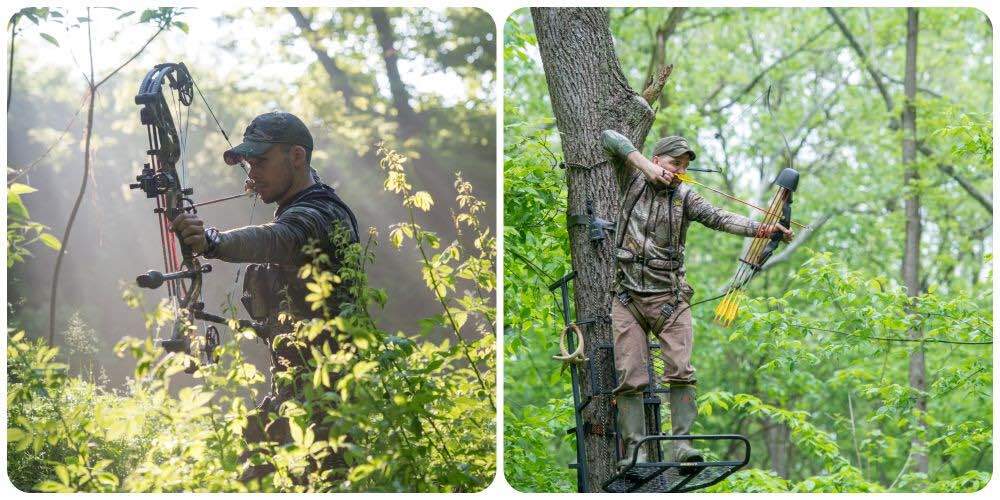
Compound bows are easier to hold at full draw than traditional bows (i.e. recurves and longbows) because of the cams. Cams are wheel-like gears that are attached to one or both ends of a compound bow. In addition to cams, compound bows have unique strings. They have a buss, or “Y”, cable and a control cable that attaches to the bowstring and runs through the cam. The extra cables take the brunt of the weight from the draw weight. As you come to full draw, the cams will hit a point where they “let off” and take the full draw weight, relieving pressure from your arm and back muscles. This will allow you to pull the string beyond your set draw weight, making it easier to finish the draw, set your anchor point, and hold.
Example: A compound with 80% let-off means you are holding only 20% of the total draw weight at full draw. If your bow is set for 60 pounds, you will briefly pull that weight during the draw cycle, but when the cams roll over, the weight is reduced (let-off) by 80%, meaning you’ll be holding only 12 pounds at full draw. Obviously, it’s significantly easier to aim and shoot a bow accurately when holding 12 pounds rather than 60 pounds, which would be the case if you were shooting a 60-pound-draw recurve or longbow.
Compound bows made for bowhunting are shorter and lighter than compounds designed for target archery. Recurves and longbows weigh much less than compounds, but as explained previously, because traditional bows don’t have let-off, they require a great deal more practice to shoot accurately, especially at distances beyond about 15 yards.
This isn’t to say that you can’t harvest wild game with a recurve or longbow; many people do every year, including members of our ATA staff! Recurves and longbows have a single bowstring, so the gear is simpler and has the look of classic archery. As long as you meet the minimum draw weight for your state and use the correct broadheads, you can use either type of bow. Those who choose traditional gear understand that they must be very close to an animal before taking a shot; 7 to 15 yards is ideal. Most deer hunters who choose traditional gear “shoot instinctive,” meaning they don’t use a bowsight. Compound shooters with bowsights can stack arrows in a target’s bull’s-eye and harvest game at much longer ranges. Example: A compound bowhunter using a five-pin fixed bowsight likely has their bowsight pins set for 20, 30, 40, 50 and 60 yards.
Another striking difference between shooting a traditional bow vs. a compound is that a recurve or longbow shooter places their fingers on the string while a compound shooter uses a mechanical release aid. The primary reason for this is bow length; a bow shorter than about 40 inches is difficult to shoot well with fingers due to “string pinch” — the string angle caused at full draw. Most recurves and longbows are at least 54 inches long, and many are 60 inches or longer, which reduces string pinch. Most compounds are less than 35 inches, with many measuring about 30 inches.
Crossbows are legal for bowhunting in some states. Crossbows are unique in that they don’t require you to hold any of the draw weight; you pull back the string with the aid of a crank or a string-cocking rope. After the crossbow is ready to fire, hunters typically rest it on a monopod, bipod or tripod while waiting for a shot. Crossbows have scopes to help with aiming, and when you’re ready to shoot, you move the safety to the “fire” position, aim, then squeeze the trigger.
Crossbows are a good choice for deer hunters who don’t meet the draw weight requirements for their state. They are especially popular with youth hunters and aging hunters. Crossbows have the advantage of not having to move (draw the bow) when a deer is approaching; the hunter simply has to switch off the safety and they are ready to shoot. Check your state’s regulations to verify whether you can use crossbows in your state.
Sidebar: Join Bowhunters United for FREE
Visit our store locator to find an archery shop near you. Once you’ve been properly measured by a bow technician for your draw weight and draw length and selected your bow, become a member of Bowhunters United to receive discounts on your gear. Then you’re ready to go out on your first hunt. Check out our articles on Bowhunters United for more advice and hunting tips and tactics.
Photos courtesy of Archery Trade Association