
Practicing with your bow is important. That much we know, right? Skills must be tweaked, improved, and perhaps totally overhauled at times. This comes with practice, which is the repetition of a specific task or activities to achieve a goal. Want to be a world-class pianist? Tickle the ivories and read music for hours. Want to drive a golf ball 328 yards, execute a gentle fade or make more putts? You can’t do that indoors. Hoops? Football? Surgery? Yes, even rocket science? It takes hours of practice.
The same is true with bowhunting or target competition. Anyone who has picked up a bow knows this. It doesn’t matter if it’s the most expensive compound, a moderately priced recurve or a hand-made stickbow. If you have athletic skills and hand-eye coordination, you can shoot a bow. It’s not impossible to hit a target with the first few arrows if you’re able to draw, hold and release.
Even those without significant athletic skills or strength can do this. Our daughter, when she was a pre-teen, was into dance but not sports. She had good hand-eye coordination and could, when we went to the archery range, shoot a recurve fairly well. Our son was a sports nut who also played golf, helped his high school team to consecutive state playoff appearances, and also could shoot a bow well. Neither were interested in bowhunting or competition archery, though. Kids pursue different things, and we were cool with their decisions. Through years of dance and golf, however, they knew the importance of practice to achieve success.
That’s what practice is, and should be, for bowhunting. It’s a means to improve and, ultimately, achieve success by putting one shot into one specific spot on an animal. We talk about “find the crease” or “pick one little spot” or even “aim small, miss small.” Those are cliches at worst. At best, however, they’re legitimate reinforcement mantras for those who need them at the range or in the stand.
You don’t look at a giant target, or a whole deer or elk, and fling an arrow. You pick the bull’s-eye or other spot on the target. You pick the weird black hair spot on the deer’s chest, or just above the glob of mud on an elk’s chest, or center-punch the ribcage, and release.
To get to that point, however, it takes practice. Hours, days, weeks, years. Sure, some folks take to shooting a bow quickly. Others, it takes longer. Some say it might take 10,000 repetitions to become proficient. Why is it 10,000 reps? Because that’s a sexy number? Why not 9,000 or 13,000 reps? Or 8,500 reps?
Part of that is because someone picked 10,000 hours and that became “the number.” Even numbers are calming, and odd numbers throw off some people. That’s one reason magazine editors use headlines like “Top 10 Ways to Get Your Buck!” because it's easier, cleaner and simpler. Others, though, go with odd numbers that grab your attention: “17 Tips for Bow Season” or “13 Great Venison Slow-Cooker Recipes!”

Let’s Back Up
Back to 10,000 repetitions, though. For whatever the task — archery, bowling, golf, writing, public speaking, chess, whatever — that number means you spent many hours doing it. Within those hours is where you hone and refine, using your equipment and accessories and mental faculties to get better. That’s what John Hernandez learned through his years of practice and hunting with compounds, recurves and crossbows. He is Director of Product Integration with Ravin Crossbows, and previously was with Bowtech. Whatever he’s doing, Hernandez dives in deep.
“I’m 55 and have been blessed to have hunted for years and harvested a lot of wildlife,” he said. “The last few years, I’ve gotten interested in recurve bows and hunting with them. I studied everything about them from the limbs and strings to arrows, rests, the draw, all of it. My first 10,000 arrows, I had a clicker and almost all of my shots were probably inside the garage from 5-15 feet. The thing is, I was shooting with a purpose. I was learning the form, learning about back tension and release, focusing, stance, all those things because all of that is important no matter what you’re doing.”
Practicing at home can be as simple or demanding as you want to make it. If you have outdoor space and room to roam, multiple targets and distances might be an option. If not, one target in a safe location with a good backstop could be the way to go. If this is the case, and you have good-terms neighbors nearby, check with them so no one freaks out. I did this years ago with our neighbors, who at the time had young daughters giving archery a try in their yard. We always looked out for each other and made sure targets, shots and so forth were safe. Never had a problem!
If you’re unable to make backyard practice work, finding a local archery range will probably be easy. Also, you could bring a portable target to an area open for hunting and get to work.
As Hernandez noted, he got into the recurve groove shooting at a target in his garage. Indoor target shooting is a great winter activity if you have enough room. It might be a basement or garage where you’re able to set up a target and safety backstop. Consider investing in a backstop (typically netting); they’re available from several companies including BCY Archery. They work indoors and outdoors, are safe, and provide peace of mind.
Whether you’re shooting a compound and getting ready for bow season, or learning about a recurve or stickbow, Hernandez’s point about having a purpose rings true. He started with bag targets for the recurve “because they’re easy to use, affordable and light.” Now he uses BIGshot Targets, “which take a ton of arrows and hold up.” He has targets indoors and out at his home, and shoots his recurve, compound and Ravin crossbows at different distances.
“I’m the kind of guy who wants to know where the water comes out of the mountain,” Hernandez said about his practice routines. “If you do that, I think it helps you later. I have three targets in my house. One is for shooting 5 feet just outside my office. A couple are in the garage, and I do a massive amount of tuning with those. With the recurve, I shoot through paper a lot … for consistency of form, for a readout. I get feedback, and also can help my friends if they have questions.
“That closer-range indoor shooting is so good because you’re not going to miss. You’re close. You take out all the ego and grouping. You’re concentrating on form, focus and technique. It’s a great activity in winter, too, of course, during the lulls between hunting seasons and spring.”
Sometimes Less Is More
Warm months outdoors? Of course, shoot when possible. Daily is a good rule, as well. Practice doesn’t have to be rigorous or time-consuming. Many bowhunters will shoot one arrow, maybe two, in the field this season at animals. During a hunt you’ll be focused, hopefully, to make one great shot. So do the same in practice. Some of the best hunters I know shoot daily, but take only a few shots, or even just one. They pick a distance if they have multiple targets, check their stance, form, focus and then shoot — one arrow that day. And they leave that arrow in the target until they pull it next time for another one-arrow practice session. They have to live with the results of that one arrow as they go about their day.
Years ago, a super hunter I know would go through his routine and make one shot each morning. Another said he would take a good walk to get his heart rate up and then take a couple of shots. Unlike a golfer at the range with a bag of balls, or multiple bags, these guys and probably some you know would make the most of a short, focused session. Occasionally shooting a couple of dozen times isn’t a bad idea, either. We enjoy shooting our bows and crossbows or we wouldn’t be in the game. Sending a handful downrange, and at different distances if possible, is a good idea.

Rangefinders? Yes!
When practicing, have your tools with you to make any critical adjustments. Of course, always use a rangefinder whether you’re at the range with known distances or in the backyard at that funky distance. Why? Several reasons. One, that 30-yard target at the public range might be 31.5 yards or 28.7 yards. Will you hit the X with your 20-yard pin? Maybe. Or you may be off just enough to get frustrated and start messin’ with the sight.
A rangefinder alleviates that issue by putting you on the right distance as it relates to your bowsight pins. Using it also helps get into the routine of checking the range before each shot. Some hunters do that as a calming mechanism; they see a deer or pronghorn or hog, take a breath, range the distance, breathe, draw and shoot (or don’t).
Don’t guess. Use a rangefinder and become comfortable with it. Rangefinders are easily available these days at your local outdoors stores, big box stores or online. They are available at different price points and with a host of features. The least-expensive models show only line-of-sight distance, while others have angle-compensating technology that quickly computes the true horizontal “shoot-for” distance, giving you the yardage in a snap. They work in bright or dim light, terrible or great weather conditions, and are invaluable for making ethical shots. Crossbow hunters shouldn’t ignore these, either, of course.
Final Thoughts
Competitive firearm shooters practice the way bowhunters do. SIG Sauer champion Daniel Horner has won numerous pistol, rifle and sniper championships. When training, he believes shooters should “know where you are, know where you’re going.” Having a purpose is important during practice and training. Hernandez believes the same thing.
“What’s your main intention, what’s your purpose and aspect of your game you’re working on?” Hernandez said. “So many people think that just by a compilation of reps, they’ll get better. But what’s your plan? Where is your pinky finger? Where is your thumb? What’s your stance? We all enjoy shooting, but if you’re shooting you should be focusing on what you’re doing and getting better.”
This summer, make the most of your practice sessions. Figure out what works best for your training. Take your rangefinder and use it. Guess distances, then range them. Shoot at different distances when possible. Maybe get into a few 3-D events for some competition to get the juices flowing. When the season rolls around and opening day arrives, you’ll be ready to rock.
Sidebar: Use Video to Study Shooting Form
John Hernandez with Ravin Crossbows films his recurve bow practice sessions to review his form. He believes that’s a good idea for anyone shooting any bow.
“Buy a $15 Amazon tripod with a phone clamp and video yourself to watch your shooting,” he said. “I use it as a tool. The video revealed I was scraping my face, and also collapsing during my release. When I try to diagnose why something is happening, I can video it and either confirm what I’m thinking or further refine something.”
Hernandez also suggests buying an Insta 360 camera that offers a 360-degree view. It’s helpful for practice sessions, but also in the stand or blind during hunts.
Sidebar: 7 Top-Notch Rangefinders
Bushnell Broadhead — The Broadhead ranges to 150 yards (with angle range compensation) and has an ActivSync reticle that automatically changes from black to illuminated red when lighting conditions change. It offers brighter imaging for easier readouts, and special coatings for clarity and various weather conditions. $299, bushnell.com
Halo Optics XLR1600 — The XLR1600 delivers instantaneous readings up to 1,600 yards. It also features Angle Intelligence to account for slope to target, and Scan Mode for constant ranging to multiple targets. Weather-resistant and lightweight, this rangefinder is one I’ve used for years because it works like a champ. $289, halooptics.com
Leica Rangemaster CRF R — The Rangemaster CRF R measures distances to 2,000 yards, and its “Equivalent Horizontal Range” feature reaches to 1,200 yards. It has an easy-to-read LED display with automatic brightness control. $449, leicacamerausa.com
Leupold RX FullDraw 5 — This rangefinder reaches to 900 yards on animals and offers Archer’s Advantage software, which accounts for your bow’s velocity, peep height, arrow weight and shot angle. It has a full red LED readout. $499, leupold.com
Maven CRF.1 — This compact Maven CRF.1 measures distances of up to 650 yards and gets the job done without busting the budget. It offers auto red/black displays and includes line-of-sight and angle compensation modes. $295, mavenbuilt.com
Sig Sauer Kilo 3K — If you’re into bowhunting but transition later to a rifle or muzzleloader, this rangefinder is for you. The Kilo 3K has an incredibly fast read-and-display time and includes Line-of-Sight, Angle Modified Range and Archery modes. Other modes are designed for windage/elevation information for use with Bluetooth-paired riflescopes. It’s a solid package at a good price for bow or gun hunters. $349, sigsauer.com
Vortex Diamondback HD 2000 – This unit is simple, tough, reliable and computes the horizontal distance when hunting from a treestand or in mountainous terrain. It ranges deer-sized targets to 1,400 yards, with an accuracy of plus/minus 1 yard up to 100 yards. $449, vortexoptics.com
Sidebar: 6 Backyard Targets
365 Archery XL High Performance Trio — This target uses self-healing foam and has a large 14-inch, 6-sided replaceable core. The XL Trio is available with a high-vis yellow core in 24-, 36- and 48-inch options ranging from 23 to 70 pounds. Great for indoor range shooting. Comes with a support base, so no need for anchoring if you’re shooting outside. $249 to $699, 365archery.com
BIGshot Titan 10X, 10X HD — Designed with self-healing foam, the 10X is a tidy 17x17x12.5 and handles arrows hitting 440 fps. If you shoot the TenPoint 505 crossbow, take a look at the Titan 10X HD designed specifically for it. Both have 10-sided faces with numerous targets, and the corners are cut off to provide treestand aiming points. Unique? Yes, and very cool. $199 and $259, bigshottargets.com
Bloodline Buck 3D — Among the many targets from Delta McKenzie, the Bloodline Buck offers 3D realism including a gobsmacking set of antlers. Focus on the target zone, though, which is anatomically correct. The self-healing target handles arrows hitting 300-350 fps and has a replaceable core. $179.99, dmtargets.com
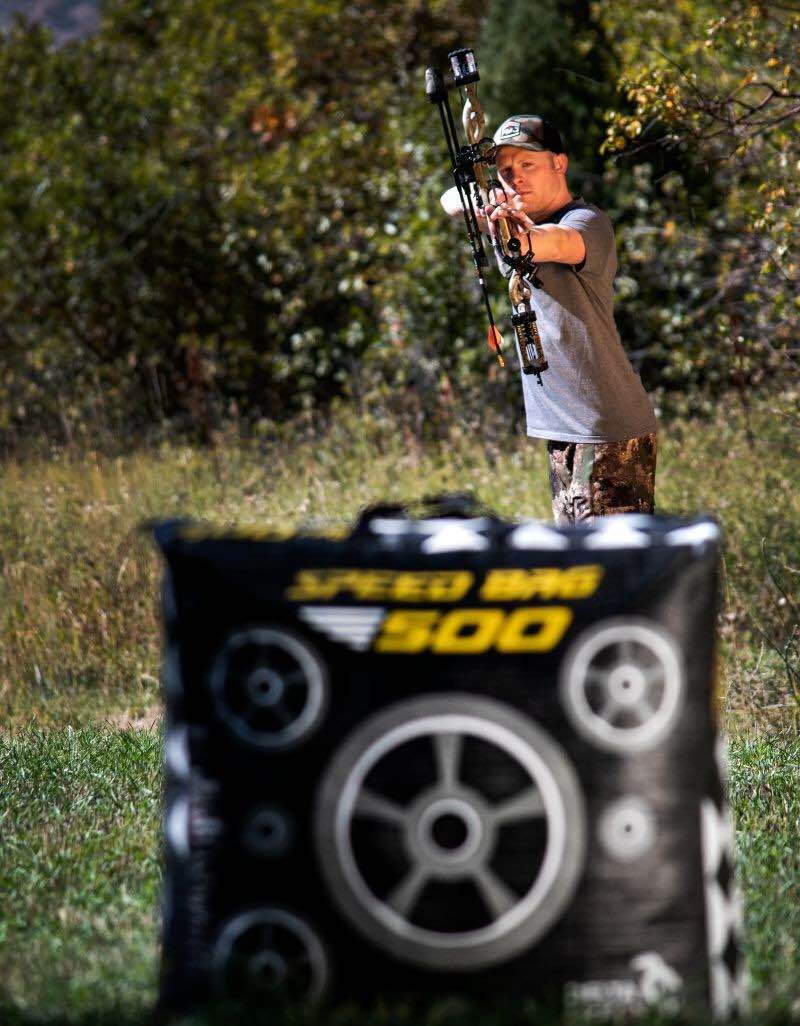
Morrell Yellow Jacket Kinetic X — This bruiser bag target handles arrows with speeds up to 500 fps and will last for years. It is weather resistant, offers four shooting sides with more than 50 spots, and is just 16x16x16. Shoot over summer and then take it to camp in autumn. $109, morrelltargets.com
Morrell Yellow Jacket Mod Pro 25 — This 35-pound bag target is 24x14x25, offering about two dozen target spots including large circles and tiny dots. It is weather-resistant, handles field points for compounds, crossbows and traditional bows. It is not recommended for use with outserts or field points larger than arrow shafts. $99.99, morrelltargets.com
Rinehart Speed Unlimited — This compact 20-inch x 20-inch target is built to stop the fastest crossbow arrows, thanks to a tough SpyLar woven mesh face. This self-healing material will withstand years of shots. It has 27 target zones and a MOA Grid design for crossbow scope adjustments. $219, rinehart3d.com