
Ever since the very first time I shot a bow and arrow, the feeling of seeing my arrow hit what I was looking at has been both gratifying, as well as downright intoxicating to be transparent about it. It never gets old, and I don’t think I’m alone here. For a bowhunter, carrying this feeling into the field translates into confidence, a key ingredient for success. If you’re not confident in where your arrow is going to hit, you’re not only doing yourself a disservice, but also the animal.
In a perfect world, we’d all maintain a high level of accuracy, no matter the situation. But the world isn’t perfect in the least, and there are things that can work against our accuracy, stripping us of that intoxicating feeling we love so much. These are the things I want to explore in this article.
Each person out there is going to have their own set of experiences to influence their opinions on accuracy. The information provided here is based on my own experience and that of others around me. There are certainly other things out there that can have negative impacts on your accuracy. These five, though, have been some repeated offenders throughout my time.
1: Face Pressure
Many years ago, after practicing at the archery range for the better part of the afternoon, I was struck by one of those lightbulb moments. On longer shots especially, I noticed I had been hitting left of center all of a sudden. I also noticed how tired I was at this point, and that I was leaning into my anchor much more because of it. Then I saw the light — the increased amount of face pressure from leaning into my anchor resulted in the left-of-center variance. Once I removed it, I was back in the center. Bingo!
Small things make big differences, and those differences are magnified at distance. Face pressure is one of those small things.
If a right-handed shooter were to dig the string into their face too much while at full draw, when the shot breaks, the string will essentially bounce off of the face causing the bow to kick left. This is why I was getting those left-of-center hits.
Since learning about this, I’ve deliberately tested it out. And at only 20 yards, my impact point was 1.25 inches to the left of center when intentionally applying too much face pressure. Once I applied a normal amount, which to me means the string is simply touching my face, not digging into it, I was back in the center of the bull’s-eye.

2: Release Technique
How we fire an arrow and the release type used both have an impact on accuracy. It’s so much more than simply pressing a button or pulling a trigger. If it wasn’t, we’d all be crack shots, but here we are.
In a nutshell, if you can engage your release, no matter what kind, the exact same way every single time, then you’re off to a very good start. The problems are knowing if you’re actually doing it the same way over and over again, as well as knowing how to use the release in general. The solutions are education and simplification of the whole process.
Education around knowing how to properly use an archery release aid is something that flies under the radar of most. This is particularly true when it comes to index-style and thumb-button releases. They are pretty self-explanatory, right? Just push the button or pull the trigger when your pin is on the bull’s-eye downrange. And then bad seeds are planted from there.
Believe it or not, there is a very simple process on how to engage any release out there. I’m not going to teach you how to fire every release in this article, but I will say that all of the methods strive to produce a surprise shot. That is the goal and the most effective route toward consistent accuracy. So, no matter the release, truly take the time to learn how to use them properly and commit yourself to it. Whether that means going to a coach, reading a book, or deep-diving YouTube, I promise you it’s worth it.

3: Focus
With any task, I believe it is far easier to focus on less than try to focus on a whole bunch of things at once. Focusing on too many things gets confusing and overwhelming. In the end, you’ll often end up going back to your old ways. With that said, when thinking about how to engage your release, simplify it.
Try and focus on one or two things, max. For an index release, it might look something like — Apply pressure to the trigger, then pull, pull, pull. Or for a hinge — Slowly relax my index finger, and don’t stop aiming.
The less you have to focus on, the more likely you are to build repeatability, which equals consistency.

4: Peep Alignment
As a youngster I never really thought much of a peep sight past the point of, “This allows me to see through my string toward my sight.” In all reality, though, a peep plays a vital role in accuracy.
Many if not all of you are familiar with anchor points — things such as touching your string to your nose, or your knuckle resting up against the back of your jawbone. These are things you feel to encourage repeatability. A peep sight is more of a visual anchor point in your eyes, or I should say “your eye.” It’s something you see to encourage repeatability. So, if your peep alignment is off, then your accuracy will struggle.
There are two main ways that a peep can be used to help accuracy through consistency. One is, while at full draw, aligning the inside of the peep with either the outside or inside of the housing of your bowsight. The other is centering the pin you’re aiming with inside the center of the peep.
Personally, I find aligning the peep with the sight housing to lend more toward repeatability, as well as consistency in achieving the alignment. To each their own, but if either is done inconsistently throughout shooting, your accuracy will suffer. Different views through the peep will result in different impact points downrange.
The best way I’ve found to get proper peep alignment is to draw the bow back with your eyes closed, get anchored, then settle in. Now, open your eyes. If you’re not looking through your peep in this natural state, then your peep is off and it needs to be adjusted. If you don’t, then you’ll be taking yourself out of anchor and forcing your way into your peep, which isn’t a recipe for accuracy.
5: Grip
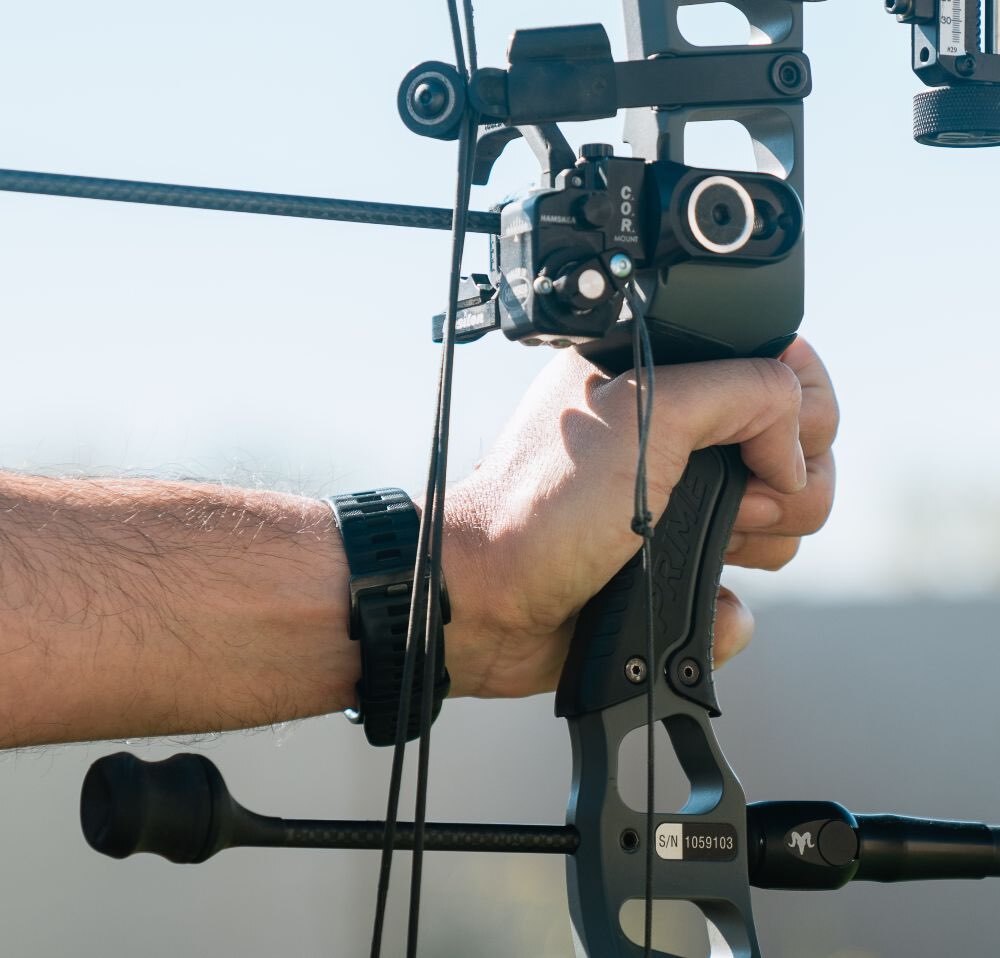
How you grip your bow has a significant impact on accuracy. Your grip needs to be consistent shot after shot. If it’s not, your arrow groups will show it. There are two ways I’ve seen poor grip technique influence accuracy — squeezing and imbalanced pressure.
Every year at some point I will see someone at the archery range gripping their bow like it’s an overstimulated dog trying to get away from them. The name “grip” is pretty misleading because I feel it insinuates that one must “grip” their bow. And from where I’m standing, it sounds like squeezing the grip of the bow. If you are doing this, it’s time to make a change, and you’re going to be way more accurate after the fact.
Instead of squeezing the grip, let it rest in your hand. Just place your fingers on the front of the riser, too. You don’t want to influence any unneeded pressure, because this will result in inconsistent shots. Let the bow shoot itself.
Before we move on, I want to mention something else I see on the opposite end of the spectrum from squeezing, and that is leaving your hand open on your grip. This is great until the shot breaks; folks will quickly grab their bow when they release an arrow. When you do this, you are influencing the movement of the riser, which 100% has an influence on your follow-through. The “quick grab” doesn’t bode well for repeatability.
Where that grip lands on your hand also matters. If this isn’t done the same way every time, you aren’t going to see the results you want. A good starting point is placing the grip between your lifeline and thumb pad. Some like it further one way or the other. When we’re at full draw, the pressure being applied to your grip hand will influence impact points. In a perfect world, that pressure would be straight back into your hand, but we all naturally torque a little.
The important part is that the bow hand placement is consistent, or else. For instance, if there is suddenly too much pressure on the left side of the grip, it will influence the bow to kick left on the shot, and the same for the opposite side.
Bonus tip: I recommend shooting with a relaxed wrist rather than a high wrist. A relaxed wrist will cater more toward an even backward pressure in your hand and is a much more sturdy platform. Shooting with a high wrist can be done, but it’s much harder to be consistent on those pressures because the bow doesn’t have as sturdy of a foundation to stand on. I’ve personally felt a high wrist to be more uncomfortable after extended shooting sessions as well.
Final Thoughts
If you haven’t put it together yet, the constant theme throughout this entire article has been consistency, both on the shooter and the equipment. When everything is done the same way time after time, and operating the same way in unison, you will see consistency. From that consistency, you can build upon your skill as a bowhunter/archer. An inconsistent shooter cannot do this because they don’t have a sturdy foundation to build anything on.
There is an old saying, “Learn to walk before you run.” Enjoy your stroll through becoming more accurate as a bowhunter, and take in every lesson one at a time.

Sidebar: Proper Bow Tuning
You can have all of the topics discussed in this article dialed, but if your bow is out of tune, it isn’t going to do you any favors on the accuracy front. The whole goal of tuning a bow, no matter what method, is to get the arrow coming out of the bow in a straight line time after time. This is going to help in achieving good arrow flight, which is a key ingredient in getting your broadheads grouping with your field points. If tuning is neglected, these things will suffer. You can even lose efficiency on penetration if the energy from your shot isn’t traveling straight down the arrow shaft. Try pushing an arrow into a target with the point on an angle. It doesn’t work well. Pushing it straight in, though? That’s entirely different.
There are many ways to tune a bow. You could bareshaft tune, walkback tune, broadhead tune, etc. You could also do a combination of methods, too. The one I’ve personally found to be the very most efficient and consistent is through paper. What the paper shows when an arrow goes through it is no lie. If I can get a bullet hole through the paper at both 3 yards and 6 yards with a fletched arrow and a field point, then my fixed-blade broadheads will almost always hit right with my field points out to 80-plus yards. This is a clear indicator of a well-tuned bow because the blades on a fixed-blade broadhead especially act as vanes and will 100% influence arrow flight through planing.
Keep in mind that in order to get the best results with tuning, you need to be consistent with your technique. It’s much easier to work with consistent variances rather than inconsistent ones.
Throughout the tuning process, make sure your bow specs are up to snuff, and pay close attention to cam timing, nock pinch and arrow spine. What I’m referring to with specs is your draw weight and draw length. If you go through the process, get things tuned, and then realize your draw weight was 5 pounds lighter than it should be, chances are you’ll have to re-tune if you increase it 5 pounds. A minimal increase likely won’t result in a re-tune, but a significant increase will weaken your arrow spine, causing the arrow to flex more on the shot.
If cams are out of sync then you’re going to get uneven pull vertically from your string on the shot, which is a culprit for elevation inconsistencies through paper and with broadhead flight variance. And the presence of nock pinch will cause your arrow to not leave the string smoothly and consistently time after time, which will also cause inconsistencies.
As far as the arrow spine goes, an improperly spined arrow will either flex too much in flight and not recover fast enough, or flex too little and recover so quickly it’ll take the arrow off course in flight. You need to nail this. Following an arrow spine chart is a great first step, but don’t be afraid to drift a little from there. For instance, arrow spine charts recommend that I should use 300 spine shafts. However, I’ve found that I group arrows the best with 350s. Results matter most.
Photos by Josh Kirchner