
2024 marked my fourth year of tracking wounded game for hunters in northern Minnesota. I have read the books, talked to hundreds of experienced hunters and guides, trailed blood for many miles and licked a lot of arrow fletchings, but most of all, I have faithfully followed a well-trained tracking dog — my German Shepherd, Stern — that knows much more than I do. (Click here for the Stern Game Recovery Facebook page.)
My few years as a tracker have left me with some exciting, surprising and sometimes downright strange campfire stories — here are a few of them.
The 1,000-Yard Bear
For a tracking team, black bear season in northern Minnesota is like Christmas and Armageddon rolled into one. The first two weeks of bear hunting run Stern and me absolutely ragged with nonstop calls.
Minnesota operates a lottery system for bear tags and often it takes years to draw a tag — for many hunters, the bear they call us to find is their first, and they’ve already exhausted every other option they can think of before they reach out for help. This was the case for Tom on a sunny morning in early September when he called me to track his first bear.
Tom had arrowed his bear the day before and immediately after it was shot, the bear fled quickly. Tom and his guide had tracked the bear 800-plus yards that night, finding his arrow on the ground along the way, until they ran out of blood. When they returned in the light of day, they had no further luck. I was already skeptical of a successful recovery and I told Tom as much. Statistically speaking, mortally wounded bears don’t usually run more than a couple hundred yards, and they tend to bed often within that distance. That said, bears don’t bleed much on account of their heavy-duty layers of fat and hide, and they hide in the worst terrain imaginable. Even bears that don’t go far can be a nightmare to find without a trained tracking dog.
Tom’s bear didn’t seem to have bedded or even paused to catch its breath during that 800-yard blood trail. I was frank with Tom that I didn’t reckon this bear would be dead, but Stern and I would try just to give him some peace of mind. Stern often isn’t interested in tracking a bear that isn’t mortally wounded, and I assumed she’d tell us in short order that this bear was long gone.
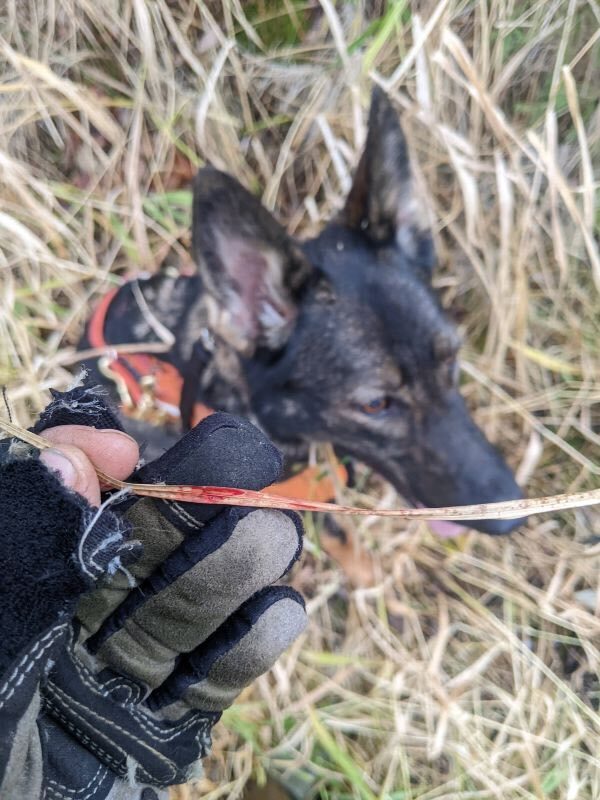
We arrived at bear camp to meet a cheering audience of hunters and the guide, none of whom had ever seen a tracking dog work before. I warned them again that this job may not be a sterling example of our work, especially if Stern didn’t think that bear was dead. I didn’t think Tom’s arrow looked promising, with minimal blood on the fletchings. I didn’t think it tasted like guts, either. I brought Stern to the hit site and asked her to get to work, fully expecting her to mill about the blood trail and then sit at my side and say “no way, Jose.” That disinterest in the blood trail happens often with marginal hits that don’t wound a bear enough for them to emit the adrenalized “I’m in trouble” scent that Stern is looking for. Inevitably, those bears live to see another day. To my surprise, Stern picked up the trail and took off like a shot, moving quickly and confidently with her nose glued to the ground. I fell in behind her at a good clip, and the guide announced we were right on the trail. “She likes your bear,” I said, “but don’t get too excited. Just follow me.”
Stern covered the hunter’s established 800 yards of blood in five minutes flat. As we approached the point where the hunter and guide lost blood, the dog didn’t miss a beat, but took a hard turn west with the intense focus of a chess grandmaster. Again, I called to the hunter and guide, “Don’t get your hopes up!” My own hopes were decidedly up — Stern was serious about this bear.
At this point, there was no more visible blood, but we continued on another few hundred yards until we came to a pond edge ringed with reeds and cattails.The guide was right behind me, but Tom and another hunter had fallen behind some. I spoke over my shoulder to the guide as we trudged along the edge of the pond, “This is where I’d be if I were a dead bear, but it’s gone a heck of a distance by now.”
While Stern brought us steadily through the reeds, I pulled out my phone’s tracking app to check the distance we’d gone (over 1,200 yards) and turned back to the guide to tell him as much.
When I turned back to Stern, she was in the pond, standing on something floating just off the bank. It looked like a log. I called to her, a bit unimpressed by her apparent detour, and she turned to look at me with a mouth full of black fur! The “log” she was standing on was a very soggy bear.
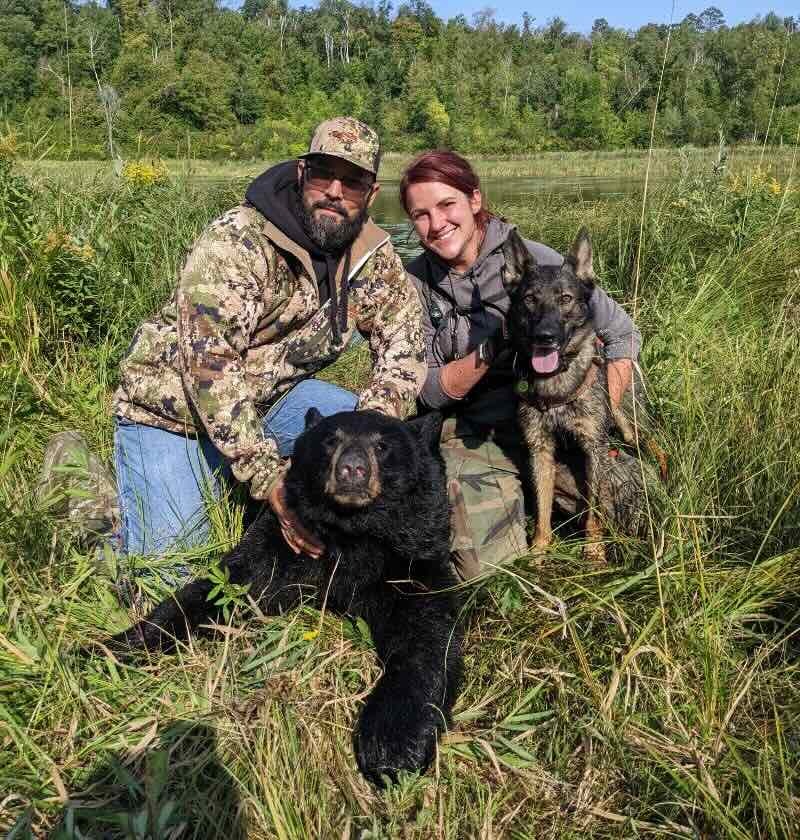
All told, Tom’s bear was one of the toughest animals Stern and I encountered in 2024. It ran the better part of a mile — an Olympic distance for a dying black bear — before dying in that pond and submerging itself almost completely underwater. Tom’s arrow had passed through one lung and exited through the intestines.
Cornfield Spinal Shot
John was hunting over a monochromatic cornfield in early October where a good-sized 4x4 whitetail had been making the rounds. John got a shot at this buck in the late afternoon, and as these things happen, the buck ducked in its tracks at the last possible second and the arrow hit high. The buck dropped like a sack of spuds. It flailed in the dirt, kicking plumes of dust in all directions with the arrow sprouting out of its back. Before John could levy another shot, the buck collected itself and took off into the corn, leaving behind the back half of a broken arrow.
When John returned in late evening to take up the blood trail, he followed scant droplets in the corn for 100 yards before he found the front half of his arrow. When John bent over to pick it up, he heard the buck get up and take off ahead of him, crashing straight toward a nearby dirt road. When John came back at first light, he walked the edge of the corn to check that dirt road. There were a few splotches of blood between the near edge of the corn and the road, but nothing on the other side of the road to help him determine where the buck went after that.
When John called me and explained what he’d seen, I could picture that buck kicking and fussing in the dirt clear as day — I’ve heard this story many times. Among trackers, this sort of high back shot is known as a spinal shock. It’s an outcome a hunter might see only once in a lifetime, but a tracker sees regularly.
In every case I’ve experienced, without a well-placed follow-up shot, a spinal shocked deer will live to see another day. They often leave a decent blood trail that dries up to nothing over the course of a few hundred yards, as muscle wounds tend to do before clotting up, and this can make it especially difficult for a hunter to believe what he’s dealing with — until the deer shows up on his trail cams. This sort of shot placement tends to completely miss vitals and simply strum the vertebrae like a guitar string, the cervid equivalent of hitting your funny bone.
I felt sure this would be the case for John’s deer as well, but he was happy to have Stern and me out to help nonetheless.
Stern plucked along the 100 yards of known blood in no time, and she brought us right to where John had heard the buck get up. Here, I examined the pointy end of John’s arrow. While I looked over the broadhead, Stern paused to check the breeze with her dusty black nose in the air, and suddenly changed her trajectory from a steady pace toward the dirt road to a mad dash heading completely away from the blood trail and dirt road.
Stern knew she could take a shortcut thanks to the breeze. She trucked right up to the buck laying dead in the corn another 50 yards away.
“John, I don’t think your buck crossed that road after all.”

John’s arrow had won the game of inches. Passing through the tops of both lungs, it had been caught in the underside of the spinal column and gotten wedged in between the vertebrae. As best I could figure, that was the cause of the buck dropping like a typical spinal shock — but as the buck had gone through the motions of a spinal shock’s telltale thrashing, the arrow broke inside the animal, leaving half of it in the dirt where it had been shot, and the other half working its way through the deer further down the trail. A small broken section of the shaft had stayed in the buck.
Even still, this buck was a tough son of a gun. It doubled back instead of crossing the road and bedded again several rows down. It’s fairly common for wounded deer to do a “J hook” or even completely backtrack on their own trail when they know they’re being followed. John’s buck used the last of its strength to pull the best trick it knew.

Frontal Shot
Jay shot a bear on a pleasant Sunday afternoon, as it sat on the bait facing directly toward him.
As a tracker, hearing about a frontal shot always makes me wince — I candidly tell hunters that a shot like that will either kill the animal in 50 yards, or they will go forever. If you’re calling a tracker, then you can imagine which of these two outcomes is more likely. Jay and his guide had tracked the bear 150 yards to where it crossed a creek, then called us to help.
Stern and I arrived the next morning. We crossed the creek where Jay and his guide had left off, found blood on the other side, then crossed back again — more confirmed blood further down the bank. The bear had zig-zagged across the creek and back again in very short order. I asked the hunter to stand on the last spot of blood we’d found, as we continued down the bank with the guide in tow — incidentally, the same guide who worked with us for Tom’s marathon-running bear earlier in this article. This guy is a trooper.
We followed Stern at least 500 yards along the creek bank with no blood to show for it, until we came to a thick stand of willows. Without skipping a beat, Stern brought us to a small tunnel of branches and matted grass, and I was forced to bellycrawl into the tunnel after her. There was a swipe of blood along a branch at shoulder height as I crawled in.
About 10 yards along, Stern stopped, ears pricked and very still. I wriggled my way up until I could see a bed beneath her, but clearly no bear. Behind us the guide had fought his way into the thicket without as much crawling as I’d done, but he swore that he couldn’t even see the dog and me for all the branches and claustrophobic mire ahead of him. This is the type of godforsaken cover I expect to find a bear in. “Can you come this way? The dog’s got something, but I can’t even stand up here.” Obliging, the guide waded through the willows beside and ahead of us. Stern never moved and barely glanced at the guide as he came past. She was focused on an impenetrable wall of sticks and reeds. For all the grumbling that the guide and I were exchanging about the mess we’d lumbered into, we almost didn’t hear the only warning we were going to get before things got very exciting. A twig snapped softly, somewhere to our right. I couldn’t see a thing from where I was behind the dog. I very nearly told myself we were hearing a grouse or woodcock, until Stern began to growl.
The twig growled back.
Just like that, we made up our minds to get out of Dodge. There was no telling exactly where that bear was, and if it wanted to pick a fight, then it was going to have to follow us out into the open.
I elected to back us out of the tunnel the same way we’d crawled in. I took Stern by the collar and began to haul her out of the thicket, dragging her along behind me while she refused to look away from the last place we’d heard her bear.
Using one arm to guard my face from the slash and the other to haul the dog along, I was reduced to shuffling along on my knees, hardly looking anywhere except directly to where the tunnel would spit us out onto an open bank.
I hadn’t even seen it coming. All at once I was holding a snarling, barking valkyrie by the collar, and as I turned to look — just a few feet from us — was the bear! It had doubled back into the tunnel with us and was very nearly on our heels. The bear got within a few feet before cartwheeling in its rush to escape from the raging hellhound in its way.
All bears look bigger on the paw than they truly are, but especially when they surprise you in a tunnel. Even so, this looked to me like a very big bear. I held onto Stern for dear life, and I hollered as many impolite words as I could think of until the bear’s hindquarters had disappeared into the thicket again.
I dragged us through the last stretch of the tunnel like someone had lit a match under me.
Now in the open, the guide and I decided to retreat, collect our hunter waiting patiently back at last blood, then return in the morning to see if the bear had given up the ghost. However, later that evening, while tending to the cows on the further side of the creek, the guide spotted that bear gingerly making its way along the creek bank again, lame on one shoulder and clearly a bit worse for wear.
When we returned in the morning with Stern and several more people, the bear was long gone. I, for one, was not sorry to see it go, but if Stern could have taken another crack at it, she would have.
Sidebar: Busting Blood Trailing Myths
As a tracking dog handler, I encounter a new wives’ tale about wounded animal behavior just about every day. A few quick myths I can dispel from experience:
Myth: Gut shot animals always go to water.
Stern and I have found just as many dead deer in the opposite direction of the nearest creek as we have deer that went to it.
Myth: Wounded deer never go uphill.
Wounded deer can and do travel uphill, across roads, over fences and through suburban yards.
Myth: Bears won’t return to a bait site where another bear was shot.
I’ve seen bears hit a bait while we are 20 yards away tracking the blood trail of a bear shot hours beforehand.
One “rule” of wounded deer behavior that I do find consistently is this: They want to return to familiar bedding. They will go through hell and high water to do so. Important note: This poses a big problem during the rut, when bucks may be roaming miles from home.
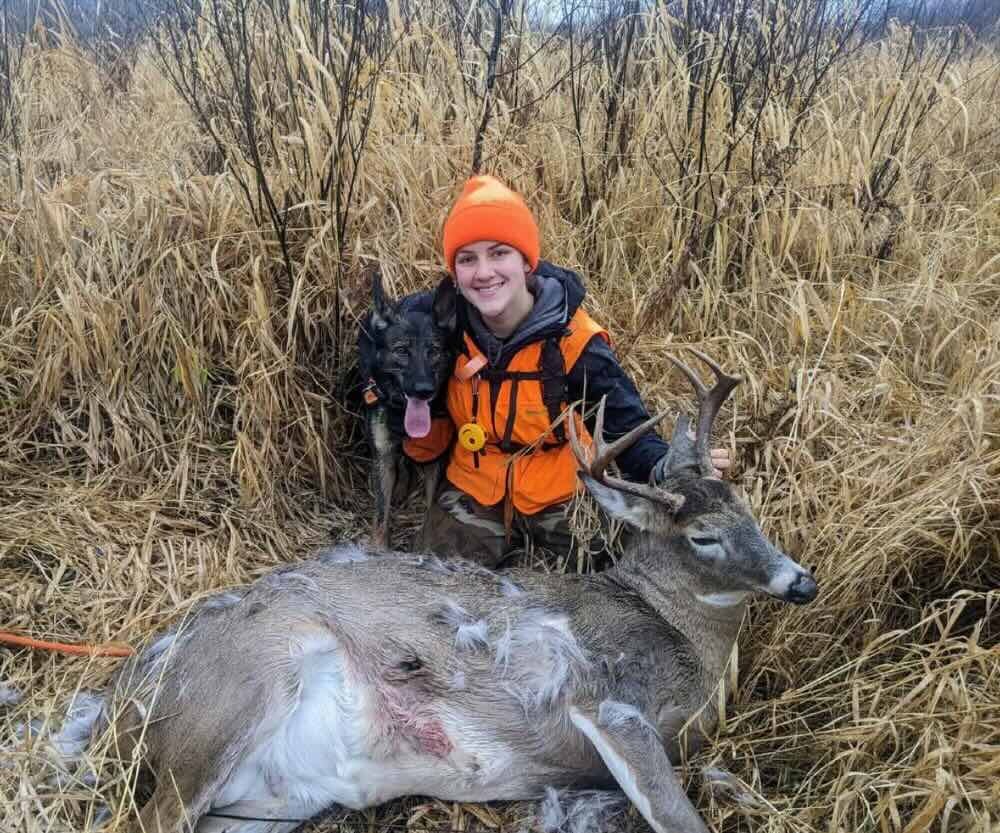
Statistically, wounded deer will normally be found within 600 yards of the hit site — during the rut, this rule of thumb often goes out the window. Black bears, on the other hand, tend to stay close by. Of the dozens of bears we have recovered, most have died within 400 yards of the hit site.
Images by Juliet Flint