
For hunters who commit themselves to playing the public land game, one of the 10 Commandments to consistent success is clear: Stay mobile! Or at least, that’s one of the many conclusions I’ve reached after several decades of chasing whitetails and turkeys around some of the wildest and most remote public lands of the upper Midwest.
Early on in my deer hunting career I learned that nothing helps you stay mobile and hunt the hottest sign and patterns as truck camping. And that takes me way back to my first-ever trophy 10-point bagged way back into a far-north Wisconsin wilderness area bordering Michigan’s Upper Peninsula, with the help of my trusty topper-equipped GMC S-15 4x4. Those types of wilderness trips eventually led to hunting out West for mule deer and elk, where truck camping, for many DIY hunters, is integral to the experience. Eventually, after acquiring all the necessary camp gear and tweaking my choices over time, truck camping just became part of my regular approach for Midwest whitetails as well.
Recently, when it was time to upgrade my vehicle, my search focused squarely on a great “go-anywhere” choice for truck camping, and I landed on a proven, if not legendary 4x4 — the Toyota 4Runner. Close runnerups were a few different brands of full-size trucks and even the popular mid-size Toyota Tacoma pickup — any of which I would have outfitted with a top-notch topper, and likely, would have worked nicely. But I’ve been very happy with my seemingly bombproof, trail-friendly 4Runner. Especially, after tweaking it a bit for hunting/camping efficiency. Here’s how it went.
Tires Lead the Way
In the past, while driving somewhat lesser vehicles, I’ve been temporarily stuck/stranded on my share of muddy/marshy backcountry two-tracks. Especially, during the soggy wetness so common during stretches of early fall and spring shed hunting, after a long winter’s thaw. So the first modification made to my 4Runner was trading in its stock all-season tires and upgrading to a much more aggressive all-terrain tire. I wanted a set more suitable for off-road hunting adventures.
After researching my tire options I settled on the aggressive and highly rated Falken Wildpeak AT4s, and I have not been disappointed. The 265s I purchased were two sizes larger than my previous set of 245s, and the largest my 4Runner could handle without serious body/wheel well modification (at this stage a no-no because it would void my factory warranty). At least one tire shop employee was a bit confused that I was swapping out tires with virtually no wear. But hey, from where I sit, hunting is serious business. And now that my 4Runner has been through its share of dicey terrain, I can report that the aggressive Wildpeaks have delivered and then some.
A Worthy Roof Rack
A major goal while modding out my vehicle was to do it as budget-friendly as possible, but one more splurge was on a high-quality full-length roof rack. After much research I settled on The Drifter by Backwoods Adventure Mods ($1,200), and for several reasons. Before I get into specifics, know that I’m not a fan of the stock Fifth Gen 4Runner roof rack, a barebones partial-coverage design that requires some type of modification/add-on to carry the kind of gear I deem essential. Two of my must-haves are canoes and kayaks — whichever suits the situation best. Most all the reasons why center on accessing areas, typically remote public stretches, where others are unlikely to go.
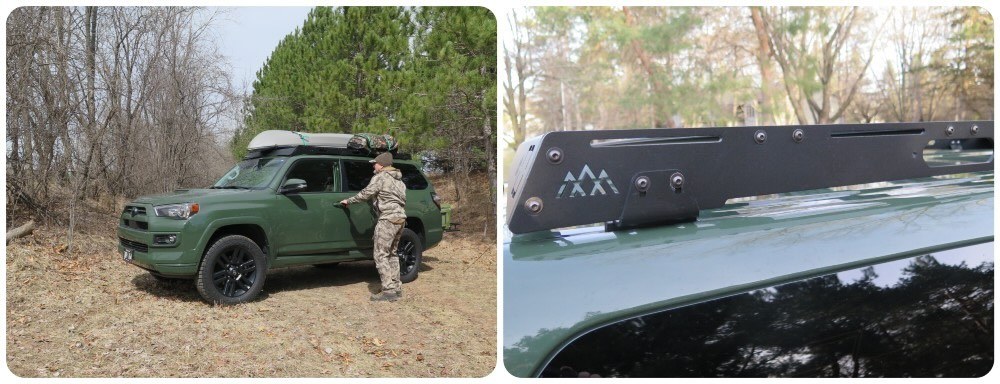
My Drifter Rack is as stable and strong as they get, easily able to support a heavyweight roof-top tent — although I’m not a fan of that tent style. As we’ll talk about later, I'm a much bigger fan of a traditional ground-level tent camp for the extreme versatility it affords, coming and going with my vehicle as needed without having to break down camp.
Make no mistake, getting away from the competition was a major reason I sought out a go-anywhere-type vehicle. But with the popularity of ATVs, especially high-performance side-by-sides, you’re not leaving anyone in your dust with a 4x4 alone. Not even close. For that you must find other barriers to access and for me, waterways — in the form of swamps, creeks, rivers and lakes — have reigned supreme. Many longtime public land-hunting gurus agree, and I had to smile recently when watching a recent YouTube podcast featuring John Eberhart, a Michigan-based saddle-hunting/public land expert who has arrowed more than 50 P&Y bucks on public lands. His name is well known to many public land devotees.
When questioned about typical places he’ll seek out to hunt in heavily hunted Michigan, Eberhart has some strong thoughts.
“If I can walk to a location on public land in Michigan, I don’t care how much sign is there, I won’t hunt it. Because somebody else will have found it also,” he said. “I’m looking for locations other hunters are not willing to go. In Michigan it’s very rare I’m not donning a pair of hip boots or waders, or using a canoe. I’m crossing deep creeks, rivers — accessing places other hunters are not willing to go, or don’t take the gear to go to those places.”
I’ve been a fan of John’s for years and that statement confirmed we are on the same page. Considering the areas I hunt in far northern Wisconsin and Minnesota, my approach is much the same. Each fall my truck holds both hip boots and waders; I’ve worn out several pairs of hippers used for deer hunting exclusively. My choice in hippers these days is the Burly Hip Boot by LaCrosse, a rugged design that’s holding up nicely. They are always within reach in the back of my 4Runner.
A Sweet Hitch-Haul Bargain
Again considering my goal of keeping my build budget-friendly, I hit the jackpot with my rear hitch hauler, which I consider a necessity for several reasons. After much research considering several models that retailed for more than $1,000, I settled on the Haul Master ATV Cargo Carrier from my local Harbor Freight, which I scored on sale for about $50. A huge win. The great thing about this rugged steel hauler designed for ATVs — which its extensive reviews prove is being used on full-size trucks and vehicles of most any size and shape — is the fact that it is angled upward to avoid bottoming out in uneven/rugged terrain, which it also does nicely on trucks. And in my case that elevation keeps any hauled cargo out of harm’s way of my 4Runner’s rear exhaust. That’s a win-win.
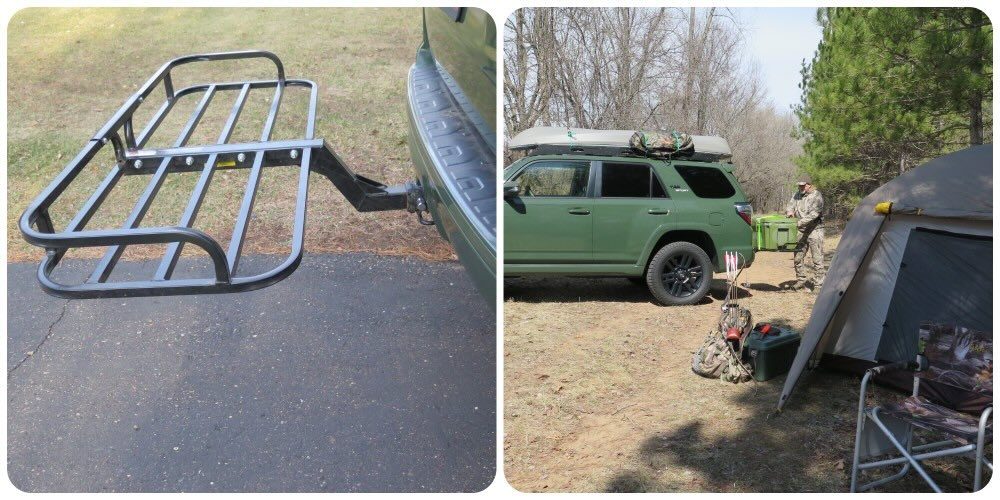
Why add a Hitch Hauler? Its 300-pound capacity and 24- by 48-inch haul platform will easily carry a large 85- to 120-quart full-size cooler (required on any DIY hunt trip where big game is expected). And in my case, the extra haul space is needed due to giving up the convenience of a full-size truck bed. Once in camp I can stash the cooler in my tent or in the back of the 4Runner, and use the hauler and a few ratchet straps to tote a deer carcass quickly and easily back to camp. No stashing the bloody carcass inside the back of my 4Runner, no attempting to struggle it up on the roof. Pro Tip: Don’t forget to also purchase a Haul-Master Anti-Rattle Hitch Tightener ($12) also found at Harbor Freight. With this little hitch-haul-silencing gem you won’t even know your hauler is back there.
3 Ways To Backcountry Scent Reduction
Over the years while hunting remote in- and out-of-state properties, I’ve spent my share of cash on motel rooms and in restaurants, trying to maximize both comfort and efficiency. And while that approach was heavy on comfort it was also very expensive and not very efficient. Typically, available motels were nowhere near prime hunting areas, requiring long gas-guzzling commutes that required rising extra-early and also, forcing regular gas station stops. Camping near your chosen hunt areas and prepping your own meals eliminates or reduces much of these types of hassles.
What about regular scent-reducing regimens? Dedicated whitetailers will want to figure out some type of system that makes sense, but one of the best I’ve found is a three-pronged system that comes highly recommended. First is some type of “sun shower” elevated bag-type water-holding system you can hang from a tree limb, allowing me to shower while standing on a simple outdoor-rated plastic mat to avoid mud. The second part is disposable, scent-free, washcloth-type wet wipes that can quickly get you scrubbed and ready for the day’s hunt and freshen as needed. For these I favor the Scent Killer Gold Field Wipes and Heavy-Duty Washcloths from Wildlife Research Center. (wildlife.com)
The third part of my scent regimen might be the most critical. It’s my HuntStand app that helps plan my day of scouting or hunting. It not only shows me detailed 3-D maps of my chosen area, but also delivers accurate, hour-by-hour wind and weather forecasts. The net result is I am always playing the wind whether scouting or hunting, helping pinpoint the best stand access routes. And all that is just the start. The HuntStand app (huntstand.com) has too many additional, hunter-friendly features to detail here, but suffice to say that a premium hunting app comes highly recommended when hunting remote.
The only real downside to hunt app usage is you’ve got to find a way to keep your phone charged in the remote backcountry for up to a week or more. To date I’ve gotten by toting a handful of small, ultra-portable power banks (some not much larger than a deck of cards) that I can keep in my pack and fully charge my phone three to six times each.
I’m just now considering upgrading to a larger portable power station such as those offered by companies like Jackery and Bluetti. With these types of larger but still portable (12 to about 20 pounds) power stations, I could fully charge one before a hunt, keep it in my vehicle, and use it to recharge my phone and other gear nightly. For extended hunts, some of these stations also offer the option to pair with solar panel chargers. You can purchase such power stations for about $200 to $350, with an additional $200 to $300 for a solar panel charging system. Something to think about if you also have camera batteries and/or laptop to charge, or if you frequently run multiple rechargeable gear such as headlamps, lanterns and flashlights, or portable electric refrigerator/cooler.
Build What You’ll Use
Is it time to build your own hunting-focused vehicle? While I’ve decided to keep my own rig somewhat barebones, if this article strikes a chord know that the possibilities are nearly endless. As proof, a search on YouTube will expose you to dozens of custom car-camping setups, including some truly amazing build-outs with elaborate beds, shelves and other gear storage.
As stated, I like the option of a tent-focused base camp and overnighting in my truck as needed, but the options are all yours. Regardless of the details of your build, your own hunting 4x4 will give you some welcome abilities. So equipped you’ll be able to explore new areas you might have otherwise overlooked, all the while increasing your hunting efficiency, enjoyment and very likely overall success. Remote stretches that once had you simply dreaming about the possibilities can now become your regular stomping grounds. And if you’re like me, that type of adventure, and freedom, equates to a little slice of hunting heaven.
Sidebar: Smart Mobile Camp Accessories
In my opinion no hunt-focused vehicle is complete without a spotting scope and window mount for scouting on the run. For farmland hunters the benefits are obvious, especially in August, September and October watching for activity in ag fields. But even though my “home turf” is the no-ag big woods of northern Wisconsin and Minnesota, I still find plenty of use for a spotter, especially in recent clearcuts. In my neck of the woods paper-company-managed clearcuts are on the increase, and a few hours spent scouting them in the first and last hour of daylight can be time very well spent.

I’m currently running the ultra-compact and value-packed Nature-Trek 13-39x56 Spotter by Hawke Optics, ($359, hawkeoptics.com) which includes a window mount. So it’s always at my fingertips when cruising backroads, and at 9.6 inches is compact enough to fit easily in a pack with a small collapsible tripod when I head offroad.
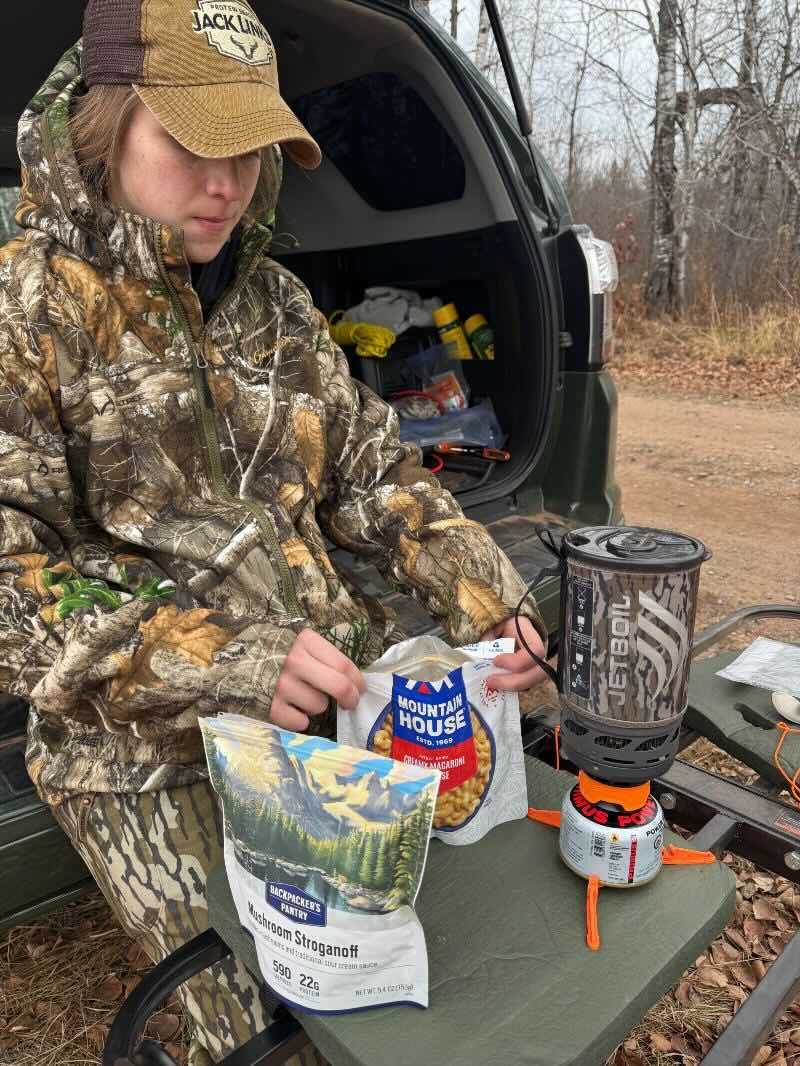
I like to maximize every precious daylight hour of a hunting trip, and because of that a JetBoil 1.0 stove ($120; jetboil.johnsonoutdoors.com) is always handy. Boiling water for morning coffee and oatmeal is a speedy no-brainer, and I’ll also lean on my JetBoil to prepare lunch and dinner (typically freeze-dried meals). Quick, simple and easy. The result is that I get into the woods quickly in the predawn, and am able to hit the sack early in late evening to fully recharge for the next day.

When you’re hunting and camping and providing for yourself 24/7, tools that can pull “double duty” not only help reduce gear and hassle but help make you a more-efficient predator. To crack my arsenal they also must be rugged and dependable, and the Bear Valley Tactical BV-TAC 8 Multitool is a great example (bearvalleytactical.com). At $200 it’s not cheap, but consider the insane versatility of this heavy-duty U.S.-made (S7 tool steel) tool: Among its functions are hammer, axe, pry bar, stake puller, and 7/16 & 5/16 wrenches. In addition, smart add-on components include a shovel, pick and hoe — and bow-saw and sand anchor attachments are currently in the works. Need to dig a vehicle out of trouble, stock the woodpile or dig a camp latrine? With the TAC 8 you’re good to go. Available in wide-ranging Cerakote colors, I got mine in Coyote Tan with a bright orange paracord handle to prevent loss in brushy/grassy terrain.
Organization is critical when you’re looking to sleep inside your vehicle, or haul tents and other gear efficiently. Rugged but lightweight Plano Sportsman’s Trunk ($20-$50; planooutdoors.com) help keep my kit together, protected and handy when I need it now. I make use of two: the small and medium, to hold my axe, saw, extra rope, lantern, portable jump-starter, Jet Boil stove, freeze-dried meals and plates/spoons/bowls. There’s also room for a vehicle tow/haul strap and hitch mount D-Shackle that could help pull my rig out of the ditch if necessary. The boxes’ water-resistant design means I can stash them outside my truck when sleeping inside, or store in my tent when I go that route.
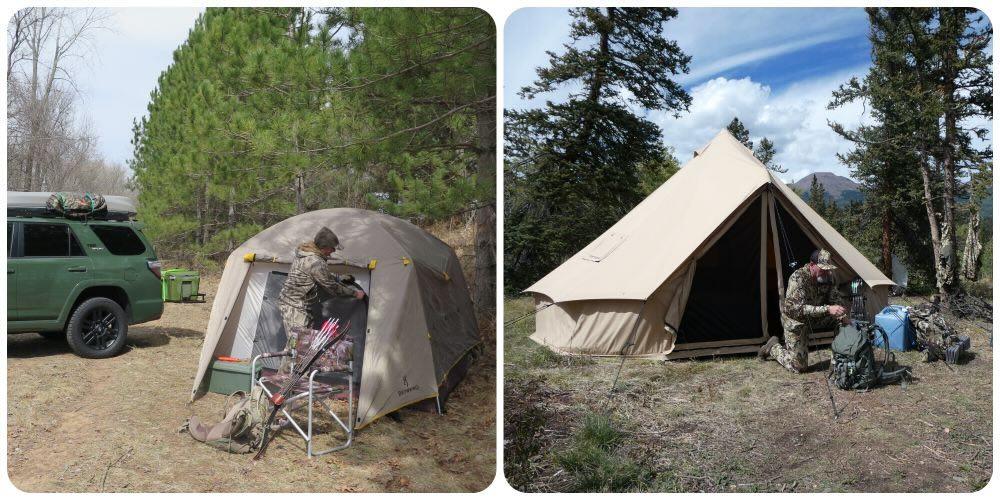
I love the option of simply sleeping inside my 4Runner when scouting new areas and staying ultra-mobile when that makes sense. But my first choice when truck camping is almost always to set up a base camp — complete with a nice roomy tent that for me offers the most sleep comfort and efficiency. My Browning Glacier 4-Person Tent ($500; alpsbrands.com) technically sleeps four but is ideal when hunting solo with all my gear, and can easily accommodate a buddy and his cot/gear when needed. The rugged bombproof design has easily withstood snowstorms and high winds with no hiccups, with plenty of room to stash a full-size cooler and other gear boxes — while I have the option to range far and wide with my 4Runner during the day, scouting and hunting several different spots.
When the goal is a week or longer stay with two or three hunters, I will instead pack my immense WhiteDuck 16-foot Regatta Bell Tent (a huge 16-foot circle; whiteduckoutdoors.com) that offers the comfort of a full-size wall tent but can be set up much quicker and easier (15-20 minutes) even when solo. Originally acquired for use as a base camp for western elk hunting, this $950 canvas tent packs down nicely but is somewhat heavy (about 90 pounds). Regardless, it’s simply the cat’s meow for extended trips. It also offers the ability to include a wood stove. For heat during hunting trips I choose to pack along a no-hassle propane-powered Buddy Heater, firing it up quickly in the morn to get the tent warm enough to comfortably dress in, and again in the evening, to get things toasty in there before bed.
For all-night comfort? That’s taken care of by my choice in high-quality sleeping bags. Back in my younger years I was a big proponent of extreme mummy bags, which were really the only smart choice for max warmth back then. But these days there are a number of equally warm but much more comfortable and roomy rectangle-style bags, including two I use regularly: The 0-degree Big Timber Pro bag by Slumberjack, and when things get seriously cold, I’ll haul the incredible Redwood minus-25-degree bag from ALPS Outdoorz (alpsoutdoorz.com). Sleeping cold while hunting hard is never an option.
Photos by Mark Melotik