
As “hunting” is pretty much seeking or searching, hunters should be somewhat skilled at it. After all, that’s what they do. But the measure of success in any search is in the finding. You can’t be good at looking for something if, more often than not, you don’t find it.
I’m not a good hunter. Mostly I miss seeing animals I want very badly to find. Quail, for instance. Closing within feet of a white setter that’s visible at two kilometers, I look where it is looking. No quail. Dog insists. Another step, and my boot is darned near brushing its nose. Nada. The snarl of weeds is no bigger than a house salad. I kick it anyway, to show Dog he’s wrong. He’s not. My missing with both barrels sends him off on a sulk. Like other bird hunters, I’ve overlooked even crouching roosters, painted as only the Chinese can.
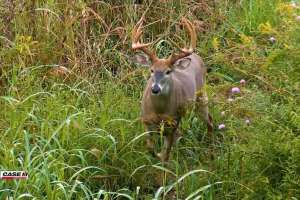
This past fall, a lad failed to spot a deer catching early sun on an open prairie against retreating shadows — though, pointing, I shoved my elbow against his cheek. “Right there!”
Few hunters, however, have bumbled into a rhinoceros. I have. Just shy of contact. The bush was neither thick nor poorly lit. Had the beast come instead of gone, it would have flattened me in two steps. Actually, flattened us. “Close one, that.” My companion was a professional hunter, someone paid to see animals before his clients did. “If we were hunting rhinos, I’d owe you an apology.”
All animals can evade detection in cover. A coyote hiding behind basalt is no less present; the rock simply blocks our view. Distance can do the same thing. A fox a couple of miles off can stare back from the skyline without revealing itself. While in good light a healthy human eye can distinguish detail to a minute of angle, it can’t unfailingly make an animal from a piece that small.
Creatures as dim as pheasants, with an average life-span of nine months, learn that hiding from hunters entails less risk than jumping up to escape them. They seem to know the human sense of smell is worthless, that hunters hurry when they look and will more likely pass by than spot them. Larger game, aware hunters avoid thickets, have honed hiding to a fine art. They see but are not seen, natural features in front and behind breaking up their profiles and obscuring all but shards that don’t readily register as parts of a whole. Animals with good noses and ears track hunter progress around them without bringing their heads off the ground. One buck in a tiny patch of scrub let me hunt past a fly-rod length away. I saw him with a lucky glance back.
Camouflage blesses some creatures, mostly small ones — toads and moths, for example. Oddly, few big mammals are boldly patterned. Zebras, leopards and tigers come to mind. In photographs, their striking appearance seems hardly in keeping with camo. Black spots on bright yellow, black stripes on orange and white? Where could they blend in? Well, just about anywhere. A leopard can be as hard to see in tan grass or green bush, or against slate-hued rock, as in forest’s dappled shade. Depending on their angle to the sun, zebras on open veldt may not appear striped.
Markings steal our eye from the profile of a motionless animal. Movement upstages color and contrast; dust obscures both. A lion craving zebra might be momentarily confused by a tide of stripes racing by.
Built to Blend
Deer and elk, and some of Africa’s big antelopes — kudu, eland, waterbuck, blue wildebeest, red hartebeest — have white or black highlights but are mostly solid brown, gray or russet. Ditto predators, from coyotes to lions. A motionless bobcat can appear as small earth-colored patches against background not much different. Creases of muscle and bone, and the brushwork of hair become background, too.
Sometimes it’s helpful to look between and beyond what we know is not animate. Creatures that roll in dust and mud meet the eye as dust and mud. Hence my rhinoceros surprise. It’s why in thick bush ivory hunters often found themselves within spitwad distance of elephants before they saw them. While these beasts seem too big to escape notice, their hide is mottled by shadows, and by the patches of earth our eyes accept as unimportant. Creases in the skin become lattices of branches. Up close there’s no visible profile because the creature is too big. It becomes a mural of the insignificant, so vast we must move our eyes to peg its height and breadth.
Stateside, even game of modest size slips our gaze in the same way. Our eyes are slaves to our thinking. They crave details peculiar to the quarry — say, deer. We’re programmed to search at a certain height above the ground (usually too high!), and to look for specific forms or colors. New hunters want to see a deer. Veterans make do with a horizontal back-line, the dull gleam of antlers, a white tail border, the glint of an eye. But even those clues are gifts. To see more game is to discern the less obvious.
Looking low is a good start. Engaging other people, we’re used to looking straight ahead. We put computer and TV screens, mirrors, microwaves, household thermostats, taxidermy and wall art near eye level. So habituated, we gaze over the backs of most North American game animals. A whitetail buck, 42 inches at the shoulder, is a big deer. Bedded, it’s ankle-high. A reclining coyote is no taller than a can of beans.
You’ll see more deer and predators when you inspect cover as if looking for a lost rabbit.
Also, you’ll see more of everything when you’re still. When an animal — predator or prey — wants to scrutinize a suspect form, it becomes stone-still. It can’t see well when moving. Neither can you. Brush and hillsides sliding by as you walk become blurs, erasing detail. The flick of an ear is canceled by your own motion. Glassing while moving the binocular — panning — has a like effect, magnified by the lenses.
Even when you try to hold it motionless, the bino exaggerates quivers induced by your pulse and twitching muscles and wobbly joints. Steadying the glass with shooting sticks or against a tree, or resting elbows on knees from the sit is a pious idea. One-hand binocular use can give a quick read on an object or movement suddenly obvious, but effective glassing requires two hands, plus any support you can muster.
To keep track of where you’ve glassed a landscape or a patch of cover, read the field of view with a still binocular as you might the page of a book — left to right, top to bottom, Then shift the field to bracket the adjoining patch of hillside or cover. Still-hunting, stop often where you can look back and to the sides, ideally where you have lanes of fire.
Use Logic to Locate
At any given moment, game can be just about anywhere. But you haven’t unlimited time to find it. To improve your odds, look where logic and your knowledge of the animal tells you it’s most likely to be at that time of day. Then probe less likely places that might appeal to pressured game. On one mid-season hunt, a friend and I prowled a complex of canyons, looking for a big mule deer. The first day we saw several bucks, the next day, fewer. Sightings diminished as the week spun out. The last morning showed us no deer.
While packing up at the cabin, my pal opted to make one last pass solo through gentle headlands. He drove up just before I left, a dandy muley in his truck. “I got lucky,” he conceded. “Too much of too little on those flats.” In other words, where no cover looks good enough to hold deer, nearly every clump of grass is good enough. We’d already covered the best places. This deer had found peace in a weed-patch hunters hadn’t bothered to kick. Scott had been persistent. He’d also targeted possible hideouts repeatedly with his binocular, knowing that as the sun moved, a slight change in its angle could reveal pieces of deer.
Animals eat where the food is good and access is easy. But hunting pressure can put them off those places. Security matters, especially to game old enough to weigh risks against rewards. Foraging at night, animals can tap preferred places safely, but if travel at the edge of day proves hazardous, they might move to adjacent range or just eat on the cheap where hunters don’t go. They bed with an eye to concealment, thermal protection, wind coverage, escape routes and traffic. Often woody cover that looks secure to us can be less appealing to game that’s been rousted from it or has dodged a missile or two from treestands.
A pal once shot a big buck on close-cropped pasture after hunting for a week in “ideal” cover on slopes above. Bedded in ravines and eating at night, this deer had simply lived where hunters didn’t look.
Animals such as coyotes, pronghorns and Western deer are adept at using landform to conceal their movements out of cover, traveling from bed to food source and back, or just foraging in the open. In the bellies of coulees and irrigation canals they can scoot from one plum thicket, hedgerow or corn field to the next undetected. They slip over barren spines quickly. Knowing they’re vulnerable, they often duck their heads to run low or open the throttle to spend less time exposed.
These days, as long-range rifles, loads and optics tempt shooters to fire at game once too far for a shot, animals are wising up. Once, riding through aspens just before sunup, I heard elk moving. My pal and I bailed off our ponies and dashed to the edge of a meadow. The elk didn’t tarry, sifting into distant timber as, crosswire on the bull, I waited for my friend to get the shot. He was seconds late. I didn’t fire.
Fear of missing opportunity at long range has shifted hunters’ focus farther out. Result: They often overlook closer game and forfeit easy shots. There’s no point in looking where distance precludes a shot or terrain makes an approach untenable. Close is where you want to see your quarry! If you wanted to see it yonder you’d be yonder! An overlooked animal nearby is a chance lost, because there it will detect you, if it hasn’t already. Peering into country impractical to reach or too far for a shot makes more sense when scouting than when hunting.
Sneak and Peek
In brushy hills cut by coulees and steep washes where ridge-to-ridge distances are less than, say, 300 yards, I like to still-hunt just below the horizon, and glass to the adjoining slope. So positioned, I can see animals that would hear or scent me and then slip away were I on that slope. Even small folds can be hunted this way. Once, in a woodlot split by a ravine, I eased through logging slash, glassing just 70 yards into the cover opposite. A buck rose from his bed in debris too thick for a quick sprint and hesitated just long enough.
Another time, a friend and I split at the head of a narrow canyon and moved parallel just off the top. I watched a fine buck appear in mountain mahogany short yards ahead of Vern, then slip downhill and stand as, unaware, he passed. I declined the shot, but soon caught my friend’s eye and signaled him back through, cross-wind. He eased along the same trail and killed the buck at 30 steps.
If you can’t glass a lot of country, examine less country well. Terrain too steep and wooded for easy hunting can concentrate game in the few places where travel is easy and sun pierces the canopy to fuel forage. Once, numb with cold and about to leave a rocky lip that showed me only a couple of slots in timber below, I glassed my surroundings once more. A forked branch I’d dismissed several times became an antler just 80 yards off! With no shot, I tried an approach. Stymied by ice, I backed out of my descent just in time to catch the deer making off.
Persistence can pay on the prairie, too. Calling coyotes from a perch that afforded a great view and a basalt outcrop to scotch my profile, I watched the frost give way to a pale sun. About to leave, I looked once more over my shoulder. A fine pelt was staring from 60 yards. My .243 Win. claimed it.
If you muff a stalk, watch the animal as it leaves. You might get a second chance. In a woodlot I once startled a doe that bounded off with a small group of other whitetails barely visible through the trees. On a hunch, I hurried crosswind to a gap to watch a skid trail. The group appeared at a walk. The buck fell to my .300 Savage.
Another time, I stupidly topped an open ridge without examining the off-side as it revealed itself a step at a time. A buck sprinted from a hollow, sped across the sage, then slowed to a trot on a hill nearly a mile off. At its crest, he suddenly dropped from view. Bedded! Hidden by land-form, I swung wide on a long approach. On hands and knees, then my belly, I reeled in the yards up that hill. When an antler tip moved a stone’s toss ahead, I readied the rifle, struck the earth with my foot and killed the deer as it rose. Years later, I would take a big whitetail the same way, muffing a first attempt, then snaking through grass to spot antler tips.
Peering into dead grass has rewarded other deer hunters. One, having blanked on an all-day trek in Colorado, was nursing sore feet on his way back to trailhead when he spotted dull slivers of white in a brushy swale 30 yards off. A cautious step brought him another angle. “A cow skeleton,” he surmised. Then the slats moved! Seconds later, his .30-06 bullet claimed the first Colorado whitetail ever listed in the Boone and Crockett Club’s all-time records.
Hunting predators or deer, or just trudging through bush in rhino country, you’ll fare best when you look low and close and carefully — and recognize what you’re looking at.

Good Glass — Spend What You Can
For many hunters, the high cost of a binocular by Leica, Zeiss or Swarovski is a wise investment in seasons to come. An animal overlooked because its image wasn’t crisp or bright enough might be the only game you see that season, or an exceptional specimen.
A binocular helps you see, partly because it magnifies. It also helps your eye focus and limits its field, so your gaze doesn’t as easily wander. The bino’s main task is to show detail, near and far. You pay more for the best binoculars largely because the lenses have the resolution to deliver the sharpest images, and all lens surfaces have multiple coatings of rare earths to make images brighter. (An uncoated surface can lose up to 4 percent of incident light to reflection and refraction.)
For almost all hunting I favor the modest power and size of an 8x32mm binocular. It’s an easy glass to carry and to tuck into my jacket during a squall. More importantly, it’s easy to use, with a wide, bright field that doesn’t dance about uncontrollably when I’m winded. It also offers great depth of field; images appear sharp across a wider range of distance than in high-power glass. The shine of a coyote’s eye comes clear yards beyond the stump that caught my attention.
Powerful lenses can’t substitute for mediocre glass. Besides, magnification has its own liabilities. Brightness diminishes unless bigger front glass boosts the diameter of the exit pupil — the shaft of light transmitted to your eye. (EP = objective lens diameter/magnification.) Healthy eyes dilate to about 6mm in very dim shooting light but shrink to the size of a finishing nail in bright sun. An EP bigger than your pupil is of no use. I’ve found an 8x32mm’s 4mm EP is big enough for most light conditions. — Wayne van Zwoll