
The huge fox tracks led down the snow-covered road from the edge of a vast CRP field for a couple hundred yards before dropping into a small, weed-choked draw. They were easy to follow where they emerged on the upper end and started out across several sections of rolling pasture — one of my favorite red fox glassing, tracking and stalking areas. This was unfarmable southwestern Minnesota prairie, broken by countless red granite outcroppings ranging from barn-size boulders to piles of baseball-size rocks. Unlimited den sites. Unlimited lay-up cover. Fox country at its best.
I followed the fresh tracks nearly a half mile on foot, using my binocular to pick them up as far ahead as possible as they zigzagged through the outcroppings. From a small knoll, I could see where the tracks disappeared behind a vehicle-size rock about 100 yards downslope and never reappeared. I figured my hairy quarry was either holed up under the rocks or curled up sunning itself out of the breeze at the base.
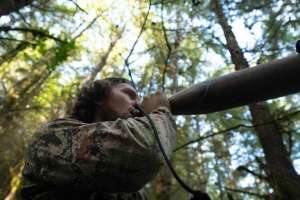
Snuggled in with a solid shooting rest for my newly acquired .220 Swift, I unlimbered my Circe mouth call and sent a low-volume series of squeals toward the rocks. Instantly, my suspected “fox” bounced onto the outcropping — morphing into a large coyote just in time to catch a 55-grain hollowpoint through the chest.
According to the county auditor at the Luverne, Minnesota, courthouse, that was the first coyote ever bountied in Rock County. I had to show him on a map exactly where it was taken, and it was unusual enough that he kept the carcass for several days to show the county commissioners and local farmers. That same year, my junior year at South Dakota State College in Brookings, I became the aerial shooter for a crop-sprayer friend.
At the time, South Dakota was the pheasant capital of the country. With millions of acres of Soil Bank and prime cropland habitat, it could just as easily have been called the red fox capital. We hunted almost daily from late December through February and accounted for just over 200 red foxes at a $7 bounty and a whopping $2.50 pelt price. In contrast, we took only a dozen coyotes, even with a $10 bounty and the same pelt value.
Today, that count would be completely reversed. CRP acreage has declined, farming practices have changed, pheasant numbers have declined, and with them the red foxes that once thrived. That vacuum allowed the larger, tougher, more adaptable coyotes to expand and dominate. In my hometown in southwestern Minnesota — and across most of the Midwest and East — coyote populations have exploded. Today, they rule the roost. With little interest and low value in long-haired furs, there is no meaningful pressure to reverse that trend anytime soon.
When I transferred to Pagosa Springs, Colorado, in 1970 as a Game and Fish officer, the southern San Juan Mountains supported several large sheep operations on private land and on the Jicarilla, Southern Ute and Navajo reservations, all summering flocks on public land. Lloyd Anderson, born and raised in those mountains, was the government trapper for the entire region and the most effective predator control agent I ever worked with. According to records, he drove the coyote population — over 10,000 animals — into the basement using traps, coyote getters and carefully placed lethal baits delivered by horseback, snowmobile, helicopter and fixed-wing aircraft.
That first winter, I caught 20 bobcats with hounds, called in a half dozen red and cross foxes, and took only six coyotes. Any road-killed deer or elk — and there were plenty — would draw bobcats almost immediately. When the government shut down predator control and retired most of the experienced trappers, coyotes rebounded within two years. If fur prices hadn’t skyrocketed during the late 1970s and early ’80s, fox numbers would have been devastated. My best trapping year in the late ’70s produced just under 200 coyotes and 66 bobcats. Quite a swing.
Today, trapping regulations continue to tighten, and foxes are increasingly classified as furbearers rather than predators. When I arrived in Pagosa Springs, the combined town and county population was about 2,500. Today it’s closer to 17,000 — a familiar story across the West. Subdivisions have sprawled into former habitat, and the foxes, ever adaptable, have moved into close proximity with humans. These are places coyotes still hesitate to frequent, and the ultimate frustration for hunters and trappers is sitting on the porch with a cold beer, watching a prime red fox dig voles in the middle of a 2,000-person subdivision — untouchable, unpressured and increasingly rare.