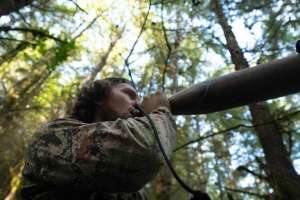

“Play Girl Fight, Play Girl Fight!” my partner whispered from where he was seated only 5 yards away. His yearning for the sound was spawned from the success it brought on two stands earlier that February evening. I did not need much persuading.
Within 30 seconds of playing this nifty sound from MFK Game Calls, a pair of coyotes appeared on the midnight horizon, and when one of them dipped below the skyline, I anchored it with a lethal shot. Any chance of a double was surrendered when my buddy yelled out, “How about that Girl Fight?” That was fine by me because this had been an epic hunt in my book — demonstrating that fight sounds have a definite place in any coyote caller’s toolbox.
Years ago, when using coyote vocalizations became avant-garde, the use of howling was all the rage. Then, pup distress sounds were found to be productive. Coyote mating sounds were soon to follow. Now, the most recently discovered sound category of productive coyote vocalizations is fight sounds. The standard advice for their use is simple: Finish your calling sequence with a coyote fight.
At the forefront of recording coyote fight sounds as they occur in a natural environment is MFK Game Calls owner, Torry Cook. Regular PX readers know that I have incorporated Torry’s knowledge of coyote vocalizations in many of my “how to” articles, and this discussion follows this trend because I firmly believe that Cook’s insight about coyote fight vocalizations is second to none. This article will dive deeply into the world of coyote fight sounds. Cook urges hunters to go beyond prey distress sounds and gain an understanding of coyote vocalizations.
The first thing to realize is that fight sounds are not only to be used during the breeding season. Cook says they can be effectively used throughout the year. He also believes that many hunters are scared to use fight sounds because they are often so intense. Cook points out that all fight sounds are not created equal and certainly do not mean the same things to coyotes. For this reason, he has identified four categories of coyote fight sounds. All the sounds in the categories have certain characteristics that can trigger a coyote at any time. For the sake of clarity, we will discuss these categories separately.
Round One: Pup Fights
When hunters think of fight sounds, they usually envision mature coyotes squaring off over territorial or breeding rights. However, coyote pups start fighting at three to four weeks old to establish a pecking order. Hence, pup fights are the first category of fight sounds hunters can use afield.
According to Cook, pups fight all summer long until “bust up” time when family units begin to separate. It is not only the young pups that come to the pup fight sounds, the entire family unit might respond. While any fight sound can work at any time of year, Cook said, “It makes perfect sense to match the age class to the time of year.” It is no coincidence that the MFK sound library contains pup fight sounds that are recorded and labeled according to age class. Cook said, “The separate age classifications act as different triggers because the coyote pup voices change quickly as they grow.”
Readers might be wondering how long they should play the fight sounds. Cook says he plays each fight sound for three minutes. The exception to this is when using sounds that are strung together based on increasing intensity. “These sounds, such as Den Vicious and Den Vicious 2, can be played longer,” he said.
To assist hunters who are wondering what some of the best pup fights to use, Torry suggests the MFK Den Vicious or Bam Stanky Fight sounds. These pup fight sounds are effective all summer long. For hunters who truly wish to match their calling to the age class structure of the coyotes, it will be helpful to know that at 12 to 16 weeks old, the pups are now sub-adults and a new category of fights can be utilized.
Round Two: Sub-Adult Fights
Depending upon when the pups were dropped, they may be classified as sub-adults by late August to early September. By now, the family group is not getting along well, so they spread out but do not completely disperse. The fights that occur are related to establishing a pecking order, but turn into bust-up fights that indicate a definite division within the group.
Examples of sub-adult fight sounds from the MFK library include Thicket Thump, Yo Mamma and Bad Intentions Fight. These sounds can be effectively used at the tail end of summer through late October. As when using the pup fight sounds, Cook advises playing each sound for three minutes and then playing a different sub-adult fight after a moment of silence. Again, Cook believes that the differences within the sounds can act as triggers and hunters should present as many triggers as possible at each setup.
Round Three: Adult Fights
Once we get into late fall and early winter, the calling season is in full swing for many hunters across the country. While it is true that prey distress sounds can and will be effective, using fight sounds can often bring success when other sounds fail. Why is this so? In part, because coyotes may have been inundated with a barrage of prey distress sounds at this point. Due to the pressure from hunters, coyotes might be educated to the whine of certain rabbit sounds. This is why it is so important to have some calling tactic tricks up your camouflage sleeve. Using specific fight sounds is one such trick.
According to Cook, there are multiple types of adult fights. One is adult pecking order fights. Remember, wild animals are always in a state of flux. Coyotes are no different, and social hierarchies can be challenged at any time. While recording the MFK adult fight sounds, Cook observed that coyotes represented different age classes together at the scene. Perhaps one of the most effective fight sounds in use today is Pound Town. This sound, which was recorded at family bust-up time, contains multiple triggers as sub-adults and adults square off. Torry recommends two other aggressive and very effective MFK fight sounds: BMF Fight and Fight Challenge.
The second major type of adult fights is food fights. Cook emphasizes, “These fights trigger coyotes for different reasons because they know food is involved. These contain the sound of chewing and growling. Coyotes pick up on this quickly and investigate.”
Torry explains what is happening during the recording of the ultra-effective food fight sound called Bad Taste Fight. “This sound was a fight over a deer carcass,” he said. “At first, it was not a true fight. It was two coyotes trash-talking to each other, bickering back and forth. Then two more adult coyotes showed up and an intense fight broke out.” Cook offers this effective fight sequence to hunters: “Start with Bad Taste Fight for two to three minutes. Intermittently play prey distress sounds of your choice along with the Bad Taste Fight. After 10 minutes of alternating these sounds, use Grouchy Lil B Fight as a follow-up.”
Round Four: Breeding Fights
The fourth category of fights is breeding fights. These work at any time but are most effective during the breeding season. Cook believes that breeding in another coyote’s territory is an invasion of the bedroom. The unique sounds within the recordings contain additional triggers to prompt responses from coyotes. For example, MFK’s Hooked Pair sound was recorded when the female was not ready to breed. She and the male are fussing about the situation and frustration escalates. The sounds of chirps, whines and yaps are all included in the recording. Other coyotes are familiar with these sounds and know exactly what is going on. This is what prompts them to respond.
Cook stresses that it is important to play several fight sounds while on stand. This is because the multiple sounds provide multiple triggers to elicit a response from coyotes. Once again, Torry suggests an effective breeding fight sequence. Start with Hooked Pair for up to three minutes. Then play Subordinate Male for another three minutes. For the sake of interest, the Subordinate Male fight sound recording has three coyotes involved. The fight is about an older male coyote putting a subordinate male coyote in his place in front of a hot female. Follow this sound with the ultra-effective Girl Fight sound. For inquiring minds, such as mine, the Girl Fight sound is a recording of two hot female coyotes at the height of the breeding season.
Putting It All Together
At this point, we have discussed the four different fight categories, examined their use and taken a sneak peek at the back stories of some of the sounds. Now, we shall investigate when the fight sounds should be used.
Cook is quick to point out that fight sounds can be used year-round successfully. “Even though I try to use breeding sounds in February, they can work during non-breeding season times,” he said. This point was proven on the day I conducted the interview for this article. Torry was field testing two unreleased breeding sounds and called in and killed a huge male at 15 steps. I should mention that the hunt took place on a September morning!
We can break things down further and discuss when to use the fight sounds on any given setup, regardless of the time of year. I, like many hunters, like to construct calling sequences that begin with lower-intensity sounds and then build up to an apex of intensity. I asked Cook what his general calling strategy is and he agrees with the escalating intensity theory. He begins his stands with an age-appropriate lone howl.
For example, he is a proponent of using various pup howls throughout the summer and early fall months. During the winter months, he chooses adult lone howls. After the lone howls, Cook likes to use a social interaction sound such as MFK’s Submissive Beggar. Cook mentions that doses of prey distress sounds can be mixed in the sequence, at any point, as the calling season progresses from fall onward.
He then mixes in some pup distress sounds before moving on to the fight sound categories discussed in the text. As a rule, Cook does save his breeding fight sounds for the actual breeding season. Cook said, “I am not really sure that the order of the fight sounds matters. The important part is to use a variety of sounds so that several triggers are used on every stand.”
Cook offers some final insight on the topic of coyote fights and how hunters use them while on stand. “Following the advice of ending the stand with a fight sound is too generic, he said.” “Different fights mean different triggers to coyotes. We do not want to leave triggers on the table when hunting.”
Indeed, hunters who understand the complexities of fight sounds in the coyote’s world will be able to create sequences utilizing the four different fight categories discussed here. The result will be more productivity and enjoyment of our sport.