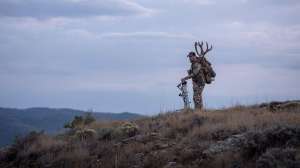

Once the small mule deer herd dropped over the horizon 200 yards away, my wife, Becca, and I parked the truck. I grabbed my bow and we took off across the rolling prairies to see if we could spot the deer and stalk them. With a few different bucks in the herd, the largest one was really a dandy.
With the wind to our advantage, we reached a vantage point where we relocated the herd a few hundred yards away. However, the deer weren’t approachable. We were virtually sky-lined, and minimal terrain contours separated the deer from us. We posted up on the sun-soaked hilltop and endured the biting winds as we waited for the deer to move into a better position for stalking.
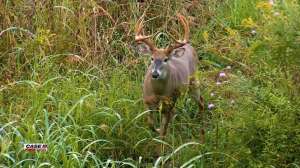
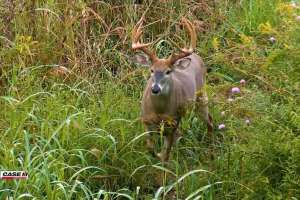
Suddenly, a beaming orange figure illuminated by the blazing morning sun decorated a distant hilltop; it hadn’t been there when I previously scanned the hill. There wasn’t a tree in sight, but it just had to be a whitetail. After a glance through my bino, I said aloud, “I thought so.” Becca replied, “What?” I explained that a wide-racked whitetail buck had crested the horizon about 300 yards distant.
SoDak Solo Trip
I applied for and drew a South Dakota archery deer tag during the spring 2023 drawing. I’ve hunted the Mount Rushmore State many times for both mule deer and whitetails since 2009. In 2021, I nailed a 140-inch whitetail on public land with my rifle after cashing in preference points on a good unit. Then, in 2022, I returned to that same area and bow-killed a big 5.5-year-old 8-pointer.
Where do you think I went in early November 2023? I spent 4 days on a solo mission hiking many miles and glassing tons of ground — some I’d previously hunted and some I had not. I couldn’t turn up a shooter buck anywhere. Becca had accompanied me the previous 2 years when I was successful; perhaps my good luck charm was all that was missing.
With a guided South Dakota rifle hunt with some hunting-industry friends on tribal ground only a few days out, I moved closer to that area and spent a couple of days hunting on some property that I’d acquired permission to hunt. I didn’t chase up a shooter buck there, either. During the tribal hunt, I passed up a 125-inch buck on the first afternoon, but he was the biggest buck I encountered in several days of hunting.
I drove home to Wisconsin through the night, regrouped, and then Becca and I headed to Kansas a few days later. I was unsuccessful there, too, despite a couple of close calls with big bucks. About a week after Thanksgiving, I attended another guided rifle hunt (odd for me since most of my hunting is DIY), this time in Illinois, with some other hunting-industry friends. There, I killed a mature buck and doe on the first afternoon of hunting.
Where Next?
In classic Darron McDougal style, my success in Illinois gave way to the realization that I still had two out-of-state bow tags in my pocket. I keep a busy writing schedule to make ends meet and chase my hunting lifestyle, and I had many hours to log behind the screen to catch up from all of the hunting I’d done in November. But, I couldn’t get those Kansas and South Dakota tags off my mind.
As I caught up on work, Becca and I discussed our options. With Christmas coming, we’d hunt one state or the other, not both. For some reason, I felt my odds for success were better in South Dakota, plus there was an area I’d been wanting to try for several years. I couldn’t quite get my work squared away before Christmas, so we decided we’d leave the day after our Savior’s birthday.
Plans Change
In between our Christmas get-togethers, I checked the weather for the area that I wanted to hunt. Shoot! A foot of snow was scheduled to fall on the area over about 48 hours. Not only would it make traveling questionable, but the weather would warm up following the snowfall. Spotting and stalking in crunchy snow would prove nearly impossible.
But wait! I had yet another area in mind that I’d been wanting to try. Lo and behold, the big snow event would miss that part of South Dakota. Only some freezing rain would fall prior to our departure, and after that, the forecast looked ideal. So, we switched destinations.
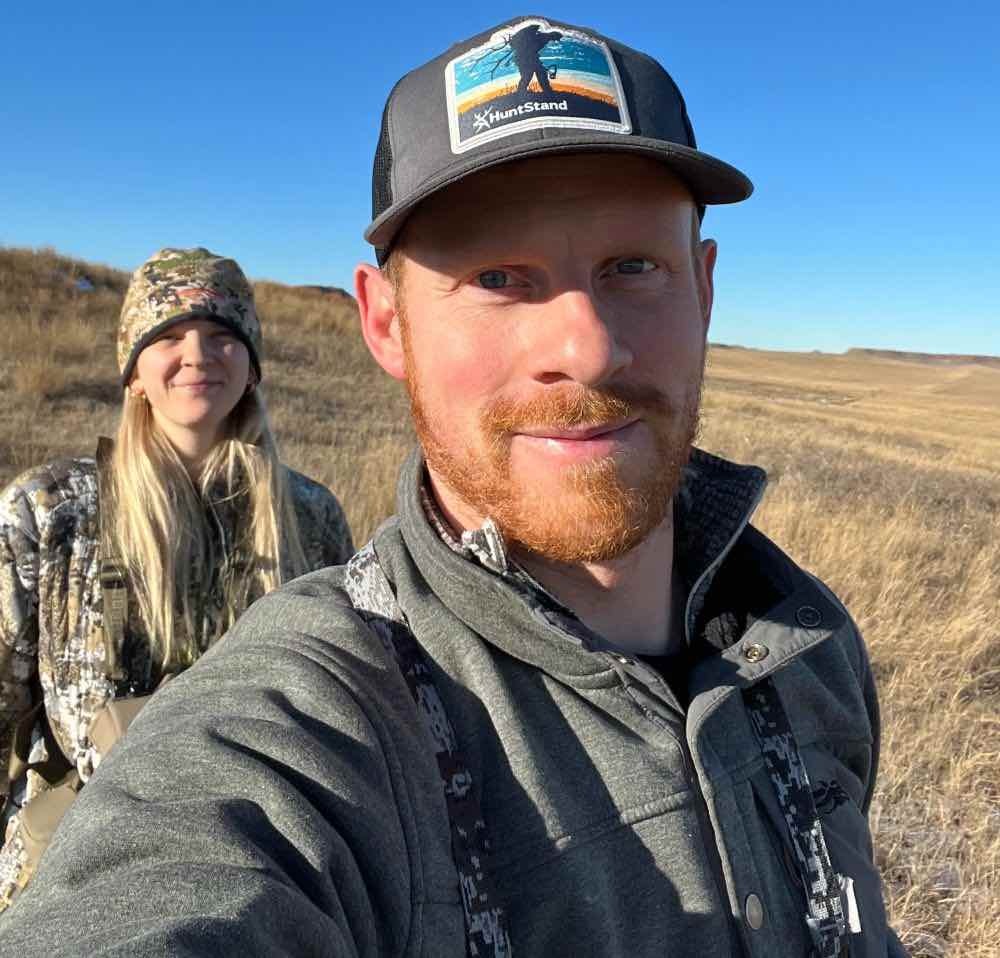
Per usual, we spent a lot of time with our families on Christmas Eve and Christmas, and we woke up the following morning and weren’t ready to leave. In my 20s, I would’ve rushed us and gotten all stressed out in the name of getting an extra day of hunting. But, at 34 years old, I’d wised up some; taking some extra time to get ready reduces a lot of pressure on both Becca and me, and I can begin the hunt in the right frame of mind. We mutually agreed to leave on December 27.
Rematch On the Prairie
We arrived at our destination and noticed the city streets were covered in ice from the freezing rain that had preceded our arrival. We settled in at the motel and got some sleep.
The following morning, we drove to the public lands I had marked up on my HuntStand app. It didn’t take long to start seeing deer, and we even found a nice tall-racked mule deer buck almost immediately. He was with at least a dozen other deer, and the terrain was very open.
We bumped around on a few different roads and glassed numerous deer. Eventually, we spotted another nice tall-racked muley with some solid width. He was visibly more mature than the first nice buck we had seen. The stalk was on, but the problem was the terrain was very open, plus the freezing rain had left ice sheets on the prairies, making for crunchy walking. Antlerless deer also accompanied the muley buck.

Becca and I used the little terrain available to get closer, and then we popped up to see if the deer had shifted. We saw a handful of does, but the buck was nowhere. The does eventually moved off, so we proceeded, acting as if the buck was still there. Despite the open country, we couldn’t find him, so we headed back to the motel for a quick nap.
That afternoon, we hiked the hills and spotted the herd with the first tall-racked muley we’d seen that morning. The deer weren’t approachable, plus I felt it best to leave him for another year since he already survived the rifle season. He was nice but not a monster. The herd eventually moved over a hill, and we headed back to the truck.
Once our truck was in view, we were surprised to see the herd standing around it. Two does were even tip-toeing toward it and bobbing their heads. They moved off and we reached the truck just before dark.
Day Two
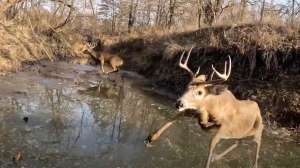
Let’s pick back up where I left off in my opener. While watching the wide whitetail feeding on a hillside a few hundred yards away, we heard the telltale sounds of antlers clacking together. I trained my bino toward the mule deer bucks and noticed they were fighting. I wondered how the whitetail, which was obviously within earshot, would react.
He began inching toward the rattling, his posture being both bristled and curious. I slid downhill on the ice patches to get a better visual of the drainage that held the muleys and to see if a stalk was possible because the bucks were distracted. Once the whitetail saw the mule deer, he transitioned back to feeding. I was having the time of my life watching mule deer and a whitetail and wondering which to pursue.
As if a gift from God, the wide whitetail altered his course and was walking toward a ditch that led to a larger ravine about 250 yards beneath Becca’s perch. Each time his head lowered, I slid downhill across the ice patches to cut the distance, keeping a low profile since there was zero cover. The wind masked the crunching ice. Finally, he walked behind a hill, clearly heading up the ditch toward the ravine. I hustled to the edge of the ditch and found a spot to tuck in against a hillside so as not to be sky-lined. I nocked an arrow and then ranged the trail in the bottom of the ditch. It was 46 yards. I waited for the whitetail buck to appear.
A few minutes passed. Nothing! Curiosity got the best of me, so I slowly rose up and scanned the area. Still nothing. I stood hunched over and eased in the direction I expected the buck was coming from. Antlers! He had gotten distracted by a patch of something tasty. Occasionally, he would lift his head, glance back toward the mule deer, then lower his head and feed.
I was hoping he’d continue up the ditch and walk by me, but then I realized his body was broadside if not slightly quartering away, and that he was likely within range. My rangefinder read 55 yards, and I went into shoot mode. I dialed my sight to 55 yards, inhaled deeply, and exhaled. Here we go, I thought.
Becca had a stadium seat from above but couldn’t quite see the buck when she realized I was drawing my bow. A slight crosswind blew my pin on and off the mark, and when it calmed down and my pin steadied, my arrow launched. It dropped right into place through the lungs.
The buck exploded, running up the ditch bank and out across the wide open. By then, I had my binocular on him, and a crimson stain confirmed that my hit was lethal. He stopped about 200 yards away where his legs stiffened up before he toppled over. I had not taken a deer with my bow during the 2023 deer season until this point, so I jumped up and down and fist-pumped while looking uphill at Becca. While she had been unable to see the deer when I hit it, she had watched it fall.
Slow Down and Enjoy It
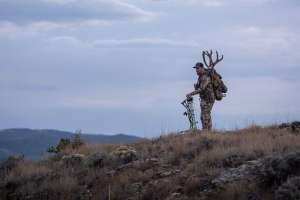
As badly as I wanted to run over to my buck, I hiked back uphill to Becca, where we sat, soaked up the sun, and discussed the stalk while enjoying a commanding view of the sun-lit sea of prairies surrounding us. Remarkably, there wasn’t a tree in view. It was by all means a mule deer spot, but God put a beautiful, mature whitetail in my path.
After 15 minutes, we descended downhill to my buck. On the way, we stopped where he’d been hit and immediately found my Victory VAP SS arrow, the Silent Knight vanes soaked in crimson. Tipped with a Rage Hypodermic NC, the arrow had passed completely through the buck.
Beyond the arrow was a vivid blood trail, and though we didn’t need it, we followed it to the buck. I hadn’t paid the buck’s tines much attention because I was focused on his post-rut body size and his wide antler frame. As it was, he really had only 5 points. His right antler hadn’t grown a G-3, and he broke off his brow tine on that same side. I didn’t care one bit. He was an old buck that was as good as he was going to get, and he’d evaded rifle hunters for four seasons (based on a knowledgeable friend’s tooth examination). And, he had a cool mane on his neck to boot.
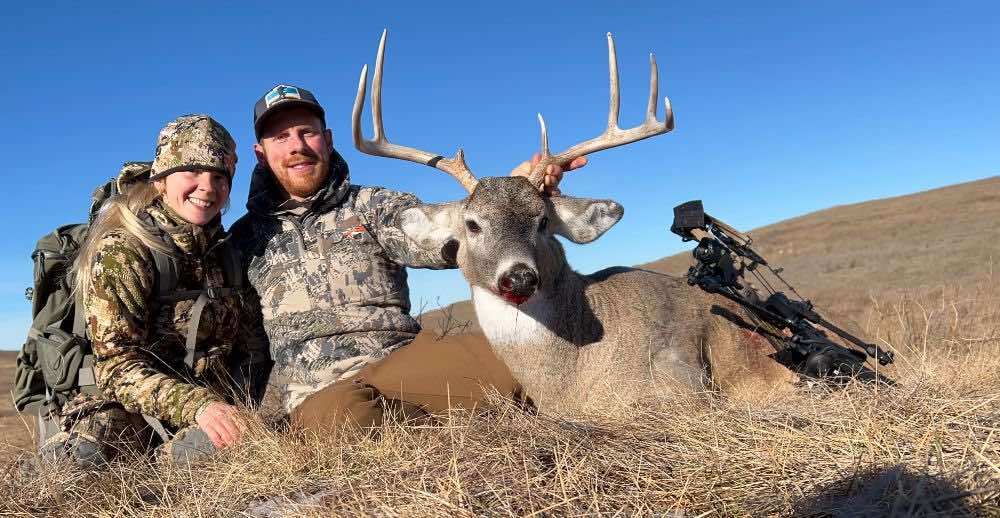
After shooting some photos, we began the labor of love, which is breaking down the quarters to be packed out on our backs, the truck being a half-mile away. Usually, I’m in a hurry to do this, but we had the entire day ahead of us and nowhere to be, so we took our time and enjoyed the warm sun and the snow-less landscape. What a perfect ending to a long deer season!
Sidebar: My SoDak Deer Gear
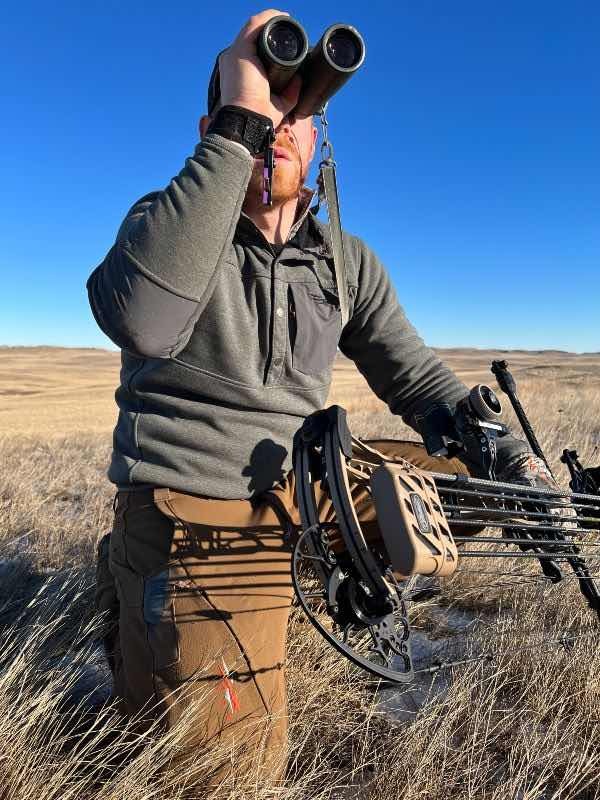
On this hunt, I shot the Mathews LIFT 29.5. Extremely stable due to its long, well-balanced Bridge-Lock Riser, it anchored nicely in the wind for my longer-than-average shot. I rigged it with UltraView Archery’s UV Slider, which adapts directly into the Bridge-Lock sight mount. My rest was the QAD UltraRest Integrate MX2, which adapts to the riser and fully contains the arrow — ideal for spotting and stalking. A 12-inch Mathews Bridge-Lock front stabilizer coupled with an 8-inch Bridge-Lock stabilizer fixed to the Bridge-Lock Adjustable V-Bar provided tons of stability.

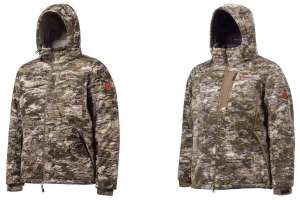
My Victory VAP SS 350 arrows, which have impeccable tolerances to optimize downrange performance, fit nicely in the Mathews LowPro Quiver. The LowPro mounts tight to the riser, improving full-draw balance. A Rage Hypodermic NC yielded full penetration and a stunning blood trail. Hawke Optics’ Frontier LRF binocular rangefinder was ideal for spotting deer and confirming yardage. Becca packed out her share of the meat with a Mystery Ranch backpack, while I used a Stone Glacier pack. We wore Sitka Gear, which kept us comfortable.
Sidebar: Mapping Out the Hunt
For any hunt, but public land hunts in particular, pre-hunt mapping is crucial to success. I used HuntStand Pro Whitetail’s Public Lands and Hunting Lands base maps to find an area with prevalent access. From there, I used the Hybrid and Crop History base maps to find habitats suitable for mule deer and whitetails — whitetails tend to stick to ag ground and wooded creek bottoms while muleys prefer the hills. In the public lands base map, I identified the road systems in the area and planned my access.
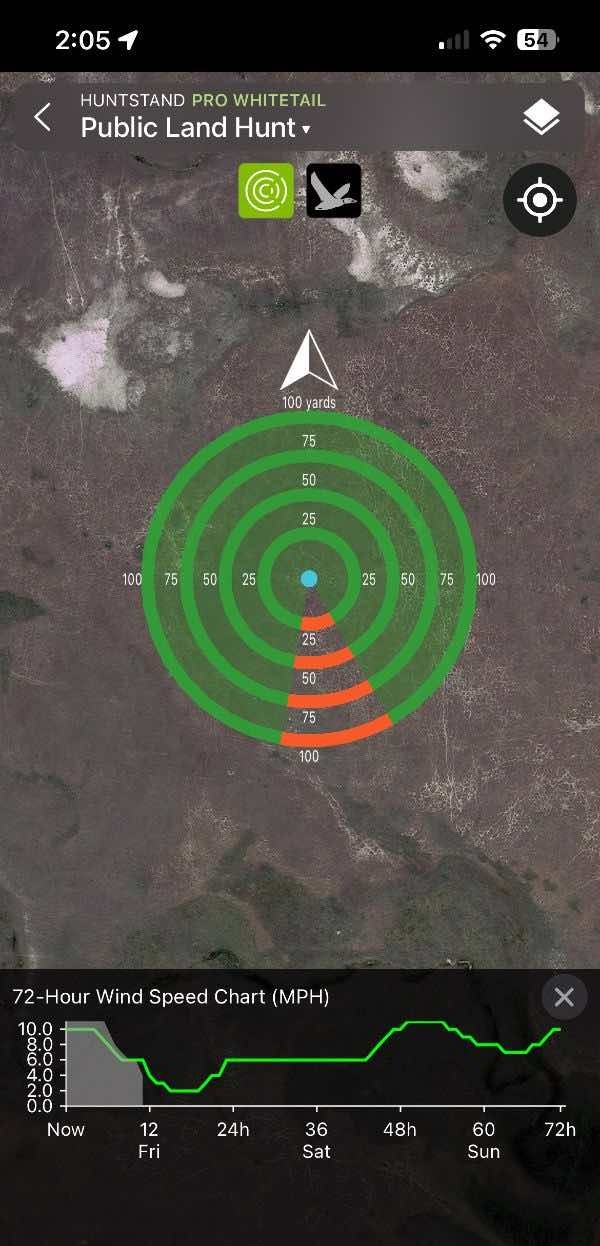
On the hunt, HuntZone, which provides an overlay showing how our scent would disperse, helped us decide where to enter. As another measure, we carried wind checkers to confirm the winds. The app is also nice to reference for navigation since everything looks the same on the rolling prairies. And when the time came to pack out my buck, HuntStand showed us the fastest route back to the truck. I highly suggest this app for your next hunt, especially if it’s a DIY hunt.
Photos by Darron and Becca McDougal