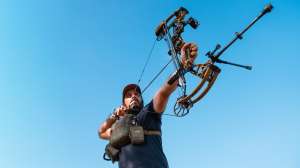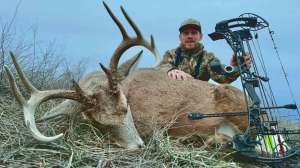

No way, I thought to myself. As if the buck read the script, he now lay at the base of a cliff chewing his cud. It’s a perfect opportunity for a stalk. Not just any stalk though. It was one I had done before. And to take it even a step further, he was in the same bed as a buck I had missed years ago. The stars were aligning, and in no time I was breaking trail.
My confidence in this approach was skyrocketing. I knew the route, the wind, and the distance I’d have to shoot. Despite the miss a few years back, I had “been there, done that” in this place. All was good, and soon I was peering over the edge looking down. He was right where I had left him, except for one thing: Now, he was facing my direction and quickly picked me off. With him behind the brush, I had no shot. My nerves raced.
Like most mule deer, this one got curious and walked out to see what I was. Him doing this, brought me to full draw. I tried my best to settle in the gusting wind and pulled through my shot. Watching my arrow zip right past him without even touching a hair was like deja vu. My confidence plummeted at that point and weighed me down each step back to my camp. Little did I know, this would be my first of three misses over the next month.
Missing with a bow is something I am all too familiar with. Don’t get me wrong, I’ve had an immense amount of success arrowing critters, but getting to that point came, and still comes if I’m being honest, with quite a few clean arrows in the dirt. It’s crushing to work so hard and then watch what is literally a matter of inches keep you from your goals.
This past early season in the high country served me up more humble pie than I’d care to consume in one sitting. However, there is always something to learn in these moments. So, I’m going to begrudgingly reflect back on these misses and weed out the lessons I learned along the way. I’ll also dive into the reasons I’ve witnessed others miss. With any luck — for both of our sakes — learning how to miss will help us not miss as much in the future.

Lesson No. 1: Don’t Force It
That miss I experienced in Utah was a reminder to not force what isn’t meant to be. You’ve got a job to do when bending the limbs back, and I didn’t do it. The job description: Stay in the moment, focus and execute. Success behind the bow comes when a lot of moving pieces move in unison. If one of those pieces is not in line, then your chances of trouble showing its face increase. And if you force the matter, well, that never goes well.
The fact of the matter is, I should have let down my draw and recomposed. With the deer looking at me, though, I didn’t, forced the shot, and I damn well know I did. This is a situation I found myself in the year before, only I did let down. Can you guess what happened? Yeah, I walked off the mountain with that particular buck. It can be hard to face reality in these intense moments when the goal you seek is right in front of you and only a matter of your release going off. We owe it to the animal and ourselves to own up and do the right thing here. Would you rather make the best shot you can or force a miss, or even worse, a marginal hit?
Lesson No. 2: Get a Good Range
Fast-forward a few weeks and I was in the high country of Colorado. After a morning of glassing, I had several bucks located. One in particular was bedded on a small spine offering a great approach for a stalk. I made my way around and started inching my way down that spine to get into position.
Antlers protruded up from the brush. Normally, I’d use my rangefinder on the antlers, but in this situation, I couldn’t due to the density of the vegetation. So, I had to make my best-educated guess on what to range. It looked like the buck was under a certain tree, and that’s what I ended up ranging.
Once the buck stood, I immediately came to full draw and made my shot before getting a good range on the deer. It was a clean miss. Hit the tree perfectly, though. It turned out the deer was 8 yards closer than I thought. Had I waited and got a solid range on him, that arrow would have looked much different upon recovery.
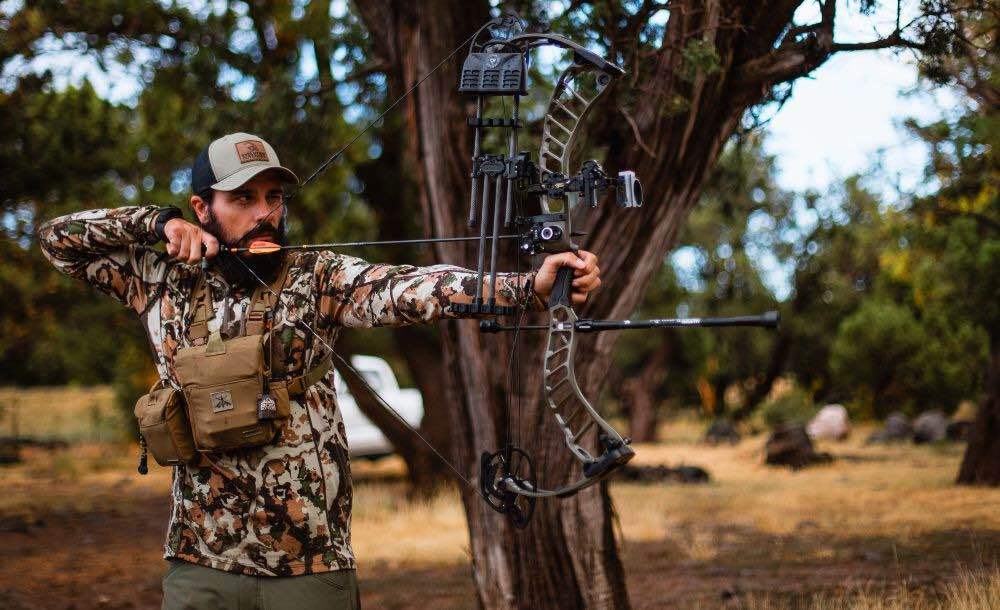
Call them whatever you want, but rangefinders are one of the most valuable assets we have aside from our own intuition and hunting ability. Some might argue that one needs to learn how to judge range, and there is a high level of value in that skill. However, in the end, it’s an educated guess. A rangefinder is a solid answer you can put your pin behind, as long as you range the right thing. And, depending on your arrow setup, the importance of an accurate range can skyrocket. For instance, if you’re shooting a heavy arrow, you’ve got way less room for error with range. So, that educated guess can more easily lead to a bad situation.
Take the time to gather an accurate range that you can trust. We get only so many opportunities out there, and this is one of those “make the most of it” actions. It takes a few seconds, which in most cases, you have. If you don’t, and can’t accurately judge the range, you probably shouldn’t shoot.
I’ve been guilty of going against the grain here, and I’m sure many of you also have. However, being honest with ourselves will prove out the best results in the end. This proved true a few years back in Colorado. I had a buck beneath me that I actually missed, but due to the hailstorm currently going on, he never busted. After getting a more accurate range, that buck laid down for the last time 40 yards away.
Lesson No. 3: Don’t Get Desperate
On my last day in Colorado, I spotted a group of bucks down beneath my glassing spot. It seemed as if Mother Nature was lending a last-minute helping hand: “Here ya go, Josh. Make the best of it.” This was a mid-morning approach. I was worried about the wind switching from the get-go, but big bucks no whammies, right? It was a last-ditch effort to bring home some tasty high-country venison.
In my approach, I reached a point where I was trying to make a decision of what direction to go next. I wanted to get closer. Just then the wind reminded me it was mid-morning. All of the bucks were bedded until they weren’t. When that wind switched, the bucks all stood and looked in my direction. Without hesitation, I started dialing my sight to a range on the edge of my comfort in practice sessions back home. This arrow ended up literally cutting the hair on the buck’s back. He ran unphased and out went my last-ditch effort.
At the start of a hunt, we all have our boundaries that we lay out. It’s stuff like “I don’t want to shoot a buck smaller than X,” or “I won’t shoot a buck past X yards.” As the hunt progresses and the deeper we get into adventure, those limitations have a tendency to grow with our desperation. “Well, what’s another 10 yards?” That extra 10 yards might not seem like a lot, but the fact of the matter is, it’s over the line of comfort you originally set in place. This is desperation to a fault if you ask me, and a very common route to missing for folks. They overestimate their abilities and inevitably end up facing the consequences.

3 Tips for Dealing With Misses
Whether it’s shooting 20 yards in my backyard, attending 3-D shoots, or honing in long bombs at the range, I spend an immense amount of time behind my bow back home. It’s one of my ultimate passions, and my effort to try and make things automatic in the field, because you might get only one chance. And what you do with that chance will seal your fate. Play this game enough, though, and it’s inevitable you’re going to miss from time to time. That experience in itself can gnaw at a person. It can eat them to their core and damn near cripple them mentally. So, missing is one thing. Dealing with it after the fact is another.
1. Make It Automatic: The first thing you can do to battle the mental hurdles of missing is to try and avoid it from the get-go. If you’re a person who is dusting their bow off 2 weeks before the season, you aren’t doing yourself any favors. Regular practice can go a long way and help build the necessary muscle memory you will need in the heat of the moment when you can’t think straight. Even if it’s just a handful of arrows a day, each one of them is going to make you stronger in the field. Try your best to “make it automatic” and you’ll be that much better off come game time.
2. Own Your Miss: We have a tendency to try and blame things other than ourselves when a miss happens. In all reality, though, we are the ones in control here. And the only way to properly address a miss and get better is to own that miss. Dissect it for what it is. Dig out the origins of the why and how this all came to be. By doing this you’ll be able to directly tackle the issue. For instance, when I came home from the high country, I arrived with doubts about the accuracy of my rangefinder at a distance on steeper angles. So, I hit the desert and set up some mock shots at greater distances on steeper angles. Doing this put my mind at rest and instilled the confidence I’ll need in future hunts.
3. Let It Go: In the words of Elsa from the movie Frozen, “Let it Go.” Sorry, the Dad in me is showing there, but this is really important stuff after experiencing a miss. It’s way easier said than done, but you can’t let these setbacks get to you. If you do, then you’re setting yourself up for failure in the future. Missing can make your mindset go from hero to zero. It’s important to know, though, that missing happens to the best of us, and you are not a zero. You know how to shoot your bow and how to be accurate. Never forget that. Think of it like this: Missing is one step closer to not missing. It’s a lesson. So, take it and use it as fuel.

Final Thoughts
I’ve had some rough archery seasons in the past, but the one detailed here really takes the cake. It broke me down in more ways than one and sent me spiraling down a path of doubt and insecurity. Not a recipe for success. At least on the surface, it wasn’t.
In the end, as rough as it was, I’m glad it all happened. It shined light on some holes I had in my game that I obviously needed to work on. Going through this process will ultimately make me a better bowhunter and the same goes for you.
The Art of Missing will paint a picture you wouldn’t have seen otherwise. Learn it and own it. Humility is healthy for the mind and your freezer. The taxidermy bill, though? That might be a bit steep.
Photos by Josh Kirchner