
The Canadian early summer evening was simply beautiful. There was a cool breeze brushing my face, the scent of pine hung heavy in the air, and migrating waterfowl lent a soundtrack to the countryside. The only fly in the ointment was the incessant hum of voracious mosquitoes. I looked at my Thermacell unit watching the vapor drift off the appliance. Though a few skeeters still got through, all was forgotten when I caught the movement of a jet-black bear slowly approaching the bait.
My buddy Justin Fisher and I had been anticipating hunting Manitoba black bears for more than a year, since booking a trip with Mikey Price at Plum Lake Outfitters. Justin and I had both shot a bear in the past, and we were looking forward to a new location.
Plum Lake Outfitters is a small, family run operation located in the Interlake region of Manitoba. After a few email conversations with Mikey, we had no hesitation in booking the first week in June. Mikey is passionate about bear hunting and probably wants his clients to succeed more than they do.
As the winter began to loosen its grip on my home in North Dakota, I began shooting my bow. While hunting bears over bait doesn’t usually produce tough archery shots, there is difficulty in visualizing the vitals on black fur, especially in low-light situations. In addition, being close to a bear, for hunters unaccustomed to it, can result in an adrenaline overload. Night after night I shot arrows at ranges from 10 to 20 yards near sundown. The poor bear target took a beating, and my confidence soared.

Field Judging Black Bears
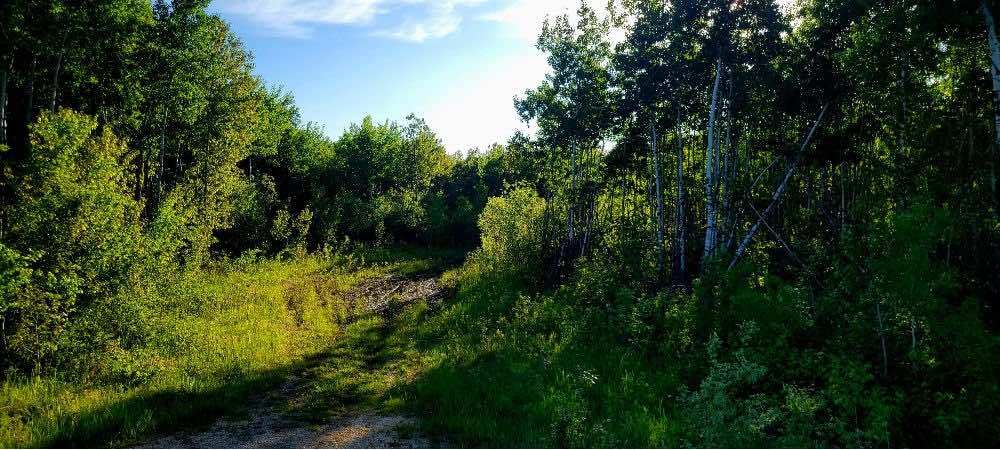
One of the reasons we chose Manitoba is that bear camp was less than 5 hours from our homes. It was an easy drive north, and as we left the Red River Valley of North Dakota and entered the Canadian bush, things changed quickly. While the land was still flat, spruce and pine forests began to dominate the landscape. In the breeze, golden tree pollen drifted across the road.
Settling into camp as dusk arrived, we sat around the fire with Mikey and guide Ryan. One of my favorite aspects of traveling to hunt is meeting new people and seeing new places. Swapping stories over the crackling fire went on late into the night.
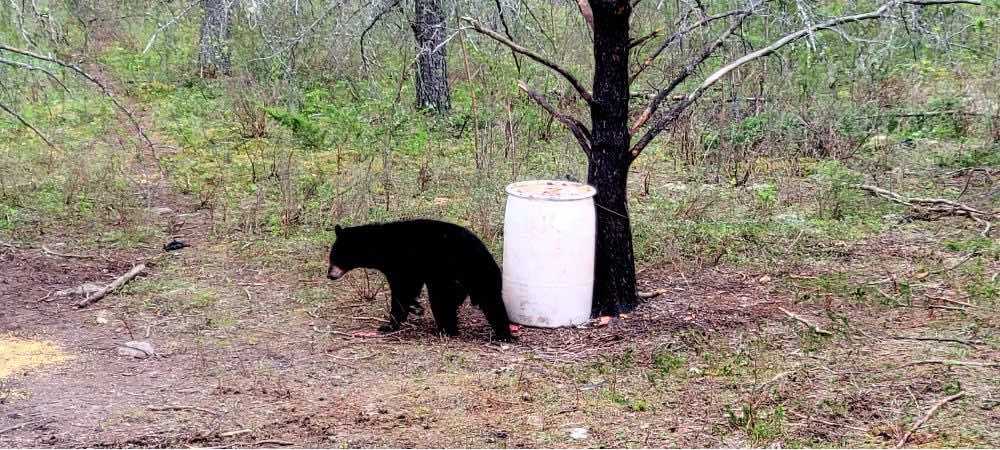
The next morning, after Justin and I took a few practice shots to loosen up, Mikey placed a bait barrel next to the bear target. He explained both the best shots to take, a few inches behind the front shoulder, as well as how to judge bear size. The bear target was just above the second ring of the barrel, meaning it was a smallish bear. Closer to the third ring, and the bear was borderline. Over the third ring, he said, was a shooter for most hunters. A bear that was taller than the barrel was a giant.
Unlike my previous Minnesota bear hunting experience, the baits were scattered over hundreds of miles of forest. We never saw another vehicle on the gravel roads, and once we parked the rigs, it was another ride on ATVs. We were truly in the bush.
Shuffling Stands
As the only bear I would end up seeing on the first night drifted in, I knew right away I wouldn’t be reaching for my bow. While it had a luxurious slick black coat, the bear was too small to consider shooting on the first night. Bears on bait allow the hunter time to watch and observe the animal, and it was a joy watching the bear feed. The mere presence of such a magnificent animal, at nearly handshaking distance, made the night memorable.
While I didn’t release an arrow that evening, Justin did. Unfortunately, he was so focused on the bear that he didn’t see a small branch, and the arrow deflected into the dirt. Even without a bear to trail, we arrived back in camp well past midnight because we could hunt until nearly 10:15 pm.
After sleeping in the next morning — black bear hunting over bait is almost always an afternoon-only affair — we gathered around the picnic table to enjoy a delicious meal. Mikey and Ryan had made the rounds the previous evening as we hunted and decided to move both of us for the next evening’s hunt. My bait seemed to have been taken over by a sow with small cubs, and the bears at Justin’s were more than likely spooked after the missed shot. Overhunting stands are a great way to shut down activity, and Mikey wanted us to see new baits that evening.
My day No. 2 stand was the most perfect location I’ve ever hunted for bears. The stand itself was a roomy ladder stand, so comfortable I almost dozed off in the late-afternoon sun. Three barrels were chained to jack pines in a small opening. The two farthest barrels had a very small hole cut in top and contained corn. The closest barrel had a large opening and contained sweets. Before leaving, Mikey added some lure and fresh bait. On three sides of the baits was mature jack pine forest, with a densely forested swamp on the other side. Numerous bear trails converged on the bait, and a large pile of scat was near the ladder.
A quick glance at my phone showed it was a little past 3:30 pm. Sunset was 9:42 pm, so I settled in for a long, relaxing wait.
In the distance, the repeated drumming of ruffed grouse caught my attention. I was focused on listening to them when a snowshoe hare hopped into view. It seemed to enjoy the granola on the ground, quickly eating before disappearing back into the bush.
A black flicker coming from the swamp caused my heart to race. Unlike hoofed animals, bears make little to no noise as they pad across the forest floor, and the bear was like an apparition. As it walked past the upright barrels, the bear’s back was above the second ring but just below the third. It wasted little time knocking the main barrel down and getting to the business of filling its belly.
As the bear fed at 13 yards, I had ample time to evaluate it. While I’m not much of a trophy hunter, I knew I was hunting in a fantastic location for big bears. It was only the second day of a 6-day hunt, so, with much difficulty, I decided to leave my arrow on the string.
After feeding for a bit, the bear moved off and disappeared back into the bush. The sun was still high in the sky when the second bear of the evening showed up.
I knew right away I wasn’t going to shoot this bear, either. It was a bit smaller than the first, looking much like a healthy black Labrador retriever. With long legs and a small head, it was obvious it wasn’t a Manitoba monster.
The opportunity to witness a bear at close range, with no idea a human is near, is rare, and I soaked in the moment. Despite thick fur, the bear still was bothered by mosquitoes. It would shake its head or scratch its ears. A halo of flying insects surrounded the bear’s head.
Moment of Truth
After the bear moseyed off, time slowed. The sun slowly kissed the horizon, and whippoorwills started to call. Frogs were croaking in the swamp and, far away, an owl hooted.
Without warning, another bear popped into the clearing. As soon as I saw it, I grabbed my bow. Though not a Northwoods giant, it was a nice-looking bear I would be happy to tag. Of course, I still needed to make the shot.
The bear fed at the main barrel for a few minutes while I waited for a good broadside shot. My heart was pounding in my ears, and I stood motionless, barely noticing the mosquitoes eagerly draining blood from my face. Just when it seemed like I would never get a shot, the bear stepped forward to look to the north. Hitting full draw, I settled the pin behind the bear’s shoulder. The arrow was off and the glowing nock flickered through the bear before burying in the soft soil behind it. With a woof, the bear loped off into the swamp.
As darkness enveloped the bush, I eagerly examined my arrow. I was a bit concerned as the blood was sparse on the white fletching and wrap. Backing out, I met Mikey, Ryan and Justin back on the road.
The next 2 hours was a master class in blood trailing from Mikey. He was able to find pinpricks of blood on leaves and grass as the trail led into the swamp. We sloshed through the 8-inch water and doghair thick popples. Tree pollen drifted through the illuminated light from the flashlight, and we fought the brush to plod forward. Mikey would find a small smear of blood on a tree or leaf, wait for me to mark the last blood, and move forward. My heart was in my throat as it was seeming less likely we would find the bear in the dark. I was preparing myself to come back in the morning when Mikey knelt in the water and peered into the bush.
“Do you see any more blood, Mikey?” I asked.
“Nope,” he said, and my heart dropped. “But I do see a pretty darn nice bear!”
Forget the work that followed. Mikey pulled an ice fishing sled, full of bear, while I pushed and pulled it around the millions of tree stems. A smile was plastered on my face that would take days to leave.
The entrance of my arrow was perfect, but the bear was not as broadside as I thought. Instead, it was slightly quartering toward me. After traversing the near lung, the NAP Shockwave-tipped Carbon Express arrow centered the liver and exited through the stomach. A piece of fat firmly plugged the exit hole, making the blood trailing difficult.
Planning Our Return
Justin had a good adventure, but his hunt ended when his arrow passed low through a chocolate-phase bear. After a long trail, the blood petered out. Like most bear outfitters, Plum Lake has a blood policy: Once blood is found, the tag is considered filled. This policy helps protect the resource and helps limit poor shot selection, and we fully understood it. Still, it was a bitter pill for Justin to swallow.
When I first decided to pursue black bears, I thought I’d shoot one and be satisfied. However, I’ve fallen in love with the Northwoods, the beavers and muskrats, the pines and the bears. Justin and I are already planning a return trip. Some nights though, warm in my bed, I wake up and can swear I hear a mosquito buzzing.

Sidebar: Preparing for Bugs
I thought I had experienced mosquitoes before. I was wrong. The number of skeeters in Canada during spring must be experienced to be believed. Simply making the short trip to the outhouse required a Thermacell and a steely resolve.
A single Thermacell works wonders on early season deer hunts, but there were times when the barrage of mosquitos overpowered it. Justin sat each night with a pair of devices and didn’t have nearly the problems I had.
Pay close attention to the pad on the heating unit. I tend to be a frugal person and try to squeeze every drop out of the pads. I quickly learned that the cost of the pads is nothing compared to mosquitos. Keep fresh pads on the machine.
For future spring bear hunts, I plan on wearing a lightweight bug suit in addition to using one or two Thermacells. Canadian spring evenings are beautiful, but that beauty is somewhat diminished by the constant blood draining of mosquitoes. It’s not fun to dread the afternoon hunt simply because of the bugs.
Sidebar: Spring or Fall?
While I’m certainly no expert on bear hunting, I’ve learned a lot from previous hunts. Three times I’ve hunted during the fall and once during the spring. In most of the United States, fall is the only option. I started bear hunting in Minnesota, a state that offers only fall bear hunting. We placed baits as soon as the regulations allowed, and bears would almost immediately begin hitting. Unfortunately, it seemed there was always a flush of natural foods around opening day. In addition, no matter how remote a bait was, there would be off-road vehicles all over the public lands. The bears would turn nocturnal, and I never saw a bear on stand over two seasons of DIY hunting.
My first successful bear hunting occurred on Lake of the Woods in Ontario. At the time, spring hunting was not allowed, and I booked a hunt for the first week in September. The walleye fishing was world class, but a heat wave gripped the area. Bear movement was absent during shooting hours. I was very fortunate to shoot a smallish chocolate boar, the only bear I saw.
Spring hunting has distinct advantages over fall, namely less natural foods and better weather. I prefer spring hunts simply because my home bow seasons for big game open in September, and I’m eager to get in the woods. From a scheduling standpoint, spring hunts are better for me.
Besides the terrible bugs, spring hunts can be hampered by long winters. When the cold and snow stick around, the first few weeks of the spring season can have slow to non-existent bear movement. Bears weigh less as well, after coming out of hibernation. Fall bears are preparing for the long winter’s nap, gorging on food. If a heavy bear is the goal, fall is the time to hunt.
Hunters looking for a glossy, thick bear pelt for the wall should hunt during spring, as the fur is thicker after coming out of hibernation. However, the bears soon begin rubbing to get rid of the winter fur. The unsightly patches make unattractive rugs or mounts, so look over each bear carefully before shooting. During fall, the fur is shorter but rarely rubbed. Of course, skull size, which is used by the record keeping organizations, remains the same for both seasons.