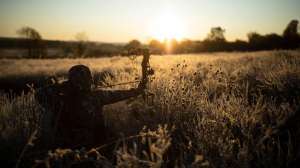

The sand was almost through the hourglass of my late-September 2011 South Dakota hunt. I was hunting along a shelterbelt bordering a standing cornfield, and the shelterbelt was littered with deer sign. There were trails, rubs and droppings galore. There was even a scrape 30 yards away.
With daylight fading fast and my trip coming to an end, I pulled out my grunt call. With cornstalks rattling in the breeze, I blew the grunt call pretty aggressively a few times so it could carry a great distance. I tucked it away and stood alert with merely minutes of legal shooting light remaining.
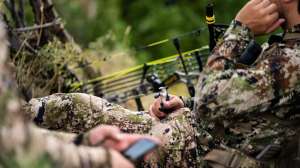
Suddenly, my ears detected some suspicious noises in the cornfield. I trained my bino in that direction to identify the source of the noise. Antlers! I grabbed my bow from its hook and prepared for a potential shot opportunity. Soon, the buck stood perfectly broadside over the scrape. My 30-yard pin hovered on his ribs as the shot broke. He piled up 60 yards away.
I wish I could say that all of my hunts over scrapes and rubs have ended like this, but they certainly haven’t. Although it’s exciting to find an area all ripped up with these two whitetail clues, from experience, I suggest it’s important to temper your expectations.
With that, let’s dive into some of the ins and outs of rubs and scrapes with input from Kip Adams, chief conservation officer with the National Deer Association and a certified wildlife biologist.
Rubs
What do you think of when you see a buck rub? Do you associate it merely with a buck rubbing off his velvet and perhaps “marking his territory” during the rut? Let me assure you, there’s way more to it than that.
“A rub is one of the primary ways deer communicate,” Adams said. “Sure, bucks rub off their velvet, but rubs are much more important as communication tools. Bucks break through the tree’s cambium layer, which releases aromatics and attracts other deer. Bucks also rub their forehead gland on the tree. This is one of a deer’s most important glands. Researchers from the University of Georgia have identified nearly 50 unique pieces of information from that gland alone. As humans, we aren’t sure what all of that information means, but deer certainly know. Researchers surmise that the information includes identity, nutritional status, maturity, dominance, etc. I’d compare it to leaving my business card at the post office.”
Again, deer certainly rub during the beginning of fall to help shed their velvet and also during the pre-rut and rut, but those aren’t the only times bucks rub trees.
“Since rubs are an important communication tool,” Adams said, “bucks will rub trees the entire time they are hard-horned. They’ll rub small trees. They’ll rub large trees. The largest rubs tend to be used year after year, and we often refer to those as ‘signpost rubs.’ It’s important to understand that rubs aren’t always used by only one buck. Other bucks often visit rubs to see which other deer have been there, and to leave their own information. Does will also check out rubs. There is even video evidence of a doe rubbing her genitals on a buck rub.
“As hunters, we often talk about ‘rub lines.’ Research shows it doesn’t quite work that way. Deer will use multiple rubs, however, even when several rubs are located close together, research shows that all bucks don’t always use every single rub. Bucks don’t put in a rub line to defend a territory. Bucks are never territorial. The only deer that are ever territorial are does during the fawning season. A buck creates multiple rubs to leave his ‘business card’ for other deer.”
Adams further explained that bucks use rubs anywhere trees grow, as well as places without trees. He noted that bucks will rub fenceposts and power-line poles, which I’ve witnessed myself while hunting the more open western states.

Scrapes
A scrape is another primary way that deer communicate. Adams said bucks scrape all throughout the year, but they tend to use them a lot more during the breeding season. I’ve personally found scrapes that were freshly worked in May and August, but like Adams, I find the most scrapes in October.
“As cool as rubs are, I find scrapes even more interesting,” Adams said. “Mature bucks, immature bucks, does, and fawns all visit them. There is usually an overhanging branch above the scrape, which is one of the most important aspects. It’s what we call the ‘licking branch.’ Bucks will mouth it and rub their preorbital gland on it. They often rub the forehead gland on it, too. The goal is to leave their identifying features on it. After they work the branch, they paw at the dirt, and then they may or may not rub-urinate in the scrape.
“The other cool part is the visual component of the exposed dirt. Anytime you expose dirt in the timber or along a field edge, deer almost cannot ignore it. They have to go visit it; it’s that ingrained into them as a communication tool. So, there is a visual component and certainly an olfactory component with scrapes.”
Adams reminded that deer don’t always have to be directly over the scrape to check it. He says video evidence supports that deer often swing downwind to collect information about other deer that have visited the scrape. In some of these cases, they don’t hit the scrape to leave their own information.
Implications for Bowhunting
I spent a lot of my younger years hunting over fresh rubs and scrapes along food sources. I’m talking about areas littered with rubs and scrapes. However, I encountered more hunters than shooter bucks in these areas. While the concentrated sign is alluring, the only reason it is so prevalent around food sources is because deer congregate there daily. But, when does mature-buck activity peak on open food sources? In the dark.
“Research shows about 84 percent of scrape use occurs at night,” Adams said. “Most of the activity is just before dawn and just after dusk. If I say hunting right over scrapes isn’t always the most productive, someone might argue, ‘I killed the biggest buck of my life over a scrape!’ I’m not arguing with success. If it works for you, keep doing it, because 16 percent of scrape visits are during the day.
“In most cases, though, it’s often a better strategy to find the scrapes and then determine where there is good cover in the vicinity. If you position yourself somewhere in between the two, you have a greater chance of encountering the buck during legal shooting hours. We can use scrapes to our advantage, but sitting right over them isn’t always the most productive.
“Rubs and scrapes are generally great spots to hang trail cameras to learn what deer are using them. As far as timing, I’ve found rubs and scrapes most useful for hunting and scouting during the pre-rut just before peak breeding. Research supports that this is when scrape usage peaks because deer are moving all over and advertising themselves. When peak breeding occurs, bucks aren’t using scrapes as regularly because they are with does. In fact, you can learn when peak breeding occurs where you hunt simply by monitoring trail cameras (where legal). You’ll see the activity ramp up more and more, and then it will diminish. That usually means that peak breeding is underway.”
Final Thoughts
Hopefully, this input has shed some light on the purposes of rubs and scrapes. If you’re one of the many hunters who has sat over these clues countless times with minimal results, you might want to consider the 84/16 (night/day) percentage we discussed above and reframe your hunting strategy. But, if you’ve had tremendous success over scrapes and rubs, by all means, keep doing what works.