
Clear back to the Paleolithic Era, our close prehistoric cousins, Neanderthals, lived active lives as hunters and gatherers. Truth be told, this is where night hunting began, and tens of thousands of years later, a hunting passion of mine is firmly rooted. Of course, modern night hunting grew in popularity worldwide throughout the 18th and 19th centuries using torches and lanterns, and continued to grow as a traditional, heritage-driven and sustenance pastime in the 20th century, still employing lanterns, as well as flashlights.
Indeed, as true as Fred Bear’s iconic statement, “Bowhunting is the history of mankind,” night hunting has been around equally as long, perhaps longer. Fortunately, I began night hunting at a time where the popularity of post-sunset pursuits was perched upon the edge of a steep rise in technological advancements, thermal included, but we’ll get to that tech-talk in just a moment. Like many others, I did begin night hunting for feral hogs, coyotes, other predators and even varmints with flashlights and heavy, bulky spotlights.

Of course, most night hunters would agree, hunting with white light is virtually a non-starter. Varmints aside, larger animals, deer excluded, are not keen on standing still when blasted with white light. Most often, critters ran when lit up. Colored lenses on spotlights and flashlights were a great help; however, the filters inhibited long-distance illumination. By 2008, good friend and hunting buddy Kelly Garmon had changed the game with his Hawglite Marauder, employing a high-intensity LED red or green bulb, and soon after, laser illuminators burst onto the night-hunting scene with flood-to-spot focusable illumination — Firefield’s Laser Hog Designator as an example.
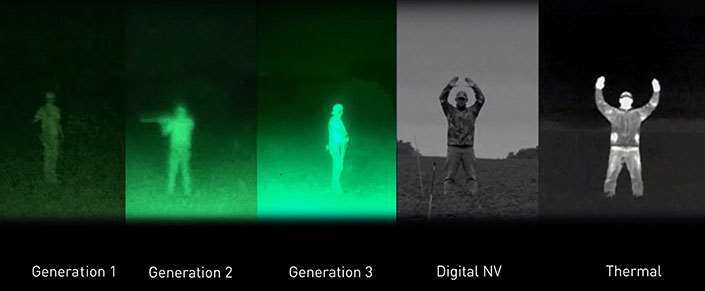
With respect to advancing technologies, throughout my night-hunting time, military-type generational night vision was used sparsely. They’re most often cost-prohibitive and used infrequently as a result. Generational night vision devices also can be easily damaged by daytime usage or long exposure to bright lights, even in an otherwise low-light environment — the components are quite delicate.
The flashlight aside, night-hunting’s greatest pocketbook-friendly technological leap came with digital night vision, quickly followed by expensive consumer-grade thermal imaging devices. Good examples of digital night-vision optics were Sightmark’s Photon riflescopes and, today, Sightmark’s Wraith family of digital riflescopes — the Wraith 4K Mini being the most popular. It boasts full-color HD imaging for daytime shooting, and with the push of a button, it puts the hunter in legitimate digital night-vision mode with a detection range up to 300 yards.
Of course, digital night vision has suffered quite the beat down by thermal imaging, especially as pricing for premium thermal performance continues to drop. Most often, thermal imaging is a far superior nighttime imaging solution compared to digital night vision. Most thermal hunters agree, “Nothing hides from thermal!” The fields of view from generational night vision as well as digital night-vision devices are muted and generally restricted to grayscale or green-hue imaging. Thermal optics reveal a field of view comprised of varying temperatures, the hottest of which absolutely glows!
While countless night-hunting consumers have flocked to thermal imagers and manufacturer competition in this niche has grown considerably in the past five years, many hunters still claim thermal technology is too expensive — but I emphatically disagree. There has NEVER been a better time to purchase a thermal riflescope, and they have never been more affordable. Case in point, Sightmark’s Wraith Mini 2-16x35 Thermal Riflescope, priced at about $1,700, much less than many premium traditional daytime scopes.
As a notable point, thermal is not night vision. Thermal is a true 24-hour scope. The technology does not depend upon time of day, only differences in temperature within the device’s field of view. Of course, it’s best used during nighttime and offers an exceptional field of view, even at long-range, in zero light! Most night hunters agree that there is no substitute for thermal technology, and Sightmark’s lightweight, compact Wraith Mini Thermal Riflescope, roughly the size of an ACOG and weighing less than 20 ounces, makes it easy to get in the game!
The Wraith Mini 2-16x35 Thermal Riflescope boasts 384x288 microbolometer sensor resolution, a Lynred sensor, 17-micron pixel pitch and <40mK NETD sensitivity for an adult-size heat-signature detection range of 1,400 yards in zero light and detailed imaging for confident shooting on identified targets out to 200 to 300 yards. The Wraith Mini Thermal also features a 1024x768 OLED display with five color-theme palettes, 10 reticle styles in nine colors for a customized field of view, 2x optical magnification with 1-8x digital zoom ratio, five rifle storage profiles, built-in video to a micro-SD card and roughly four hours of runtime from two CR123 batteries. Of course, the scope can also be powered for roughly eight hours with Sightmark’s Picatinny-rail mountable Mini QD Battery Pack. Learn more about the Wraith Mini Thermal Riflescope at www.Sightmark.com