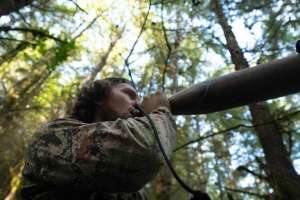

Sometimes it’s only a few muffled mouse squeaks. Other times, loud and repeated squalls make magic. There’s something special about calling predators, and emotions go off the chart when a shark dog comes barreling in, full speed and low.
I am a predator hunter and exceedingly proud of it. I am part of nature, not simply an observer of it. What I do as a predator hunter matters and has a positive impact on wildlife. From time to time, it is helpful for us predator hunters to take stock of our situation and, more importantly, to take stock in ourselves.
Who are we, really? We are predators and our prey are predators, as well. That alone separates us from many other hunters, whose primary prey are prey animals such as deer. There is no effort here to divide the ranks of hunters. Quite the contrary. All hunters are united under the hunting banner. It’s just that some of us express our hunting passions in different ways, such as a focus on hunting predators. And although we predator hunters might focus primarily on predators, most of us also hunt typical prey animals as well. Hence, all hunters are under the hunting umbrella, so to speak, and that’s fine.
Where the differentiation among hunters becomes important is when viewing predator hunters through the eyes of non-hunters. Most humans in the world today are non-hunters — not anti-hunters, but just folks who don’t hunt. Anti-hunters are a whole different breed, and they represent a small percentage of the overall human population — even a smaller percentage than do hunters, or even predator hunters. Yet it is the majority of the human population that ultimately determines whether there is hunting at all, and especially whether there is predator hunting in the future.
But what do non-hunters see when they look at predator hunters? What are the things we do that resonate neutrally or positively with non-hunters? Ideally, it is that we represent a balancing factor in the true sustainable-use conservation of wildlife. It makes sense, because if wildlife is not conserved, there won’t be any in the future, which means there will be no hunting of it. It is possible to cause species to become extinct and that’s not what we’re about. In fact, the misguided efforts of anti-hunters do more to endanger wildlife in wild places than does all hunting combined. Something to think about. Anti-hunters literally “love” wildlife to death.
Truth is, anti-hunters don’t love and honor wildlife the way we hunters do. They merely use wildlife as a way to raise money for their attacks on hunters and whatever else they do in their subversive lives. Seems to me that instead of loving wildlife, anti-hunters hate humans. They appear to be among the most serious self-loathers one could imagine. They don’t like anything and seem to hate everything.
And although anti-hunters attack all hunters and hunting, they particularly spew their venom at predator hunters and predator hunting. They incorrectly preach that, among all hunters, predator hunters are the most dispensable. This is because they believe the fantasy that nature alone will balance the scales if they introduce or reintroduce predators into wildlife populations in a helter-skelter manner.
The problem with such a worldview is that there are humans and human development in the equation. Planet Earth hasn’t been the same since humans came on the scene many millennia ago. What the current situation means is that predator hunters represent the balancing element between predator and prey species. Unless humans become extinct, predator hunters will be needed forevermore.
Speaking of humanity becoming extinct, that is actually what the anti-hunters strive to achieve. They hate themselves; they hate predator hunters; they hate humanity itself. Rather than recoil amid persistent assaults by anti-hunters, it behooves predator hunters to recognize that who we are is noble and that what we do is needed. We represent the solution, not the problem. We are predators, so how does that fit into the bigger picture — the natural order? The term “natural order” can be misleading because, upon closer inspection, nature is a study of imbalance.
It kind of goes along with the concept that the only constant is change. Predators exist in nature as agents to keep the populations of other species in check. This is evidenced in many ways, not the least of which is the phenomenon of the hare population cycle, which, depending on various factors, is more or less a 10-year recurrence when including the resultant predator cycle. The local populations of predators follow the population fluctuations of hares. In other words, trailing by a year or so, the number of predators increases or decreases in delayed parallel to the increases or decreases in the number of hares where hares represent the primary prey species.
It takes a lot of words to convey this reality totally, but it is important when looking at the big picture because our strongest justification for existence in the eyes of rational people is that we contribute positively to nature. To assure a bright future, we need to do what we do and invite others to join our ranks. Each of us can introduce family members and friends to predator hunting. Through the ages, hunting has continued because one hunter mentored another person and then those two mentored two more, etc.
For those among us who want to go to the next level, becoming politically involved is critical. This needs to happen locally, statewide, nationally and internationally. Anti-hunters are global, so hunters need to be represented everywhere, as well. The two biggest advocacy groups for guns and hunting are the National Rifle Association of America and Safari Club International.
Regardless how involved individual predator hunters want to become, it is important to do something — even if it only means continuing to hunt and inviting others into the fold. What we do now will determine what tomorrow looks like. Let’s make it a bright future.