
Life is an extended stay in school. If you think long enough about it, you learn something new every day. The same phenomenon occurs while coyote hunting. Every setup provides a different twist and when you break it down, on the spot or later, you learn something from every calling experience. When you tally your years of coyote hunting, the lessons you learn make you a better hunter, hopefully. The following tips offer a snippet of the hunts that crafted me into a modestly successful coyote hunter. Lessons learned.
Listen to the Locals
“Pull in here. Do you see that grain bin? We can set up there and call the coyotes across the corn stubble,” my Kansas hunting pal directed. This all occurred in the predawn light, as I glanced over my shoulder at the highway less than 300 yards from the location where he fully expected a coyote to show up. Morning commuter traffic was already beginning to hum past with headlights blazing.
“Won’t the coyotes be leery about running toward a highway?” I asked him. He assured me he was right (a common practice) and that I wasn’t the expert (also a common comment). I ate humble pie to avoid 30 minutes of debate, and we trudged to the giant tin can to set up. That’s when I noticed a stack of round bales farther along the field edge and suggested we climb into those for elevation because the bin sat in a low spot in the field. After quickly being shut down again, I fully assumed my guest role and nodded in agreement after every question thereafter.
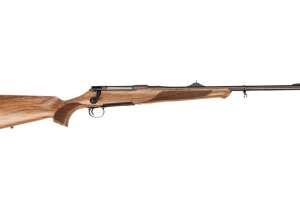
Ten minutes into the setup, my buddy whispered, “Coyote.” A shadowy figure had slipped from an adjoining hedgerow to survey the scene and listen to the sounds of distress. With the coyote on my partner’s side, I ranged it at 200 yards and his Bergara .22-250 Rem. cracked with the solid sound of a hit. The big male hit the dirt within sight of a county highway, now whirring with rural workers headed to the city.
Lesson Learned — Over decades of hunting, I’ve learned its best to listen before giving your opinion, in business and hunting. Typically, locals have experience in their ZIP-code wheelhouse. Animals react differently in different environments, and although I would rarely call near a highway, my hunting partner had experience with this location and several others. The coyotes were more comfortable with the busy rural landscape, plus some locations have a glutton of coyotes providing more ears to hear your calls. I just needed to listen to the local advice.
Be the Early Bird
I have always been an early riser so don’t be surprised if I text or email you at 3 a.m. It hit home on a recent public-land coyote hunt. A big expanse of sagebrush canyons held hunting opportunities for deer, pronghorn and upland game. I knew it also held coyotes.
It was mid-October with numerous seasons open, and I knew the public land would get busy soon after sunrise. To beat a public-land, Black Friday style of event, I rose early and arrived at the public access point more than an hour before shooting light. With the moon illuminating a path, I trekked more than a mile to reach a series of deep canyons connected to private land below where coyotes nocturnally hunted. Before dawn, they beat a path back up the canyons into the rough country for refuge — where I’d be waiting.
Hoping for a canine confrontation, I set out a Montana Decoy Company Sitting Coyote decoy 75 yards to my right and kept my decoy dog Sully beside me for further provocation. Ten minutes into a series of howls that included a challenge howl, a pair of coyotes raced off the canyon wall to my position. One held up while an aggressive coyote crossed the canyon right into our trap. He spied the decoy and then Sully, thought twice and was about to leave when a V-Match ended the escape.
As I gathered up the coyote for a quick photo album memory, shots rang out above me. With my binocular I spied a pair of pointers followed by several blaze orange upland hunters. A busy day on public land had begun.
Lesson Learned — Most people don’t have the motivation to get up super early. Oh, they rise and shine, but few appreciate walking through the wilds in the dark. They would much rather hike to a hunting area with dawn breaking and not under moonlight. Whether it’s hunting deer, elk or coyotes, I try to beat the average hunter into public lands by a minimum of 30 minutes and oftentimes by an hour. This way I can get one good set in before possibly being disturbed and have the rest of the day to craft a hunting plan, or even get back to work.
Best Seat in the House
“Let’s set up here. We can see nearly everything,” my long-time hunting partner and past mentor directed. How could I argue? The clear day allowed us to see a long way, and a road, where we parked my truck, likely would act as a deterrent for coyotes approaching from the opposite direction. Still, one narrow yet shallow gully leading downhill for hundreds of yards caused me to pause. Would a coyote actually run the entire length of that eroded terrain feature to reach our calls?
My mentor had more years than me at this point regarding coyote hunting experience, but I also had experienced my share of cagey coyotes. More than once I barely stopped calling to be shocked by yellow eyes already staring at me almost within archery range.
I sat back and listened to my friend work through a series of sounds any coyote would consider risking a peek to appraise the prey provisions. The first few minutes ticked by without action, and I slowly rotated for an over-the-shoulder look. Slight movement from my partner brought my attention front and center. Bearing down on our position was a coyote about to hit “Top Gun: Maverick” mach 10 speed. Until it was 15 yards out, it had run the entire length of the depression in stealth mode. In an unarguable act of elite marksmanship, my pal hit the coyote squarely with a .22-250 Rem. roadblock. The coyote skidded to a halt at our feet.
Lesson Learned — Coyotes, particularly veterans, acquire a remarkable skill of traveling out of sight when in the mood. Choose your setup site accordingly. Not only do you need to consider coyotes approaching from a downwind position, you also need to evaluate every terrain feature with a coyote mindset. Will a coyote be able to approach and even wind you without you ever seeing it? Using a vetted hunting app, such as HuntStand, aids you in analyzing terrain beforehand, and when you acquire a firsthand look, do your best to have the best seat in the house so coyotes have a bad day.
… Till the Fat Lady Sings
Kneeling, I scanned around my setup site and picked up hand calls, a glove and my rangefinder and methodically began putting them in my pack and pockets after an hour of calling. Reaching down, I grabbed the bolt of my Bergara to eject the round in the chamber when a gray apparition appeared in my peripheral vision. Slowly, I twisted my head in the direction of the ghost to shockingly discover a coyote looking for the maker of the earlier noise. It was a latecomer to the party, but despite its dawdling personality, it represented a fur-taking opportunity.
Still as a statue, I waited for the coyote’s next move. When it moved behind a particularly large yucca I eased into the prone position. The coyote sensed my motion, but still in investigative mode, stopped to evaluate. That was a bad decision, as I punched a V-Max hole through its vitals.
Not only have I scored a win while packing up at a calling site, I have punched fur on the walk in and out many times. One afternoon, I walked along a snowy hillside toward a valley for calling. Glancing up the hill occasionally, I hesitated at a glimmering object. Lifting my binocular, I couldn’t believe my luck. It was a napping coyote! A quick shift to a nearby berm gave me benchrest stability to wake the coyote, albeit for only an instant!
Lesson Learned — Never give up your vigilance until you finally get back to a trailhead or your vehicle. I’ve lost track of the number of times I picked up an extra coyote simply by still-hunting into and out of areas. You might encounter an inadvertent coyote, a slowpoke or even an oddball nosey coyote uneducated in the ways of the bullet. Regardless, the hunt ends only when you have your shooting iron stowed away.
Simple Equals Real
“You’re not a DJ at a dance club,” I hissed to my hunting partner beside me. He slyly smiled, as he switched to yet another sound on his expensive, new electronic caller. I couldn’t argue the realism of the sounds radiating from the high-quality speakers. I just questioned whether changing tunes too often during the set sent a confusing message to coyotes, especially those that had already been pressured over the long winter.
We did not call in any coyotes that afternoon. The next morning, I asked my hunting partner if I could do the first set. He obliged, and I started out with a simple chorus of lone coyote howls. The brief serenade was meant to announce to any coyotes in the area that a visitor was looking for social interaction. Whether a coyote took that as a friendly invitation or a threat was up to them. Ten minutes later, I added the ruckus of gathering crows to the ruse and real crows flocked in to see what the squabble was about. So did a snooping coyote. I whispered to my buddy, “Coyote,” as I settled the crosshairs on its shoulder. When it stopped to scan several crows passing overhead, I depressed the trigger.
Lesson Learned — I don’t blame my hunting partner for trying to masterfully deceive coyotes with a symphony of nature’s sounds. Nevertheless, I feel that sometimes simple is better. Coyotes that have run to calls and worked unseen downwind to detect hunters, or possibly experienced a near miss, might not be as ambitious to respond to the same prey-in-distress calls. A short series of howls, crow calls, magpie chatter, jay fighting or other ubiquitous sounds could be more effective. On many occasions, I have used unsophisticated sounds of birds, coyotes and other game species to lure in a coyote burned out on DJ music.

The Coyote Nose Knows Best
Try these tips for getting by a coyote’s No. 1 defense.
I take my coyote hunting as seriously as I do my pursuits for deer and elk. These species survive with the use of their olfactory security system, but I feel coyotes rank even higher in the nose superiority category. My initial blow to a coyote’s defense system begins with a thorough washing of my hunting clothing. My Muddy Outdoors TRX hunting attire gets a rinse using Wildlife Research Center’s Scent Killer Gold Ultra-Concentrated Detergent Strips. No measuring. No liquid mess. Just drop a strip in with your clothing for convenience, especially while traveling.
Next, I liberally spray all my scent-collecting hunting gear with Scent Killer Gold spray. Hunt Dry Technology Plus provides 99 percent protection even after 20 days. I use it on my backpack, gun slings, hats and, of course, as more protection on every layer of clothing that accompanies me while in the field.
Lastly, keep in mind that coyotes have more than 220 million olfactory receptors in their nose. You have only 5 million. Use their superpower to your advantage with a good dousing of coyote urine. It works great to pause coyotes in openings they might use to circle downwind and out near your electronic caller as a stop sign. When they hit the brakes, bang. End of story. To keep scent concentrated, utilize felt-style wicks for soaking purposes and place them at coyote nose level, or even higher to spread the odor over a larger area. For more information, visit www.wildlife.com and www.gomuddy.com. — Mark Kayser

CONTACT INFORMATION
HuntStand Hunting App
Hornady Varmint Superformance Ammunition
Bergara Rifles
Rocky Mountain Hunting Calls
Montana Decoy Company Coyote Decoys