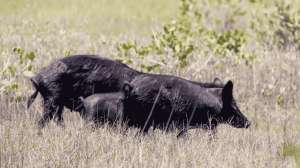

A female grizzly bear and her three adolescent cubs lope away through tall grass in an open agricultural field. It’s an aerial view, but from a drone rather than a helicopter, footage recorded during a study conducted by researcher Wesley Sarmento. The study, published in 2025, found that grizzly bears on the plains along Montana’s Rocky Mountain Front ran away when hazed using drones.
As grizzlies expand into areas of their former range, they can run into conflict with humans. Managers and researchers such as Sarmento work to prevent these conflicts. Grizzly bears are listed as threatened under the Endangered Species Act, so lethal removal is a last resort. To promote both bear and human safety, managers often employ hazing methods.
Sarmento, then a bear management specialist for Montana Fish Wildlife and Parks (FWP) started by holding a series of public meetings in the region to determine what the locals hoped for when it came to bear management. The consensus in these agriculture-based communities was to keep bears away from homes and livestock and instill in them a healthy fear of people to promote public safety.
Sarmento and his team obtained permission from landowners to haze bears on private property. They tested three classic hazing tools, including a shotgun with cracker shells and rubber bullets, driving a vehicle and honking the horn and chasing with Airedale dogs. Into that mix, he threw a lesser-used option — chasing with drones.
Although the study was limited by the small sample size and the inability to completely randomize the methods (dogs couldn’t be used near highways, shotguns couldn’t be used too near towns or during high fire danger), drones appeared the most effective of the tools and were statistically more effective than the dogs. “For the situation I was in on the prairie, it was hands down drones,” said Sarmento.
While the drones performed well on the plains, one of Sarmento’s colleagues on the study, Daniel McHugh, went on to help identify some limitations based on location. McHugh now works as a bear management specialist for FWP in Red Lodge, Montana, in the more heavily forested part of the state. “When bears are in the timber, it can be a lot harder to haze them using drones, but not impossible,” McHugh said.
Oftentimes, the bears McHugh interacts with in Red Lodge are near residences, and typical hazing methods, such as vehicles or shotgun crackers, are unsafe or overly disruptive for use in these environments, while drones are limited more by restricted airspace. McHugh often relies on a paintball gun for hazing instead. But McHugh still finds drones particularly useful for many management applications such as telemetry, checking bear culvert traps and scouting conflict sites to ensure safety for himself and others.
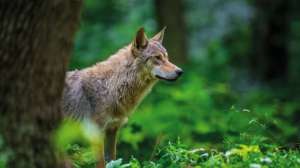
Drones can also be a good tool for wolf management. Dustin Ranglack, the Predator Project leader with the U.S. Department of Agriculture’s (USDA) National Wildlife Research Center, first started using drones in 2022 to deter wolves in the Klamath Basin in southwest Oregon.
After ranchers in the area experienced 11 depredations over 20 days in July of 2022, the U.S. Fish and Wildlife Service and Oregon Fish and Wildlife called Ranglack and his team in. For the next 85 days, Ranglack and other USDA employees were on scene, using drones as well as other deterrents to haze away wolves. Over that period, they experienced only two more depredations. Ranglack sees the major benefit of the drones being their dynamic capabilities. “The drone is responding and adapting to the wolf in real time,” Ranglack said. “It’s not like fladry [flags placed around a perimeter to frighten wolves] or a lot of our other tools where they are static.”
Part of Ranglack and his team’s success is their use of speakers on the drone to play human voices, often music, while hazing wolves. The program has seemed successful, although Ranglack cautions that they have yet to fully analyze their data. One concern with any hazing method, especially those without pain stimuli, is that the animal becomes desensitized and realizes it isn’t a threat. But the USDA team hasn’t yet experienced this issue with drones. “Four years into this, so far we haven’t really seen any signs of habituation,” Ranglack said.
Ty Smucker, a wildlife biologist based in Helena, Montana, has been using drones for wildlife management for years. Smucker really picked up on it during his time working with wolves in western Montana during the early 2010s. “From the beginning I was always trying to think about how to count wolves, count pups, chase wolves away from livestock,” Smucker said. Since then, he has used drones in many contexts and with many species beyond wolves, from spotting elk calves for collaring to counting moose in marshes.
Although a useful tool to have in the toolbox, managers do run into stumbling blocks when procuring drones, including the high cost and red tape, but these drawbacks are not stopping them from pushing forward with drones.
For Jared Beaver, assistant professor of wildlife management at Montana State University, the expansion of drone use in wildlife management is more about figuring out how to use the data drones provide. He’s working on using AI and machine learning to enable producers and landowners to detect threats to their operations, be it ungulate or predator, and use the tools they choose to respond to them appropriately.
Beaver shares the enthusiasm of biologists and managers for the future of drones in wildlife management. “Our ability of when, where and how we can fly and the sensors we are monitoring with is advancing very quickly from year to year,” Beaver said.
Photo Credit — Ryan Brennecke