
When I started to become more serious about predator hunting during the mid-1990s, I didn’t have the luxury of looking up information on the newly created internet. The world wide web was just gaining public popularity, and in those early years, no one really knew what to make of it. Most of my early information on calling was gleaned from the pages of coyote calling books and the rare predator hunting magazines. Honestly, I remember thinking that if I wanted to be a successful predator hunter, I would have to learn all I could on my own through trial and error.
One short article that stuck with me came from an early varmint hunting magazine on bobcat hunting. Up until that time, I had seen only a couple of bobcats quickly crossing the road as I drove the back hills at night, and I had never attempted to call one. The article showed an older hunter holding a nicely spotted cat by the back legs. He wore a headlamp, and the photo was clearly taken at night. Applying my own limited experience with bobcats to the article, I assumed that you could call cats in only at night. That self-induced myth would be crushed during a solo desert hunt.
After a few years of struggle, I finally started seeing a leveling of the predator calling learning curve. By the late 1990s, I was regularly calling and killing coyotes in the desert near my home. One morning, I headed out solo to call and test out a new firearm I was hoping would be a reliable rifle for predators.
Arriving before sunrise, I quietly hiked to the edge of a dry drainage with an amazing view of the surrounding desert. I quietly sat down, placed the Savage .17 HMR on my shooting sticks and started calling using a Lohman mouth-blown call. Within minutes I had some action.
A lone coyote trotted through the sage and then jumped up on a boulder 250 yards out. Understanding the limitations of the .17 HMR, I knew I needed him to get a lot closer. I was just about to get back on the call when movement to the left caught my eye. A beautiful, orange-colored bobcat had sneaked in and sat down only 60 yards from me.
I was stunned at the presence of the cat. With my limited experience, I was convinced that cats were active only at night. I slowly swung the rifle over, found the cat in the scope and killed my first bobcat. I looked back out to where the coyote was, but I never saw him again. Knowing that other more suitable calibers were available and would greatly extend my shooting distance on interested predators, I never fired the .17 HMR at another predator again.
Focussing on Bobcats
After that first bobcat, I became somewhat obsessed with chasing daytime cats. Over the next two decades, I kept careful track of the specifics of how bobcats responded when I went predator hunting. I kept a notebook where I noted everything from calls used, calling habitat, time of response, distance of shot, behavior of approach and whether I killed a male or female. They say the more data you collect, the easier it is to see patterns. Once I started paying attention, I began to feel confident that if I looked for certain calling conditions, bobcats would respond if they were present. If I’m targeting a daytime bobcat, this is what I look for.
Type of Habitat — In the areas where I hunt, bobcats primarily prey on birds. They are well equipped to sneak through the thick brush and ambush unsuspecting game birds. They also prey on small mammals, such as cottontail rabbits, wood rats and field mice. When I head out to call bobcats, I look for habitat types that hold all the prey listed above. Essentially, I call where the food is.
When I’m looking for bobcat habitat, I seek out heavily brushed areas, such as sage and rabbit bush. These areas are thick, but not too thick. I look for places that provide ample protective cover for prey and stalking avenues for hungry cats. Before I add the spot to the call routine, I’ll walk through the area, examining the prints of everything that lives there. I also want to see the prints of the predators that visit the spot to hunt.
Bobcats love to approach through a thick tangle of brush, often just appearing during a calling stand. I feel like they make two approaches; a general movement to the sound to close the distance and then they check up at the edge of the brush to just observe. This is why I also look for open areas near the edge of thick brush. I set up on the far side of these open spots, so approaching bobcats can observe from the comfort of the bushes. I look for heavy cover that can hide a cat’s approach but offers an edge feature, allowing the cat to confidently observe before they make their next move.
Lastly, ask any bobcat trapper, and they’ll tell you that the favorite travel corridors for bobcats are canyons and dry drainages. These are their highways, and they use them constantly when out hunting. When I find these terrain features choked with thick brush, I know they will be heavily used by bobcats.

Sounds — While I believe almost any prey-in-distress sound will get the attention of any hungry predator, I want something special when I head out for bobcats. Whether I’m using a mouth-blown call or an e-caller, I make sure the sound has a fast cadence and is high pitched and loud. When using a mouth call, I like to really put some effort into it. Using my hand as a bellows, I can alter the sound, producing higher pitches and gravely screams. I make the call loud and frantic. In short, I make it sound like someone is running a rabbit through a woodchipper. I love the gravely sounds I can produce with Dan Thompson closed-reed calls, and honestly, they are my go-to calls, day or night, when targeting bobcats.
In today’s e-calling market, there is a diverse library of prey-in-distress files available that fit the bobcat calling bill. Any of the high-pitched small mammal or bird sounds available are excellent choices and will get the attention of a hungry cat if it’s within earshot. When I reach for the e-caller on a bobcat hunt, I always pick small mammal or bird-in-distress sounds. The faster and higher pitched, the better.
Response — It doesn’t matter what predator I’m targeting, I don’t spend more than 12 to 15 minutes on a stand. This might go against the grain of many predator callers, but in the areas where I hunt, I can make 10 to 12 stands a day in quality habitat, and I’d rather do that than sit longer. In my opinion, if bobcats are interested and nearby, they will show themselves within that 15-minute window. I know callers that religiously call for longer periods, believing they are giving the predator a “chance to respond!” I’d rather make more stands in quality habitat than call for longer. That’s just my preference.
I mentioned earlier that I believe bobcats have two modes of responding to prey-in-distress sounds, moving quickly to the source of the sound, then easing into stealth mode to close the distance. And I’ve found that distance to be routinely about 60 yards. From the very first bobcat I ever killed to the dozens I’ve called and killed during the day since then, they either walk or trot in to investigate the source of the sound and then check up and observe, often just sitting down and looking. I understand that they feel comfortable in thick brush and move freely. Once they hit an open spot, most of the time they stop. Find this type of edge habitat and you’ll likely see more bobcats.

Bring Enough Gun — I will forever believe that bobcats are just wired differently than other predators. They are hard to kill, on constant alert and might run off even after a perfect shot. Years ago, I shot a large bobcat right in the heart at 100 yards with a .204 Ruger and he ran 250 yards before collapsing. While I was skinning him, I opened the chest cavity, and the heart had been reduced to mush. I attributed his lengthy attempt at escape to pure adrenaline. Like I said, they are just wired differently.
I’ve killed bobcats with the .17 HMR, .204 Ruger, .223 Rem., .22-250 Rem. and a shotgun. The only rifle round that consistently anchored them after the shot is the .22-250. Despite killing my first bobcat with the .17 HMR, the round is just too small to be an effective cat round in my opinion. I used the .204 Ruger for almost a decade and was happy with its speed and knockdown power for bobcats, but I started to notice an issue with extended distances. I’ve killed four bobcats with the .223 Rem. and I had to go looking for each one. All shots were in lungs and heart, and the cats were still able to run off. I attributed this to the round’s slower speed. From 60 yards out to 250 yards, the .22-250 Rem. has consistently knocked bobcats down for good when I do my job. Hunting calibers are, of course, a personal preference, but in my experience, you should bring enough gun to knock them down for good or you might never find them.
Camo Confidence — During more than two decades of pursuing bobcats, I’ve noticed one behavior that still puzzles me. Whenever I call during the day, I try to keep the sun at my back. It makes the approaching animals easier to spot, and predators looking my way often lose me in the glare. And when a bobcat responds to the call and checks up, it stands out like a sore thumb. Its bright white chest and white face tufts are easily spotted against the subtle browns and greens of the desert floor. Yet, it sits there believing it’s completely invisible. I’ve seen this “you-can’t-see-me” behavior so often that I’ve concluded that bobcats are almost overconfident in their camo when approaching a stand.
This daytime behavior is supported by their nighttime approach as well. Whenever I spot approaching bobcat eyes while night hunting under a red light, I watch how they respond. They’ll use structures to hide behind when moving toward the call, but once they get to that 60-yard distance, they check up and just stand there out in the open. That’s usually the last thing they do. Not only curiosity, but overconfidence kills the cat.
A Morning to Remember
The sunrise was still 15 minutes out as we sneaked into our calling spot. A large volcanic mound protruded from the desert floor, offering an amazing view of the sage-covered terrain. My good friend, Ed Davis, and I quietly climbed the rocky mound and settled in to call. He’d cover the right side; I’d handle the left. With the peaking sun at our backs, Ed looked over at me and nodded. I returned the gesture, and we got started.
Using his favorite Crit’ R Call, Ed began to fill the surrounding desert with a symphony of pain. When I first started predator calling, everything I learned about using a mouth call, I learned from Ed. In my opinion, he is the best predator caller I’ve ever hunted with. Ed’s pattern is to blow a 30-second series on the Crit’ R Call and then ease into about 45 seconds of silence. These silent gaps are when we search for movement.
After the third series, I spotted something moving 100 yards out, a little to my left. Something was easing through the sage behind a large boulder. I raised my rifle, found the huge rock in the scope and waited. Within seconds, a beautifully spotted bobcat walked out from behind the boulder and sat down. The crosshairs danced on its chest for a few seconds before I squeezed the trigger, killing him there. About one second later, I heard a shot from Ed’s side. Another unseen shot from the right side punctuated the stand five minutes later.
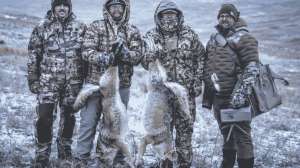
Ed slowly stood and looked over smiling. Apparently right as I shot the cat, a coyote came from behind us and Ed made a running shot on him. Waiting, Ed called in a second bobcat a few minutes later on his side and dropped it as well. Two 24-pound daytime bobcats and a bonus coyote on that one morning stand.
While I do love night calling for predators, there is just something special about watching bobcats come to the call during the day. They are stealthy, sneaky and a little overconfident. And while I do love calling coyotes, watching a bobcat come in on a desert morning, knowing you’ve fooled it, is my favorite predator hunting scenario.