
When it comes to binoculars, I’m not exactly an optics snob, but I am a bit picky and opinionated. Through the decades, I’ve field tested the best binos that money can buy, and not surprisingly, I loved them. That said, I also understand there are a few bino brands that the vast majority of hunters either can’t afford, or choose not to purchase due to the super-high price.
On the other side of the coin, I’ve spent thousands of hours in the field with what I call “value optics.” I’m not talking about a $99 binos — in general, this price point is so low that the optics are almost worthless (my opinion). By “value,” I’m talking about binos in the range of $250 to $500. There’s no doubt that a smart sharper can find a decent hunting bino in this price range.
Where does the bino covered in this field test article, the Steiner Predator 10x42, fit into the mix? Well, the MSRP listed on the company website is $747.99, but like many hunting products, the street price is significantly lower. For example, I found a few online retailers selling the Predator 10x42 for $649.99. Even this price is higher than my value category maximum, but MUCH lower than the highest-end binos ($1,500 and up).
Unboxing and First Impressions
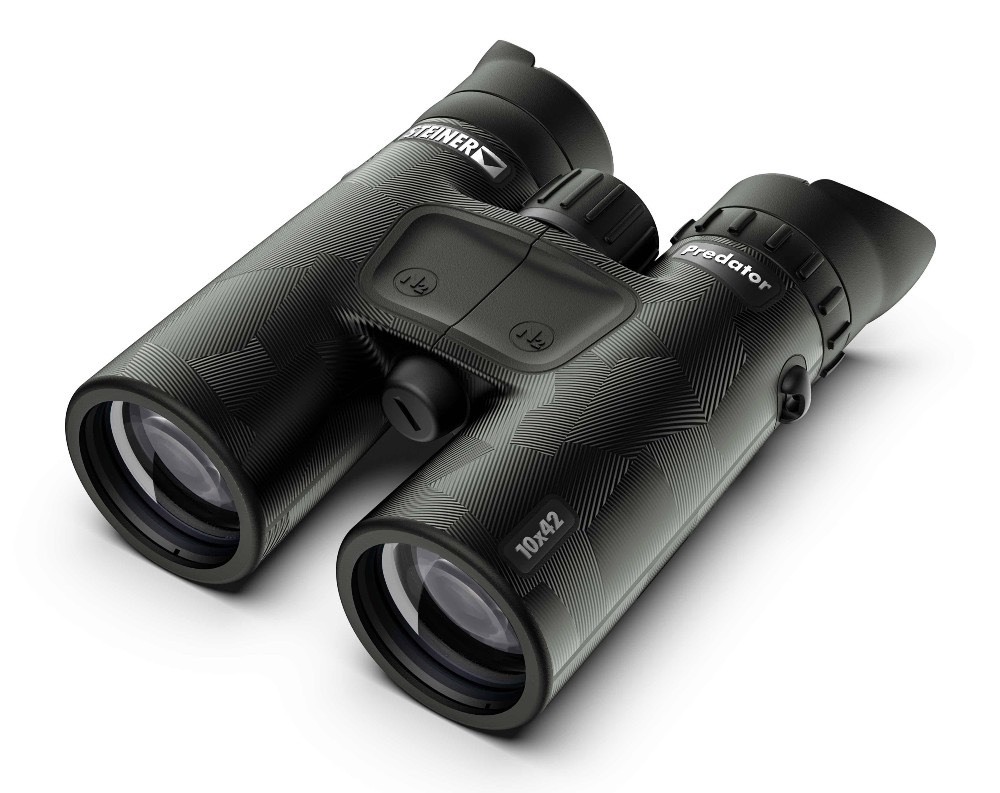
I’ve used Steiner binos in the past, and the one word I would use to describe them is “bulletproof.” And that was my first thought when unboxing the Steiner Predator 10x42. There is nothing chintzy about the Predator; everything about it screams durability.
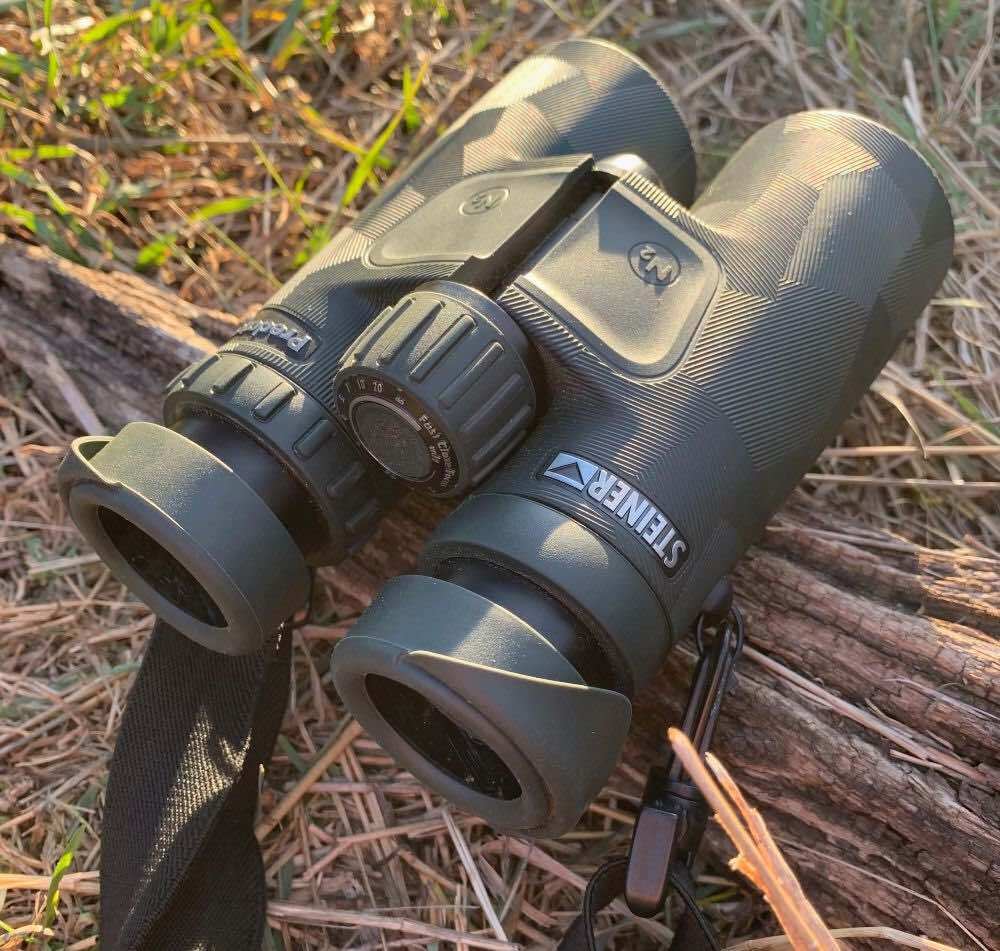
I was immediately impressed by the synthetic rubber armoring. It is laser-textured and not only looks great, but I knew it would provide a 100 percent positive grip.
Next, I noticed bino weight — let me explain so you don’t get the wrong idea. The Predator 10x42 weighs 26.3 ounces. Is this light? No. But is it heavy? No. If you compare this bino to similarly sized models at the very top end of the market (i.e. price), the weight is right where it should be. For example, a Swarovski 10x42 EL (MSRP: $1,999) weighs 29.6 ounces; a Leica UltraVid HD 10x42 (MSRP: $2.399) weighs 26.8 ounces.
In general, a bino that is durable enough to last a lifetime and possesses great glass won’t be super light. Enough said.
In-the-Field Observations
I attached the Predator 10x42 to a bino harness and wore them while bowhunting in South Dakota last fall, and also used them as my “house bino” during the winter of 2024/2025. What do I mean by house bino?
My backyard butts up to a wooded river-bottom, and I often see whitetails and a variety of other wildlife throughout the day. Because I work from home, I’m able to look out my office window from 7:30 to 5, and the Predator 10x42 sits on my desk right next to my water bottle. If I spot a deer, coyote, wild turkey or interesting song bird with the naked eye, I can quickly stop typing and grab the Predator 10x42 for a better view.
At the end of my work day, I move the bino into my living room, beside the chair where I watch TV and read. This chair is also positioned where I can see the river-bottom, this time out of a very large picture window.
I mention my home layout because the biggest test for the Predator 10x42 happened recently from my living room and not the treestand. At sunset, I watched two bald eagles circling above the trees beyond my backyard, and soon both birds were perched high in trees about 150 yards from my house. I sat down and looked at them through my picture window with bino in hand.
Evidently, there was a dead animal directly below them, and they were carefully checking out the scene before landing on the ground to feast. I don’t know how often a coyote and eagle will fight over a carcass, but I could certainly see the eagles scanning the forest floor below for danger.
Finally, the biggest of the two white-headed eagles landed on the ground and slowly walked in the 2-inches of fresh powder toward the carcass. I could see everything play out with the naked eye, but watching it through crystal-clear 10-power glass was spectacular!
For the next 30 minutes, I watched the eagles take turns ripping apart the carcass with their talons and beaks. One bird would eat, then fly into a nearby tree, then the other eagle would take its turn.
Remember, 30 minutes after sunset is the end of legal hunting time for big game in almost every state (Wisconsin is only 20 minutes after sunset), so I settled in for a true low-light optics test. Any bino with okay-quality glass will provide a decent view leading up to the end of legal hunting time, but only good to great glass will extend your viewing into the darkness.
With no lights on in the house, my living room was basically black as I continued to view one of the eagles feeding on the carcass. Could I still make out feather detail from a distance of 150 yards? No. But the fact that I could still decipher whether there was a bird on the carcass — now 40 minutes after sunset on a cloudy night — is a testament to the quality of the Predator 10x42.

Other Favorite Features
In addition to being impressed with the Predator 10x42’s low-light performance, I liked its silky-smooth focus knob. On some binos, the focus mechanism is too loose, making it difficult to achieve and keep a tack-sharp image. On the Predator, the mechanism isn’t too loose or too tight; it’s just right.
Similarly, the left-eye dioptric correction, which enables you to customize the focus to correct for your individual eye strength and prescription, isn’t too loose. I’m often annoyed when carrying other binos to discover that the adjustment I’ve made to the diopter has moved slightly because I bumped the bino against the tree while climbing. I want the diopter to be a “set it and forget it” adjustment, and it is with the Predator.
I’ll end with a bit of user advice. A friend of mine bought a Steiner 10x40 bino a few years ago, and he told me the only thing he didn’t like was the “winged” angled rubber on the twist-up eyecups. The reason for this design is to block stray peripheral light from interfering with views; it limits peripheral distractions and improves image contrast.
My buddy explained that the wings were in the correct position when the eyecups were in the down position (the wings are orientated this way from the factory), but when he extended the eyecups, which is where he wanted them as someone who doesn’t wear eye-glasses, the wings were in the wrong position. For that reason, he left the rubber wings folded over.
As we talked on the phone about his issue, I explained that he could rotate the wings around the eyecups to orient them so they are perfect when the eyecups are extended. The wings fit tightly on the eyecups, as they should be so they don’t move, but you can move them with a bit of force.
I look forward to carrying the Steiner Predator 10x42 bino this spring while turkey hunting, and then again during fall 2025 while pursuing whitetails in the Upper Midwest. In my opinion, they perform just as well as binos I’ve tested that cost twice as much.
One final note: The Steiner Heritage Warranty promises that this bino will be free from manufacturing defects for its lifetime. The company will repair or replace the bino if it’s covered by this warranty. Of course, the warranty doesn’t cover defects due to normal wear and tear, or damage due to misuse.
Click here to visit the Steiner website to learn more about Steiner optics. The features/specs of the Predator 10x42 are shown below for your reference.

Steiner Predator 10x42
Features/Performance
- 10x magnification brings distant subjects in close for detailed observation and identification
- 42mm objective lenses keep the overall form factor small while offering the low-light performance required for hunting, birding, and observing wildlife when many animals are most active
- Compact roof prism optical path ensures the optical tubes are thin for easier handling
- Extra low-dispersion HD glass reduces the appearance of chromatic and spherical aberration to improve color rendition and reduce distortion at the edge of the view
- Predator Diamond coating improves light transmission and contrast for high-definition views
- Wide 60° apparent angle of view presents an immersive observational experience with edge-to-edge clarity and reduced appearance of distracting hand-shake
- 324-foot field of view at 1000 yards
Use and Handling
- Closed-bridge configuration provides a solid and stable platform for the internal center focusing mechanism
- Fast-Close-Focus wheel requires minimal rotation for quick transition from close-up to infinity with tack-sharp clarity
- Left-eye dioptric correction enables users to customize the focus to correct for their individual eye strength and prescription
- 4.2mm exit pupil will cover pupils as they open and dilate in low light to ensure the entire scene stays in view without vignetting
Construction Details
- Laser textured armor design improves grip, especially in cold and wet conditions
- Oil-, petroleum-, and chemical-resistant NBR synthetic rubber armor offers improved grip security, especially in cold and wet weather
- Winged twist-up eyecups block stray peripheral light from interfering with views while improving contrast and limiting distractions
- Carrying case included
- Weight: 26.3 ounces
- Height: 5.8 inches twist cups down; 6.125 inches twist cups extended