
Since the time I wrote my first article on big-bore airguns for Predator Xtreme way back in the early 2000s, these rifles have evolved from being a relatively unknown oddity, to gaining mainstream visibility. Many states now allow their use for hunting deer and other big game, and there are several manufacturers producing them to meet the growing demand.
For many years, there was a common design thread amongst these guns. All were equipped with PCP power plants, came in calibers ranging from .30- to .50-caliber, and most were big, heavy, single-shot rifles. These guns were all bolt actions at first, often with two bolts, with one used to access the loading port and one to cock the gun. Triggers tended to be heavy, and guns often lacked an external safety mechanism, so they needed to be de-cocked when the user was on the move.
Following the earlier rifles built by Quackenbush Airguns in small production batches, large scale manufacturers such as Hatsan, AirForce and others eventually came to market with their own big-bore offerings. The performance was refined in these rifles, achieving higher velocity/energy output, and some began offering even larger calibers, such as .58, .62 and .72. These guns were throwing impressively large chunks of lead downrange with power and accuracy. The ergonomics and controls were also improving, side-lever cocking replaced bolt actions in many designs, safety mechanisms became ubiquitous and trigger quality improved substantially, but the designs were similar to their predecessors.
But as the market continued to expand, new designs started to emerge alongside enhancements to existing gun models. Carbine and bullpup configurations made an entry, the use of regulators to improve consistency and shot count gained traction, and the development of multishot rifles utilizing various approaches became available. In this article I will discuss a couple of the next generation rifles that I’ve been hunting with and talk about what advanced technology they bring to the table.
Let me start by saying that I am in no way implying the big bores we’ve used in the past are obsolete or inferior. I have taken truckloads of game animals with my unregulated single-shot Hatsan Piledriver, AirForce Texan and Air Venturi Recluse over the years, and continue to use them year after year. I’m also not a fan of new technology for the sake of new technology, but some of the newer designs offer novel (for the big-bore airguns) features that can be advantageous. As an example of a couple newer designs I’ve been using, let’s take a closer look at the Umarex Hammer .50-caliber and the Western Airguns Rattler .457 SA/FA designs.
Umarex Hammer .50-caliber
The Umarex Hammer is a transitional hunting platform, in my mind representing an evolutionary step from earlier designs. The primary technology upgrades are that a) the gun is regulated, and b) it is a multi-shot platform that has implemented a two-slug linear magazine. By implementing a regulator, the Hammer produces four to five consistent shots in the compact carbine version, generating up to 565 foot-pounds of energy (fpe) depending on slug weight. There are two purpose-designed slugs offered by Umarex for the gun — 350-grain and 550-grain projectiles — with several others available from third party sources.
The Hammer rifle is 43.75 inches LOA, and the carbine is 34.12 inches LOA, though there is only an ounce or two difference in weight due to the higher volume air tank on the carbine (35 vs 24 cubic inches). As mentioned, the power is higher with the rifle version, but the shot count is about the same. I find the stock ergonomics provide a stable hold and like this gun a lot for its offhand shooting capability. While most previous big-bore designs were single shots, the Hammer is a two-shot repeater, and with an extra magazine you can get four rapid shots with only a single reload.
I have used the Hammer in both the more powerful rifle version and more compact carbine version, to hunt hogs, javelinas and deer. Even though the rifle is more powerful, getting up to 700 fpe for four shots, I find myself gravitating more to the carbine. I find the carbine fits my hunting style of stalking in heavy brush and thickets, and I’ll trade off the additional power for better handling in dense cover. Unless I’m hunting bears or elk, there is not much I would shoot with a gun generating 700 fpe that I wouldn’t feel comfortable shooting at 565 fpe.
Many rifles of the previous generation have been highly focused on function and less on ergonomics. One of the things I really appreciate about the Hammer carbine is that in addition to excellent performance Umarex has managed to build a well-balanced, ergonomically designed stock and pistol grip, with logically and conveniently positioned controls. It carries well and is a great shooter off-hand or rested.
Western Airguns Rattler .45-Caliber
Another big bore loaded with innovative technology is the Western Airguns .457 (also available in a .35-caliber version). First off, this rifle is a semi-automatic repeater, which represents a lot of firepower on tap! The ammo is fed through a 12-shot revolver-type cylinder that generates 365 fpe in the standard version and up to 435 fpe in the LS configuration. Next, the Rattler is regulated, so the shots are very consistent and reliably cycles the semi-auto action. It is also a key component in optimizing air management that not only improves consistency and reliability but also results in a high shot count of 12 to 36 shots per fill, depending on the setting of the power adjustment.
This rifle has a very modern “tactical” feel to it, with the filling port, magazine release, firing mode selection and safety, tank and regulator gauges, all well placed and easy to access. The rubber buttpad and pistol grip offer a solid hold, and I find it shoots well for me off-hand. With a LOA of 40 inches, I would not call this a compact rifle, however it is very handy in tight spaces and easy to handle. I also like that there is a moderator extension to the shrouded barrel, making this one of the quietest big bores as well.
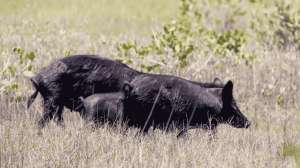
The accuracy of this rifle has been impressive, and I can consistently print sub-1-inch groups at 100 yards through the entire shot string. It’s useful to have additional shots on tap. I was on a hog hunt earlier in the year and spotted a group of hogs laid up in the morning sun. Stalking in, I lined up on a solid porker still bedded down at 50 yards and dropped a slug on its head, then another pig jumped up and swung around offering a broadside shot that I took. With two down, I swung around on a small pig as it started to run. I missed the first shot but hit him in the back of the head with the follow-up. About this time, I turned and saw the second pig climbing to his feet and sent him to the ground with another body shot. Five shots in about a minute, three pigs in the bag, and I still had enough air and ammo to keep hunting.
This is a worthwhile technology, especially for hog and predator hunting, where you might find a target rich environment. Both rifles utilize a high-pressure air fill; 4,351 psi for the Western Airguns Rattler and 4,500 psi for the Umarex Hammer, so you’ll need a method to keep the guns charged with air. This can be achieved using either high-pressure air tanks that can be refilled at a dive or paintball shop, or a portable compressor, which I think is a more cost-effective approach these days.
If you are hunting quarry such as wild hogs or larger predators, where there is potential for multiple targets or the need for rapid follow-up shots, having a multi-shot option that is powerful and consistent is a real advantage, and one of these next generation big bores might be what you are looking for!