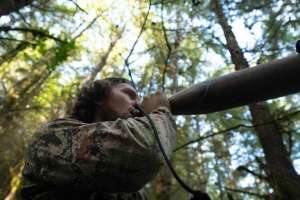

During the decades I’ve been hunting and calling up coyotes and other predators, I’ve had only one experience when I felt I was actually going to have a hungry coyote literally in my lap, ready to take a chunk out of me. To be honest, I don’t believe that song dog knew what I was — dressed in full camo gear, crouched on a rock outcropping as the first rays of sun bathed the high desert in slanted, golden light.
But the coyote meant business as it came to my calling, no doubt about that. I could see it in its eyes as it broke out of thick brush at a dead run only yards away, bounding straight for me. I had the camera to my eyes, hoping to snap the shutter on something farther out. The coyote filled the frame so fast and close it was all I could do to kick out and yell. I don’t know who was more shocked, surprised or scared, or maybe all three. I do know I could have easily reached out and touched the coyote with my rifle barrel, before it swapped ends and streaked back into cover.
I should add that by the time I dropped the camera and grabbed up my .243
Winchester bolt gun, I was so shook up I missed the shot. I’ve never forgotten the look
in that coyote’s eyes, and I’m certain I wouldn’t want to meet it again on some dark street in town unarmed.
More and more people are having these kinds of encounters, but not out in the wildlands where we hunt. And they can end in tragedy. There are no reasons why they should, given proper game management. These human/coyote events are happening in major cities and towns across the nation, from New York to San Francisco, and everyplace in-between.
Equally disturbing is the reaction of local politicians, police and fish and game departments, people we depend on for answers. Instead of solutions, we get excuses and half-baked suggestions on how we should learn to live with wild predators of every kind in our backyards and on our city streets. Aggressive urban coyotes are bold predators that not only endanger domestic pets such as cats and dogs, but adults and children.
Inner-City Coyotes
The San Francisco Bay area is one of the most heavily populated regions in this nation, yet coyote attacks on humans are happening there with increasing regularity. The cities of Moraga and Lafayette have also had attacks on men, women and children. One man was bitten on the stomach as he did push-ups on a local high school football field. He fought the coyote off. Other encounters and attacks have taken place on playgrounds and even at a local grocery store parking lot in the same area.
One terrified mother of a 3-year-old girl told a local television station reporter of a coyote attack on her and her daughter. She was pushing a stroller containing her new baby, with her 3-year-old walking behind her. The little girl screamed, and the woman turned around to see a coyote attacking her daughter — biting her leg and trying to take her down.
“I screamed and yelled, and the coyote retreated, but didn’t go far,” she told the reporter. “It would come right back at us and was not scared off by me at all!”
Rabies? Not in this case. Which means that this and others like it are outright attacks in which victims are considered nothing more than food.
Camilla Fox, executive director of an animal rights group named Project Coyote, says in defiance of these attacks. “We’re in a state where there are thousands of coyotes and most of the time they want to have nothing to do with us.” Obviously, Miss Fox hasn’t been bitten yet.
In 2023, Evan Menist, a city councilman in Poughkeepsie, New York, was out walking his dog when he was charged by a coyote in College Hill Park near Morgan Lake. The animal came within 5 feet of Evan and his dog, until he waved and yelled to keep it off. Earlier in February of that year a student at Marist College was attacked and bitten by a coyote and had to undergo rabies shots to stave off that deadly disease. In another report, an aggressive coyote charged a man and his dog in Secor Woods Park near the town of Ardley. A week after that another coyote attacked a dog and knocked down its owner about a mile and a half away from the same village.
In the Menist attack he says the coyote, “was not interested in letting me get away.” He added, “I’m just thankful it was me and not an elderly person or child who could not defend themselves.”
Everybody thinks of the “Wild West” as prime coyote real estate. But in Westchester County, New York, an off-duty police officer heard a woman screaming and went to her aid, in Thornwood Park, in 2018. He physically attacked the German shepherd sized predator by slamming its head on the ground while kneeling on its chest, until local police showed up and shot the animal. He had to endure six rabies shots for his bold response.
And it appears to be a universal problem. The executive director of Chicago Animal Care and Control stated, “So far in 2022, we’ve tracked 1,359 coyote interactions in Chicago, up from 1,137 during the past year. There have been another 79 interactions so far in the month of December.” That current estimate of coyotes living in the Greater Chicago Area is 4,000 animals.
Residents in the North Center neighborhood are speaking out, saying coyotes have become much more aggressive as of late. A man named Dean Ferenac was out walking his dog on a Sunday morning. He said, “I haven’t seen fangs before on a coyote. But its mouth was open and it was looking to hunt. The coyote was standing no more than 6 feet away from us.” Ferenac yelled and screamed in an attempt to drive the animal off. “They’re not taking any cues to leave,” he said. “They’re not afraid of people shouting or anything like that.”
With dangerous encounters becoming more frequent, it’s stunningly clear that much of today’s coyote population have become “urban coyotes,” living and thriving in cities and towns. It’s also obvious that when this trend began, local politicians, police departments and state wildlife agencies did little or nothing to stem the flow. Coyotes moved in, began to flourish unchecked, and now outnumber even domestic pets in many places. What are concerned, local citizens told to do when they complain? Learn to co-exist with these apex predators.
A Template for Disaster
The template for this nationwide disaster was started in California some years back.
So called “animal rights” organizations demanded the end of legal sport hunting of mountain lions in the state. They howled that all those blood thirsty hunters were killing off the big cats, and that only a meager handful of 600 animals were left, and fading fast. Up to that point in time only a limited number of lions were allowed to be taken. When that figure was reached, all sport hunting ended for that year.
Alarmed urban dwellers who didn’t know a mountain lion from a Cheshire cat, fell for the propaganda hook, line and sinker. The law was enacted and all lion hunting ended in 1972. So, what has been the result? In the previous nearly 100 years when lion and human encounters were tracked, only a handful were ever reported. But it took only a few years after the law was passed that attacks on humans began going up, and fast. Men, women and children were attacked and mauled in broad daylight in state parks and public campgrounds and walking trails. Between 1994 and 2024, three women and one man were attacked, pulled down and killed by lions. Some were partially eaten. New attacks are reported now every year.
Why this sudden change? The answer is very simple. The big cats have lost all their ancestral fear of man because they’re no longer hunted. And a study by the Fish and Game department several years after the ban showed there were not 600 lions left but 6,000! The big lie worked once again. Coyotes are now following the very same scenario. All this was as predictable as sunup.
Consider this, too. City-dwelling coyotes are raising litters of pups that have never lived in the wildlands hunting jackrabbits, cottontails and birds. The only “home” they know is concrete, asphalt and back alley garbage cans. Domestic pets, synch as dogs, cats or caged birds, are now on their menu. They roam nighttime streets unafraid, right along with pedestrians and speeding cars only feet away. That’s how far in the wrong direction this has been allowed to go.
Fighting Back
Coyotes eyeing children playing in a schoolyard or public playground should never be tolerated. Those animals should be quickly taken off the streets by police or Fish and Game people. Likewise, any coyote lounging by your backyard swimming pool area or casually walking the streets of suburbia, should not be allowed either. They are disasters just waiting to happen.
But there are measures each of us can take to help alleviate the problem. First, never leave pet food out on the back porch or deck. Coyotes will find it, eat it and return for more, making themselves at home. Never leave young children unattended where coyotes are prevalent, in either your back or front yard. They’ve openly attacked children as old as 8 or 9 without hesitation, in broad daylight. Teach children to quickly get inside the house if a coyote shows up. These canines are not the cartoon characters they see on television or in the movies. They are opportune killers looking for an easy meal, and children can quickly become a target.
Adults should report the presence of coyotes to local authorities, asking for assistance to remove these animals. Citizens can ban together and demand animals be taken off local streets where encounters and attacks are growing in frequency. The coyote breeding season takes place between the months of January and March, with February being the high point in this cycle. At this time aggressive males travel extensively, and can confront men, women and children, raising the level of dangerous encounters. When these events take place on your property against you and your family, I believe you have every right to remove that threat with legally owned firearms that do not threaten neighbors.
Today’s urban coyotes are not going away. Their numbers will only continue to grow, and with it there will likely be more human/coyote encounters. Be alert, be prepared and continue to report the presence of these apex predators anytime they begin to invade your neighborhood. By joining with friends and other moms and dads, you can make a difference.