Loading...

Predator

Displaying results 109-126 of 2058

I Stock 1442648293

RMEF Intervenes in Wolf Relisting Lawsuit

A coalition of hunting groups including RMEF support the U.S. Fish and Wildlife Service’s decision to maintain state management of gray wolves.
I Stock 1226471633

Baiting for Bears in Alaska Banned by National Park Service

The National Park Service has banned hunters from using bait for brown bears and black bears in Alaska, effective July 2024. The ban applies to all NPS-managed preserves in the state, based on a final rule that amends its 2020 regulation for sport hunting and trapping in Alaska national preserves. The new rule, which applies only to sport hunting, prohibits bear baiting due to significant public safety concerns. The final rule reflects extensive engagement with stakeholders, Alaska Native tribes and corporations, local and state leaders and the public.“The amended rule will advance wildlife conservation goals and objectives, including a prohibition on bear baiting in our national preserves, as mandated under the NPS Organic Act of 1916,” NPS Alaska Regional Director Sarah Creachbaum said. “We take our responsibilities under ANILCA seriously and the new rule reflects our commitment to providing conscientious service to the American public.” In February 2022, the NPS initiated rulemaking to reconsider the 2020 regulation after early engagement with Alaska Native tribes and Alaska Native corporations. Later that year, a Federal District judge remanded the 2020 regulation back to NPS to address the court’s decision that the 2020 rule violated NPS laws and policies in some respects. The new rule addresses the court’s concerns and is more consistent with NPS obligations to manage for natural processes, protect wildlife and promote visitor safety. NPS accomplished this by focusing the rule to address urgent public safety dangers posed by bear baiting, which had been authorized by the 2020 rule.Bear baiting encourages bears to become conditioned to human-provided food, increasing the likelihood of negative human-bear interactions. The final rule also affirms the federal government’s role in wildlife management on Alaska national preserves, consistent with the Alaska National Interest Lands Conservation Act (ANILCA) and does not affect activities by qualified federal subsistence users.
I Stock 1156934044 1

FWP Releases Online Tool to Track Grizzly Bear Mortality

HELENA – Montana Fish, Wildlife & Parks released a new online tool today that provides the public with up-to-date information on known grizzly bear mortalities across the state. The Grizzly Bear Mortality Dashboard displays mortality information, including the various factors that contribute to grizzly bear deaths in Montana, outside of Tribal lands. By increasing transparency and providing accessible information, FWP aims to educate communities and foster a better understanding of the circumstances that often lead to bear mortalities. “Tracking grizzly bear mortality is a key metric when we look at bear management,” said FWP Chief of Conservation Policy Quentin Kujala. “This dashboard allows us to be transparent with the public on what kinds of mortality we’re seeing and what the causes are. It will also help reinforce our consistent message of securing attractants and being bear aware to avoid conflicts.” Grizzly bears in Montana are currently listed as threatened under the Endangered Species Act (ESA). However, Montana has petitioned to remove ESA protections from bears in the Northern Continental Divide Ecosystem (NCDE) and has supported Wyoming in petitioning to remove ESA protections from bears in the Greater Yellowstone Ecosystem (GYE). Montana is also home to four grizzly bear recovery zones including the NCDE, GYE, the Bitterroot Ecosystem and the Cabinet-Yaak Ecosystem. Between Montana’s portion of all four recovery zones and other areas where grizzly bears have established populations, FWP estimates that about 2,000 grizzly bears are in Montana, though a precise number is difficult to estimate. In recent years Montana has established a framework of statutes, regulations, rules and a new management plan that give clarity on exactly how grizzly bears would be managed in the state when ESA protections are removed. FWP has also recently relocated two bears from the NCDE to the GYE, establishing genetic connectivity. These actions have addressed concerns raised by previous court decisions on delisting grizzly bears and provided clarity on what grizzly bear management would look like under state management. A key piece of Montana’s management would be accurately estimating grizzly bear populations from year to year. One of the data points critical to this estimate is mortalities. “We know the public is interested and passionate about grizzly bears and their management,” Kujala said. “This dashboard lets them see what’s happening with bear mortalities on a daily basis.” The Grizzly Bear Mortality Dashboard will update daily at 1 p.m. The dashboard will reset to the new year in January, but data from previous years will be available through FWP’s Grizzly Bear Management webpage.
I Stock 682954094

In The News: Utah Outfitter, Guide Sentenced for Lacey Act Crimes

The men were charged with defrauding hunters by means of canned hunts for mountain lions.
I Stock 868922834

In The News: Utah Runner Attacked by Black Bear

Officials locate the sow after hours of searching in the area where a man survived the attack.
Scattered Thoughts

Get Off My Back!

I was just finishing up a three-day solo hunt down state and was ready to head back to the big city when I felt something in the middle of my back. I swung my arm around trying to feel what it was, but it was in that zone I couldn’t reach no matter what angle I tried. I propped a couple mirrors together in my cabin and discovered I had a tick buried in the dead center of my back. I’m not grossed out by ticks, but the idea that this thing would be joining me for my four-hour road trip home, sucking my blood the entire time, was something I couldn’t allow.Once I realized I couldn’t reach it, I got one of my wife’s serving spoons. Then a spatula. Then salad tongs. But as hard as I tried, that tick wasn’t budging. Eventually, the entire utensil drawer was scattered across the kitchen counter with nothing able to dislodge the parasite. Then I tried the old bear back scratcher on the corner of the door trim. The only thing my attempts produced was a back covered in red welts and scratches.Then I remembered reading somewhere that if you covered the tick in a sticky substance it would start suffocating and pull out. I looked around the cabin and discovered a stick of deodorant. I still couldn’t reach the tick so I jammed the deodorant in the crack between the door and the jam and rubbed it all over my back.I threw my shirt on and made the trip home. When I arrived, my wife immediately inspected my scratched up back and pulled the hitch hiker off. The deodorant hd worked! The tick was dead on arrival.
I Stock 1156934044

In the News: Alberta Restores Hunting for ‘Problem’ Grizzly Bears

Modification to a provincial wildlife act allows selected hunters to pursue problem grizzlies, if necessary.
I Stock 963820972 Carmelo Forte

Counting Idaho’s Wolves

A new modeling method could augment or replace current photo-based estimates for the Gem State’s wolf population.
Screenshot 2024 05 28 at 07 53 41

Fat Don’t Float

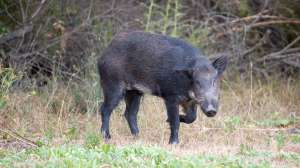
My friend Simon and I stood at the water’s edge, looking down at the kayak. Both of us had ARs strapped on our backs and we were about to embark on an afternoon of wild hog hunting in deep southern Mississippi. Due to flooding, the water levels were higher than normal. That would work to our advantage, we figured, because the pigs would be confined to high ground. All we had to do was find them. That’s where the kayak came into play. The problem was that the kayak was a single, but Simon was very hopeful we could make it work. I was not so optimistic. But with the rising waters, we had no other options.I relented and carefully climbed on board — and the entire backend of the kayak sank. I had never felt fatter in my life. We paddled for 8 feet and completely capsized. Needless to say, no hogs were harmed by us that day. But I did look up the 1-800 number to Jenny Craig.
I Stock 1216700925

California Has a New Wolf Pack

The California Department of Fish and Wildlife confirmed a new pack in Tulare County, the southernmost location since wolves returned to the state in 2011.
Photo credit Chelsey Anderson 8

Mountain Lion Maneuvers

Here’s what you need to know before tackling one of North America’s most elusive apex predators.
DD13 Sully and Sage on a coyote hunt Sully learned much from Sage snowfall copyright Mark Kayser

Dog Deception

Kissing cousins they’re not. But coyotes, suckered by the sight of a living, breathing relative — your decoy dog — can’t resist a closer look.
A beetle cleaned baboon skull

Dermestid Beetles: Nature’s Cleanup Crew

Cleaning your own predator skulls might be easier than you think. Give flesh-eating beetles a try.
PH593 Fog can sometimes boost the confidence of paranoid predators copyright Mark Kayser

Weather Awareness

Coyote hunters can increase their success in the field by understanding and taking advantage of weather events that affect animal — predator and prey — behavior.
I Stock 183278049

Cultural Conundrum

This is a wake-up call. Hunters are under attack now more than ever before. But the true attack is not from the anti-hunters who are open and up-front with their efforts to end all hunting of everything forever. The more subtle and potentially more effective attack on hunting lies in the state legislatures and the state bureaucracies where policies that affect hunting are created and implemented. Backed by well-funded anti-hunting interests, ballot box wildlife management laws are becoming more and more common. Laws that adversely affect hunting are promoted as being pro-wildlife and an uninformed public suckers into voting for them. Although these initiatives can be challenged in court, it is much more difficult to undo a bad law than to defeat it in the beginning. It takes a lot of money and grass roots effort to defeat bad ballot measures, and hunters are not as well-funded as the antis.The National Rifle Association of America and Safari Club International fight anti-hunting measures consistently. They are but two organizations against hordes of anti-hunters. With more funds and boots on the ground, those pro-hunting efforts can be more successful. That requires a volunteer army of hunters to augment the efforts.To understand what it will take for hunting to continue, take note of what is happening throughout society. The assaults on hunting reflect the most significant culture shift in history. Witness the havoc being raised this year on college campuses where demonstrators openly back terrorists. Although there were paid provocateurs agitating these outbursts, many of those participating were college students and other counter-cultural lackeys who were brainwashed over the years. They don’t love anything. They hate everything that represents an orderly society.This didn’t happen overnight. It began in the 1960s with the counter cultural movement that evolved out of the Vietnam anti-war movement. For these years since, educational institutions have been infiltrated by teachers, professors and administrators who have worked behind the scenes to undo everything this society stands for and all that it holds dear. Concurrently, during those years, we hunters were out in the wilds, doing what we do and, frankly, not paying much attention, if any attention at all.As much as an educationally brainwashed generation is now showing its true colors publicly, it is what is happening behind the scenes that represents the greatest threat. Mentally pre-programmed voters sucker into the crap the anti-hunter/anti-American subversives foist upon the electorate. They sucker in when they sign anti-hunting initiative petitions, and they sucker in again at the ballot box. Simultaneously, anti-hunters have been infiltrating state game agencies at every level, all the way up to the heads of those agencies.There is a saying among those who work in and with government agencies: Personnel are policy. This means that the actual policy often is determined by the people administering the laws rather than the laws themselves. There is all kinds of latitude between the words of the laws themselves and how they are enforced, or how they are overlooked, depending on the whims of those in the government who stand between elected officials and the electorate. Often, it is more devastating when bureaucrats ignore pro-hunting laws than it is when they enforce anti-hunting measures. The point is that hunters are swimming upstream all the way.So, what can we predator hunters do? Everything possible, of course. But that’s nebulous and can easily result in no action at all. Often, the focus during elections is at the national level, with maybe a little drip down to the state level for some measures. Yes, it is important to vote at both of those levels. But ultimately, it is critical to put the right people in office at the local and county levels. This is because most of those running for higher offices started at the local level. If only right-thinking politicians are elected at the local level, then the group from which the higher offices are determined will be from among them rather than from among the subversives.So, be active locally. Contribute to organizations that are fighting the local fight and be involved personally. Volunteers are especially effective at the local level. Pay attention to what local and state game management bureaucrats are doing. It is easier to defeat bad government before final decisions are made than it is to undo bad decisions later. Join and support organizations that fight anti-hunting efforts, both within the bureaucracy and at the ballot box. Yes, this is asking a lot, considering that predator hunters also have regular lives and spend most of our otherwise free time in the wilds, pursuing predators.We have no viable alternative. We’re in a fight for all the marbles. We want to keep it all, and they want to take it all away. It’s that simple. We must argue, based on wildlife science and on tradition. They want to undo the entire society and cancel our culture. It’s not all about pro-hunting vs. anti-hunting.The bigger fight is at the cultural level because the anti-hunting efforts are but a small slice of that bigger pie. This has become abundantly clear this year as the counter cultural activists have come out from the shadows and have made their presence known around the country, even around the world. This is a major election year, so if we do nothing else, vote for the right-minded candidates at all levels. Combined with all of our families and friends, we represent a possible tipping point society wide.We need to send a strong message lest the anarchists tear apart everything we hold dear. What we do or don’t do right now will determine what our future looks like. I trust individual predator hunters will pick up the standard and join together in victory. Failure to be involved this year very easily could doom the entire future of hunting and our culture. Think about it and then do something. We hold the future in our hands. What it looks like is up to us right here, right now.
I Stock 497712343

The Ideal Coyote Rifle

Old school meets new school when shopping for the be-all and end-all predator gun.
13

Avoiding the Dreaded Miss

If you’ve ever missed critters you should’ve hit, consider these nine reasons in your analysis of what went wrong — and then work to reduce their frequency.