
Fast action gets you out of stressful situations faster, but the results tend to be inconsistent and unpredictable. Take public speaking, for example. Rush through your address, and your sentences will likely be muddled and your enunciation slurred. Fast, choppy speech also highlights your nervousness, whereas clear and careful delivery can disguise it.
Or, imagine a quarterback being simultaneously rushed by a defensive end and a linebacker. He can avoid a hard hit by lobbing the ball in the general vicinity of a receiver, but sloppy passes are often intercepted. Taking another split-second to identify a receiver and intentionally throwing the ball where the receiver can at least get their hands on it substantially improves the odds of a reception.
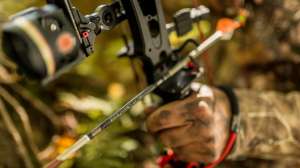
In bowhunting, a common mistake is rushing the shot. In the heat of the encounter — especially an encounter that took weeks, months or even years to unfold — there’s a false sense of urgency to shoot immediately. You usually have more time than you think, and caving to this self-induced pressure might yield lethal hits sometimes, but misses and marginal hits can be expected.
Perhaps you’ve found yourself losing more than winning at crunch time, and maybe you’ve even considered some solutions. If so, maybe you’re chewing on the prospect of hunting with a hinge release.
Before you bench your existing release and order an expensive hinge to solve all of your problems, let’s review some ins and outs of what hunting with a hinge really looks like with YouTuber, tournament archer and well-traveled bowhunter, Chris Bee. He hunted with a hinge for a handful of seasons.

Target Archery vs. Bowhunting
Because hinges were traditionally target-only releases, let’s begin our talk around the difference between target archery and bowhunting, as it pertains to hunting with a hinge.
“In target archery, time is usually on your side,” Bee said. “Yes, you might have a shot clock, but at least you know how much time you have to shoot your arrows. In bowhunting, you have no idea when an opportunity will unfold or how much time you’ll have to execute the shot.
“I wouldn’t say there is a difference in the way you should shoot a hinge for target archery compared to bowhunting. There are just more uncontrollable variables, such as wind, moving animals and unforeseen shot opportunities, not to mention bulkier clothing and awkward angles. These factors give you way more to think about and less time to do it.”
Bee said that bowhunters who fail or struggle are prone to seek help through a change in mechanical release style, but that it won’t solve the underlying issues.
“If you’re struggling with buck fever, merely switching to a hinge is just a band-aid,” he said. “Introducing a new release isn’t the end-all solution. In fact, throwing in that new variable sometimes makes things worse. Buck fever and target panic are separate issues, and curing them requires specific protocols, not a simple release change. If you fall apart and punch a trigger with an index-finger or thumb release, you might yank a hinge and flinch, too.”
When Bee began hunting with a hinge, it had already been his primary release for target archery for some time, and he had thousands of arrows under his belt with it.
“That familiarity,” Bee said, “can make the hinge a fantastic tool. When you are truly comfortable with it, it can help you slow down and execute consistently better hunting shots.”
Hinge Pros
When you are truly familiar with a hinge release before you take it bowhunting, the advantages are clear. Slowing down the shot process, like public speaking or passing a football, equals consistently better results.
“Hunting with a hinge forced me to execute good bowhunting shots,” Bee said. “It calmed me down and made me more patient. I was also prone to avoiding risky shots, which is a good ethical move.”
Other hunters who’ve shot them for a spell, or have completely switched to them, have said their bowhunting accuracy has improved substantially. While watching a GoHunt YouTube video, Trail Kreitzer explained that hunting with a hinge also helps him mentally manage intense moments — something he struggled to do when shooting a trigger-activated release.
Hinge Cons
Even though many bowhunters have found great results with hinges, like every tool, hinges certainly have some drawbacks that pertain to bowhunting. Of course, these cons don’t make the prospect of hunting with a hinge an automatic “no,” but you should certainly weigh them out before buying a hinge for hunting.
First, Bee believes the hinge is the most difficult release type to shoot consistently well and with perfect execution, particularly in hunting scenarios. “You have to pay way more attention to all of the variables — cold temperatures, adrenaline, restrictive apparel, awkward angles, etc. — and you have to be more well-versed in shooting it to overcome those variables,” he said. “You can’t just pick one up and expect everything to immediately jive.
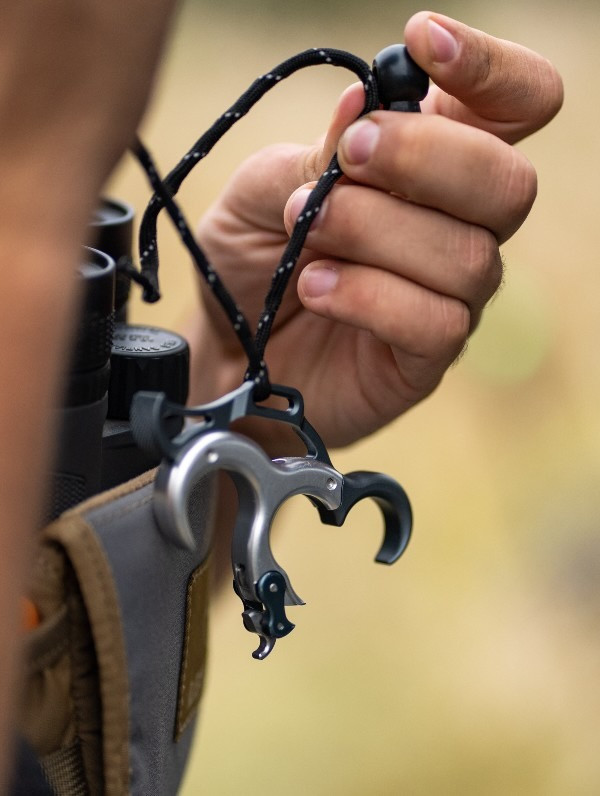
“Another disadvantage of a hinge is you can’t clip it onto your D-loop and let it hang. You can have it in your pocket, which isn’t bad, but I really like having my UV Button hanging from my D-loop, ready to go. With a hinge, it’s also easy to set it down during a stalk and then forget to pick it back up. I always suggest carrying two in case this happens.”
Bee noted that most hinges are also loud. “The release head has to cling and clang to reset,” he said. “You also have the pre-shot click to worry about during the shot. I had a deer bust me one time when I was rolling through the click. The conditions were calm, and the deer was really close. I would’ve gotten that deer with an index-finger or thumb release.
“To be as deadly as possible, you sometimes have to make stuff happen in a split-second. If something pops out in front of you and stops for two seconds, being able to get that shot off — if you know how to do it well — is advantageous. A hinge doesn’t work very well in instances like that.”
If you begin aiming at an animal and reach the click, but then opt to pass the shot because the animal moves, letting down is a bit more dicey. If you don’t tilt the release forward enough, the hinge could slip, potentially releasing the bowstring, which could lead to a bloody nose, busted lip or knocked-out teeth. Also, if you let down after the click and then redraw without resetting the release, the click won’t happen when you begin executing your shot, which can throw off your shot process.
That makes a nice segue into one final drawback, which is largely the reason Bee no longer hunts with a hinge: missed opportunities.
“With a hinge, everything has to be nearly perfect,” Bee explained. “The animal has to be stopped, and you need time to roll through your shot. You can speed things up with a thumb-button release without completely yanking the shot, but you can speed things up only so much with a hinge before it becomes disastrous. I like how a thumb-button release puts me more in control of the situation. If I need the shot to go a little bit faster or if I need to let down, it’s way easier with the button than a hinge.”
A Few More Things
If you’re constantly struggling with rushing your shots in the bowhunting woods, switching to a hinge, coupled with some mental training, can help you improve your bowhunting performance, as it has for many bowhunters. But we’re going to land the plane here: Becoming completely comfortable with a hinge is a prerequisite for hunting with it.
“If you are skilled with a hinge, it can be incredibly deadly,” Bee said. “But if a guy picks one up in July and hopes it will fix his target panic while bowhunting in September, that's probably not the best idea. Mechanical things don’t fix buck fever or target panic. Whatever release you're most comfortable with and shoot the best is ultimately the one you should carry in the woods.”
Photos courtesy of Chris Bee