
In the journals of the historic Lewis and Clark expedition, Meriwether Lewis spent much time describing encounters with the great “white bear,” as they called the grizzly. Lewis noted that these “cantankerous bears” were just as likely to attack man as leave him alone. Though great hunters, he wrote, the Native Americans would never intentionally take on a grizzly, armed as they were with nothing more than a spear or longbow. Instead, they would band together in groups of between six and 10, hoping to accomplish with sheer numbers what they could never do alone.
“When the Indians are about to go in quest of the 'white bear', previous to their departure they paint themselves and perform all of those superstitious rites commonly observed when they are about to make war on a neighboring nation,” Lewis wrote. Obviously, these expert woodsmen had learned that when the quarry was an animal with the strength of a dozen men, the speed of a fast pony, and the disposition of the devil himself, discretion was the better part of valor.
I took my first grizzly with a rifle on my first Alaskan hunt some four decades ago in the Wrangell Mountains; it was a large, dark-brown bear with long claws and a flawless hide. Legendary outfitter Terry Overly spotted the bear ambling up a drainage one September afternoon. The weather was postcard perfect, the tundra a brilliant kaleidoscope of colors set against a backdrop of cobalt sky and snow-capped peaks. We tied off the horses, climbed the 60-degree slope and fought through the alders, breathlessly coming into an open slide the same time the bear did, not 75 yards away. When he stood on his hind legs, I calmly raised my rifle, took aim — and missed him by a mile! As he took off across the scree, I emptied the rifle, hitting him all three times through the chest as he raced into an alder thicket, where he expired. It took a week for the adrenaline rush to wear off. The memories never will.
A bowhunter at heart, that adventure stirred a fire inside of me, a desire to bowhunt grizzly (and brown bears). When I moved to Alaska in 1991, it began a 15-year quest as a resident to slip within bow range of a grizzly bear and make a perfect shot.
Hunting grizzly bears was once described to me as 95% boredom and 5% pure terror. That's a pretty fair assessment. The boredom part comes with simply trying to locate a bear. This can take a lot of time or no time at all, depending on the turn of the cards. Unlike coastal brown bears, which concentrate on salmon streams in the fall and can be relatively easy to find, interior grizzlies are much more nomadic. A biologist told me they can have a home range of as much as 50 square miles, in which they may cover double-digit miles daily in search of food.
In years of a strong fall blueberry crop, grizzlies tend to congregate on mountains with large expanses of berry bushes. They also dig roots. In spring they tend to follow the moose and caribou herds, preying heavily on newborn calves. Fresh grass shoots are a favored food in spring, too, on which the bears graze like cattle. At all times they'll expend hundreds of calories to excavate a low-calorie ground squirrel or marmot, which must taste like chocolate to them. But while they have their preferences, these omnivores will eat just about anything, including plastic cans filled with gasoline left on remote air strips by bush pilots, and even your tent.
Do You Have What It Takes?
The name of the game in interior grizzly hunting is glassing. It can get boring, glassing for days and never seeing a bear. When the weather is good, it isn't so bad. The wild country in which grizzlies thrive is the continent's most stunning, and there's always something to look at. However, when the weather turns sour and cold, wind-driven rain, sleet or snow eats its way under all your clothes, and it's hard to keep looking.
The sight of your first grizzly will never be forgotten. That's also when the questions creep into the back of your mind. After all, a grizzly is a dangerous animal, one that, together with the coastal brown bear and the polar bear, is the only really dangerous game animal in North America. Your palms become a little sweaty, breathing a little faster, your heart begins to race.
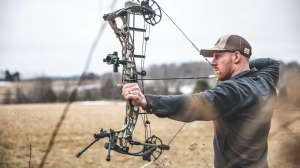
You know that the bear hasn't spotted you. You have a well-tuned bow and razor-sharp broadhead, are with either an experienced guide or buddy who is packing a large-caliber back-up rifle, and the wind is right. It shouldn't be any different than moving in for a shot at a deer back home.
And yet, deep down inside, you know it IS different. Even the best grizzly hunt can go wrong — that's one of the reasons grizzly hunting is so special. Like I did before my first grizzly hunt, you've read all the stories about wounded bears in the alders, of bear attacks and maulings, of chance encounters won by a bear. You begin to doubt your shooting ability, your courage. You wonder, “Do I have what it takes?”
I can still see the fletching spinning as my arrow disappeared behind the shoulder of my first archery grizzly. He was 30 yards away, feeding on berries on a beautiful spring afternoon. Upon impact he whirled, bit at the wound, then dashed off only 50 yards before piling up. It was a childhood dream come true. After more than a decade of chasing grizzlies as both hunter and assistant guide, I consider them to be the most magnificent big game animal in North America.