Loading...

Deer

Displaying results 37-54 of 161

John hafner archive 08330

Top 10 late-season whitetail tactics

Hunting seasons are quickly winding down across the country. Here’s how to fill that late-season tag.
Whitetail00447

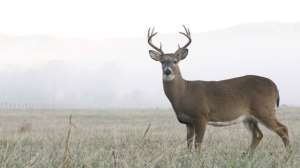
Top 10 Whitetail Deer Facts

How many whitetail deer facts do you have filed away in that hunter’s head of yours? Here's one: by day five of a deer’s life, they can already outrun man.
Mule Deer00524

Mule deer vs. whitetail deer

While mule deer get their common name from those big mule-like ears, whitetails get theirs from the completely white underside of their overly-large tail. There are other differences too from facial distinctions to the gait of each animal.
BW1579 Mast like acorns create an ideal ambush site for whitetails before the craziness of the rut copyright Mark Kayser copy

What do deer eat?

A mature buck may lose 20 percent or more of its body weight during breeding season, so it needs to go into fall fat and sassy. Here's what deer eat to make that happen.
John hafner archive 03789

Ever wondered just how well a deer can see?

Deer hunters know just how keenly aware deer are of their surroundings. But how well can they see?
C026418 cropped

What a young man learned when dragging a deer home for supper

Nobody, least of all myself, thought I had a snowball’s chance of killing a buck. I was blind as a newborn baby. But somehow, I got one: a barely-legal forked horn. Fly me to the moon!

Best Deer Rifles Of 2017

Here are some of the best deer rifles we saw at the 2017 SHOT Show, including the Weatherby New Mark V, the Tikka T3x and the new bolt-action Barrett Fieldcraft.

Learn how to estimate antler size

Before you pull the trigger or release an arrow, do you know how to estimate antler size? For those who hunt simply to fill the freezer, this isn’t really an issue. But for those hoping to shoot a buck with antlers that meet or exceed a certain numeric score, more often than not, they overestimate the size of the antlers. This miscalculation leads to that common malady known as “ground shrinkage.”Here are 6 tips to quickly estimate antler size:Your first impression will be of the rack’s height, width, mass, and number of points. Your next impression should be of the length of the main beam, length of the points, inside spread between the main beams, and the rack’s mass at four places. As a point of reference -- and forgetting about those monster bucks of Canada and tiny deer of the South -- the average buck has a distance of 16 inches between the tips of his ears, when the ears are in the alter position. Each ear is about 6 inches in length. The circumference of the eye is about 4 inches. From the center of the eye to the tip of the nose is about 8 inches. Of course, if you have hunted an area a lot and seen a lot of dead bucks, you can adjust these measurements accordingly. To estimate the inside spread of a deer's antlers, it's easy -- how far outside the tips of the ears do the antlers protrude? Main-beam length is judged using the ear length and eye-to-nose distance for reference, keeping in mind that the beams may curve in and nearly touch, which makes them seem shorter than they really are. Scorable points are any points that exceed 1 inch in length and is longer than it is wide at one inch or more of length. In a quick estimate, forget about these and look for all the longer antler points including the brow tines. Use the same ear length reference point to give you a quick idea of how long the tines might be. Mass: Here is where the deer’s 4-inch eye circumference is helpful. Is the circumference of the antler at the base, as well as between the tines, larger or smaller than the eye?Antler Size: Top 10 Components of a Typical, Whitetail Rack (And the percentage of the overall score they account for, in descending order): 10) Circumference between points 3 & 4 (H-4):         4 percent 9) Circumference between points 2 & 3 (H-3):           5 percent 8) Circumference between points 1 & 2 (H-2):           5 percent 7) Circumference of Bases (H-1):                               6 percent 6) Fourth Point Length (G-4):                                     7 percent 5) Third Point Length (G-3):                                      12 percent 4) Second Point Length (G-2):                                    12 percent 3) First Point Length (G-1):                                        6 percent 2) Main Beam:                                                            30 percent 1) Overall Symmetry: In both the Boone & Crockett and Pope & Young club’s scoring systems, deductions are taken off the gross score of a typical rack for imperfections. There was no ground shrinkage on Robb’s biggest typical buck to date — it grosses 181 3/8 and nets 177 3/8 Boone & Crockett points. In a perfect world, you would be able to leisurely look the antlers over before deciding to shoot, or not. Whenever possible you want to be able to look at the rack from the front and both sides, which is extremely helpful to estimate the length of the main beams. And never forget that a rear view almost always gives an inflated impression of how big the antlers really are. And of course, as the saying goes, if you have to talk yourself into the buck being big enough, it probably isn’t. Conversely, if the antlers take your breath away at first glance, who cares what it scores? Shoot! Need some practice? Then use some mounted heads. Use the reference points mentioned above to quickly estimate the score, then check them against the actual score.
Image1 181004 100850

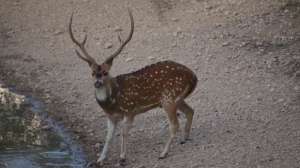
5 Reasons The Axis Deer Is A Must-Bowhunt Species

Axis deer apparently were made for bowhunting, with their morning and evening movements perfect for stand setups. Here are five reasons to hunt axis deer.
Jace Family Hunt

Memorial Day Axis Hunt In Texas Makes For Fond Family Memories

The plan was pretty simple: head to the Canyon Ranch to chase free-ranging axis and try to harvest one with Wac ’Em’s new 3-Blade Expandable.
TS 1476585071

Study: Malaria Found In Eastern Deer Population

While it isn't dangerous to humans, a new study shows nearly 25 percent of whitetail deer in the eastern U.S. are infected with a strain of malaria.
I Stock 000001955435 Medium

Why Deer Herds Are Declining

Hunters throughout the whitetail’s range are complaining of declining deer populations. It’s been enough to draw headlines, deer management plan audits and legislation aimed at growing deer herds. Are these declines real, and if so, what are the driving factors?
Whitetail Consistency Feature

A Persistent Approach To Bowhunting Whitetails Equals Consistent Success

Casually bowhunting whitetails will result in casual success, but if consistently killing mature bucks is your goal, you might consider a consistent approach.
Close Enough To Kill

6 Bowhunting Tactics To Get Deer In Close

In bowhunting, getting close to our quarry is pretty much the name of the game. Use these tactics to get closer than ever to the buck of your dreams.
I Stock 000057610064 Small

High Times: Deer Binge On Oregon Hemp Farm

A group of deer in southern Oregon might be grabbing for the Doritos after chowing down on a field of industrial hemp.
GVO powerlinebucks almy0915

How To Bag Bucks On Power Lines

Unbroken, mature forests offer little in the way of food or cover for whitetails. But a power line slicing through such sterile environments provides miles of prime edge habitat with both abundant shelter and food such as tender forbs, berries, shrubs, and saplings.
GVO acornmaps ga0915

Whitetail Tip: The Inside Scoop On Acorn Locations

At any time, one oak species or another may be dropping the most acorns on different areas of your hunting property. The key to knowing where to hunt is realizing that different oak species thrive in different habitats and they shed their nuts at different times.